






Abstract
Introduction:
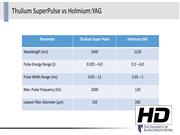
Although percutaneous nephrolithotomy (PCNL) is usually safe and well tolerated, it is still associated with a notable set of complications. The complications rates for PCNL range from 20% to 83%. 1 More urologists are adopting the mini-PCNL technique to decrease morbidity associated with conventional PCNL while preserving high stone-free rates when compared with ureteroscopy. 2 To our knowledge, this is one of the first mini-PCNLs performed in North America with the thulium fiber laser, which features more optimal intrinsic characteristics than the current gold standard for laser lithotripsy. 3 We aim to determine whether this novel combination can serve as an effective strategy for treatment of moderate-sized renal stones.
Materials and Methods:
After Institutional Review Board approval, we retrospectively reviewed two patients with stones between 1.5 and 3.0 cm who were referred to our department for evaluation. Both elected treatment with mini-PCNL. Access was obtained intraoperatively. The thulium fiber laser was used in both cases and the settings were adjusted to determine the optimal settings for stone treatment. We have selected one of the cases to highlight our technique for using the thulium SuperPulse laser for treatment of medium-sized renal calculi using the mini-PCNL technique.
Results:
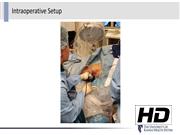
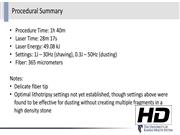
Adequate access is achieved using supine decubitus position with the side of treatment positioned at the edge of the table. The ipsilateral flank is elevated to create 15° of rotation to expose the puncture area, demarcated by the inferior edge of the 12th rib, the iliac crest, and the posterior axillary line. The ipsilateral arm is protected and placed across the thorax to avoid stretching of the brachial plexus. Access was obtained using a 15F/16F rigid access sheath. The thulium laser was capable of exceptional ablation rate and real dusting with dust particles <1 mm. A 365-µm fiber was used with total laser time ∼28 minutes and 49 kJ of total laser energy. Dusting of the initial large stone was ideal with 1 J and 30 Hz, and dusting of smaller fragments was optimal with 0.3 J and 50 Hz. Neither patient had a postoperative complication, and both were considered stone free based on imaging at follow-up. This is a descriptive video of our technique that has been performed on a total of two patients. Owing to the rarity of this procedure, no statistical analysis was calculated.
Conclusion:
The mini-PCNL technique is a safe and effective strategy for treatment of stones with sizes that fall in the middle ground between conventional PCNL and flexible ureteroscopy. Thulium fiber laser has the potential to change the landscape of stone treatment owing to its more optimal wavelength with a higher water absorption, lower pulse energy, and higher pulse frequency, all of which can increase the efficiency of laser lithotripsy by providing less stone retropulsion and smaller stone fragments on dusting settings, thereby decreasing operative time. A combination of the mini-PCNL technique with thulium fiber laser could lead to improved stone-free rates with potentially less perioperative complications. Further studies with larger cohorts are needed to further assess the generalizability of our outcomes with this novel combination of technique and technology.
This study adhered to institutional review board protocols at our institution and informed consent was obtained by all subjects included in the study. Surgical videos were obtained from routine surgical care of patients. The authors have received and archived patient consent for video recording/publication in advance of video recording of the procedure. No conflicts of interest or obligations exist for any of the authors. There are no competing financial interests for any of the authors.
Runtime of video: 6 mins 46 secs
Get full access to this article
View all access options for this article.