





Abstract
Introduction:
Radical nephrectomy with inferior vena cava (IVC) thrombectomy is one of the more challenging urological operations. We present our technique of performing this surgery robotically and highlight principles that allow the operation to be performed in an effective and reproducible manner.
Materials and Methods:
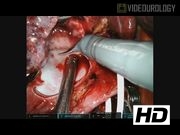
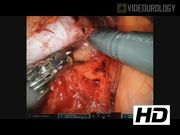
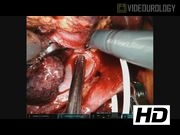
The patient is an 80-year-old man who presented with new onset gross hematuria with clot retention and was found on CT scan to have an 8.1 cm right renal mass with associated renal vein and level I IVC thrombus, as well as a single 3 cm hepatic metastasis. The remaining of his staging work-up was negative for metastatic disease. He elected to undergo robotic right radical nephrectomy with IVC thrombectomy. After mobilization of the colon, all structures lateral to the gonadal vein were divided. Elevation and mobilization of the lower pole of the kidney off the psoas muscle facilitated dissection of the lower border of the IVC. The lateral border of the vena cava was then traced to the ostium of the renal vein. All perinephric fat and paracaval nodal tissue were dissected and kept with the kidney. The IVC is circumferentially dissected above the renal vein. The contralateral renal vein was identified. The retrocaval space was then dissected and vessel loops were placed around the suprarenal IVC, infrarenal IVC, and contralateral renal vein to allow for vascular control. The full extent of the thrombus was then identified by drop in ultrasound. The artery was then stapled and bulldog clamps were then placed around the infrarenal IVC, contralateral renal vein, and suprarenal IVC. The IVC was then opened at the ostium of the renal vein and the tumor thrombus dissected from the wall of the vena cava. The IVC was then closed in a watertight manner; before final closure, the inferior bulldog clamp was released to flash blood and evacuate air from the vena cava. After removal of the specimen, the IVC closure was examined with minimal pneumoperitoneum to confirm hemostasis.
Results:
Estimated blood loss was 150 mL, and the patient was discharged on POD 1 after an uncomplicated postoperative course. Final pathologic analysis showed the tumor to be 9.4 cm, pT3a clear cell renal cell carcinoma, grade IV, and margins negative. Intraoperatively, several principles were recognized that contributed to the success of the operation. Complete mobilization of the kidney before vascular dissection facilitated the dissection of the IVC. Use of two blunt tipped grasping instruments increased the safety of vena caval dissection. Complete dissection of the vena cava with control of all tributaries above and below the renal vein allowed for total vascular control before cavotomy at the ostium of the renal vein. Before closure of the IVC, all air should be evacuated to prevent embolization upon release of the vascular clamps. Above all, there should be strict adherence to the oncologic principles of standard open surgery.
Conclusions:
This case demonstrates how radical nephrectomy with IVC thrombectomy can be performed safely robotically and highlights several important principles that facilitate an effective operation.
Authors have received and archived patient consent for video recording/publication in advance of video recording of procedure.
No competing financial interests exist.
Runtime of video: 5 mins 2 secs
Presented at the 34th World Congress of Endourology in Cape Town, South Africa, November 2016.
Get full access to this article
View all access options for this article.