





Abstract
Introduction:
Today, transurethral resection of superficial bladder cancer is the standard therapy. Assessing the correct penetration depth is crucial. Reasons for the high rates of local recurrence are under investigation. Potential disadvantages of the standard technique are thermal damage of adjacent tissue, the “incise and scatter” technique that causes fragmentation of the tumor and leads to a high amount of exfoliated cancer cells, and the difficulty of accurate pathological evaluation of fragmented tissue. 1 En bloc resection techniques are an emerging issue. 2 –4 The first description of a laser en bloc resection of bladder tumors using Ho:YAG (holmium laser resection of bladder tumors [HoLRBT]) was published by Das et al. 5 With the introduction of thulium as a new source for laser devices, several studies were published dealing with en bloc resection techniques of bladder cancer (Thulium laser resection of bladder [TmLRBT]). 6,7
Methods:
The objective of this study was to present our technique of Thulium:YAG laser en bloc resection for treatment and accurate pathohistological staging of superficial bladder cancer. Inclusion criteria were solitary papillary tumors, treatment-naive patients, and localization of the tumor on lower bladder wall and trigonum. Patients' characteristics, clinical and pathological data, and complications were assessed prospectively. Complications were defined as bladder perforation, uncontrollable bleeding, and prolonged hospital stay. The follow-up was 1 year.
Operative Principle:
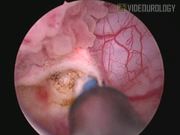
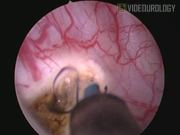
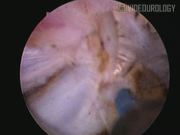
An incision into the circumference of the tumor with a safety margin of 0.2 cm to the tumor was performed with a 550 nm laser fiber that was advanced through the working element of a 26F continuous-flow resectoscope. The 2013 μm Thulium:YAG laser was used at a power level of 20–30 W. After incision, the mucosa was bluntly dissected from the deeper layers by lifting the mucosal patch toward the bladder lumen leaving the bladder facing part of the specimen intact. Remaining adhesions were cut with the laser. The tumor was extracted endoscopically in one piece with a grasper. Hemostasis was achieved with laser coagulation. Two cold-cut biopsies were taken from the tumor ground.
Results:
From June 2010 to June 2011, 11 patients were treated by Thulium:YAG laser en bloc resection. Pathological evaluations revealed six patients with pTa, four patients with pT1, and one patient with benign lesions. All specimens included detrusor muscle (DM), and all biopsies were positive for DM. Nine patients received a re-resection after 6 weeks. All nine patients were negative for residual bladder cancer in re-resection 6 weeks after initial treatment. Within a short-term follow-up of 1 year, all except two patients were without recurrent disease (one patient with carcinoma in situ and BCG treatment and one patient with recurrent pTa low grade). No complications occurred. The average operation time was 37 minutes. We saw a steep learning curve.
Conclusions:
In this preliminary results, Thulium:YAG laser en bloc resection was safe and effective for treatment and pathological staging of primary bladder cancer.
All authors have no competing financial interests.
Runtime of video: 5 mins 33 secs
Keywords
Get full access to this article
View all access options for this article.