





Abstract
Introduction and Objective:
Urologists have diverging opinions and beliefs concerning the ideal laser lithotripter setting. We decided to confirm or reject common beliefs by evaluating laser lithotripsy efficiency and retropulsion using innovative testing methods free from any human interaction bias.
Methods:
An automated laser fragmentation testing system was developed, where laser fibers moving at constant velocity over the surface of artificial stones create a fissure, whose width, depth, and volume were analyzed. Lithotripter settings included different pulse energies (0.2–1.2 J), frequencies (5–40 Hz), power levels (4–20 W), and laser fiber diameters (200 and 550 μm), including high-frequency versus low-frequency experiments. Other artificial stones were put in direct contact with a laser fiber tip, through which a single laser pulse was fired at various pulse energies (0.2–3.5 J), using small and large laser fibers. All experiences were recorded with high-speed video, the distance the stones travelled measured, and each video analyzed to detect any unexpected event.
Results:
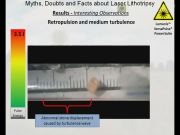
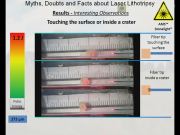
Low frequency with high pulse energy settings showed to be several times (2.1–6.2×) more efficient than high frequency with low pulse energy at the same power level tested (p < 0.00001). A linear correlation was found between pulse energy and fragmentation volume (p < 0.00001), fissure width (p < 0.00001), and fissure depth (p < 0.00001). No correlation was found between the power (W) used and fragmentation volume (p = 0.29), fissure depth (p = 0.06), or fissure width (p = 0.7). No differences were detected concerning the laser fiber diameter and fragmentation volume (p = 0.81) except at very low pulse energies (0.2 J) where the large fiber was less efficient (p < 0.015). 1 As pulse energy rises, so does the retropulsion distance regardless of the fiber size. At equal energy levels, larger laser fiber diameters are associated with significantly greater stone displacement. High-speed video analysis detected that retropulsion increases considerably if the laser fiber tip is inside a fragmentation crater; stone position is affected by cavitation bubbles resulting after laser emission from fibers that are not in direct contact with the stone even over considerably large distances; very high pulse energies (2.0 J or higher) produce turbulent waves, which push the stone even further away than the retropulsion effect alone.
Conclusions:
Automated laser fragmentation testing systems and high-speed video analysis can bring new insights concerning laser lithotripsy, and reveal details that might otherwise remain concealed to the human eye.
No competing financial interests exist.
Runtime of video: 7 mins 44 secs

Keywords
Get full access to this article
View all access options for this article.