





Abstract
Introduction:
To eliminate the disadvantages of conventional percutaneous nephrolithotomy (PNL), smaller diameters of instruments had been invented, and Helal and colleagues described minimally invasive percutaneous nephrolithotomy (miniPNL). They performed sequential dilatation up to 16F and used for pediatric population in 1997. 1 In 1998, Jackman and colleagues performed 13F miniPNL first in adult patients with smaller sheaths and instruments. 2 Today, the miniPNL is generally defined for the PNL procedure performed through the access tract smaller than 18F. 3 Ultra-minimally invasive PNL (UMP) was first described by Desai and colleagues using a novel 6F mini nephroscope through an 11F to 13F metal sheath to perform holmium:YAG laser lithotripsy. 4 Foreign bodies such as forgotten ureteral J stents especially upper parts of the stents can be removed through percutaneous access. UMP can be the safest method if ureterorenoscopy is not useful.
Materials and Methods:
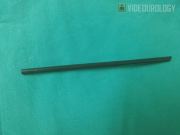
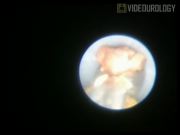
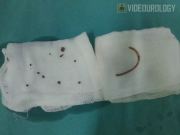
In this video, we present a 32-year-old male patient suffering from urgency and dysuria because of a forgotten left ureteral J stent, which was inserted during left open nephrolithotomy 2 years ago. Kidney, ureter, and bladder radiograph and computed tomography showed forgotten and fragmented left ureteral J stent and 1-cm lower pole kidney stone. Blood and urine samples revealed nothing and urine culture was negative. Under general anesthesia, we removed lower part of ureteral J stent by ureterorenoscopy and foreign body forceps and inserted 4F ureteral catheter to left ureter. In the prone position, we performed a lower pole access and dilated up to 12F using Amplatz dilators. By using 7.5F ureterorenoscope, 550 μm laser, and foreign body forceps, we removed both the lower pole stone and the upper part of the ureteral J stent.
Results:
The operation time was 90 minutes, and the scopy time was 5.3 minutes. Perioperative kidney was stone free. Perioperative hemorrhage was minimal. Ureteral catheter was taken on postoperative first day. Patient was discharged on postoperative second day.
Conclusion:
The removal of the broken upper parts of forgotten ureteral J stents with ureterorenoscopy is very difficult. In such cases, percutaneous removal especially using smaller sheaths such as UMP seems to be a very safe and comfortable method.
The authors declare that there is no conflict of interest.
Runtime of video: 3 mins 37 secs
Keywords
Get full access to this article
View all access options for this article.