





Abstract
Introduction and Objective:
In this video, we present our initial experience with the use of the Backstop™ gel for preventing stone fragment migration after endourologic lithotripsy.
Material and Methods:
Two patients with stones in the urinary tract were treated endourologically for stone disease. One patient had a history of a non progressing proximal 5 mm right ureteral stone and the other had a 2.5 cm right lower pole stone. The Backstop gel (thermosensitive polymer) was used to prevent stone fragment migration during lithotripsy using either the holmium laser or the ultrasonic probe. A noncontrast CT scan was performed before and after surgery.
Results:
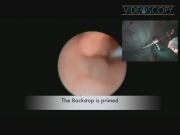
During right ureteroscopy, the Backstop gel was placed 2 cm away from the 5 mm stone lodged in the proximal ureter (between the renal pelvis and stone). Holmium laser lithotripsy was performed and basket extraction of stone fragments from the ureter was performed. During a right percutaneous nephrolithotripsy (PCNL), the Backstop gel was deployed in the proximal ureter just passing the ureteral pelvic junction. To help position the three french Backstop gel catheter, a five french Pollack catheter was placed into the ureter using the nephroscope and the Backstop gel applicator was passed into the Pollack catheter. Using live fluoroscopy, the exact position of gel deployment was secured. The Backstop gel prevented migration of stone fragments in both patients without complications. Postoperative CT scans of both patients confirmed stone-free status.
Conclusions:
The Backstop gel prevents retropulsion of stone fragments up to the kidney when performing ureteroscopic laser lithotripsy and prevents stone migration down the ureter when used before percutaneous nephrolithotripsy, decreasing the operative time.
Runtime of video: 5 mins 19 secs


Keywords
Get full access to this article
View all access options for this article.
Supplementary Material
Please find the following supplemental material available below.
For Open Access articles published under a Creative Commons License, all supplemental material carries the same license as the article it is associated with.
For non-Open Access articles published, all supplemental material carries a non-exclusive license, and permission requests for re-use of supplemental material or any part of supplemental material shall be sent directly to the copyright owner as specified in the copyright notice associated with the article.
