





Abstract
Introduction:
The development of endoscopy and minimally invasive surgery has led to the report of many endoscopic suturing techniques. 1 –11 Percutaneous endopyeloplasty is a horizontal suturing of the longitudinal endopyelotomy incision, via a single percutaneous tract. It has been described using a laparoscopic suturing device 7 –9 or using a pediatric laparoscopic needle holder. 10,11 Some authors think that generally one suture is enough. 6,10 Therefore, can this suture be performed in a retrograde fashion? We present a video of a preclinical feasibility study of an endoscopic suturing technique using a rigid ureteroscope and a basket, which can be used for ureteral suturing and retrograde endopyeloplasty.
Materials and Methods:
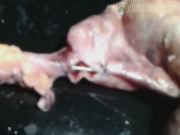
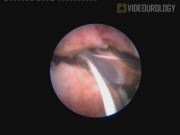
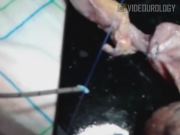
A 5/0 or 4/0 suture with a conventional curved 13-mm fine needle is used. The needle is straightened and the thread is folded over the needle. Then, it is tied in the middle of the needle using another 6/0 suture. When the suture is attracted through tissue, the needle will be horizontal and will anchor the suture. A 3F basket is retrieved in its sheath, until a 13-mm of the sheath is empty. The straightened needle is inserted in this sheath's empty segment. The sharp needle's end is left in the distal extremity of the sheath. The thread is left outside the sheath. This suturing technique is performed in a latex glove, a sheep vena cava, and a left nephroureterectomy specimen. A longitudinal incision is performed. The distal extremity of the basket is applied a few millimeters below the incision lower apex. The basket is opened, so the straightened needle, and then the sheath pass through tissue, and the needle is completely pushed outside. The basket is retrieved. The suture is attracted and the needle is anchored. Similarly, another suture is anchored in the upper incision apex. The two threads are inserted through a ureteral catheter; traction on the two strands will approximate the incision's distal and proximal apex. Thus, the longitudinal incision will become transversal in a Heineke-Mikulicz type plasty. One thread is inserted through a 5-mm ureteral catheter piece to block the knot. The suture is tied with tension. A similar knotting technique is used to perform a bladder-neck removable partition purse-string suture, 12 in open adenomectomy.
Results:
The endoscopic suturing technique was achieved easily and quickly. It was feasible directly in a glove model. Moreover, it was possible through the rigid ureteroscope in the glove model, a sheep vena cava model, and a left nephroureterectomy specimen. The limitation of this technique is that the needle will stay in the incision.
Conclusions:
The feasibility of this endoscopic suturing technique, through the ureteroscope, suggests the possibility of retrograde endopyeloplasty, which might be quicker, and might need only, the more common, ureteroscopic skills. Additionally, retrograde Heineke-Mikulicz plasty might be used for caliceal diverticulum neck, infundibulum stenosis, Fraley's syndrome, ureteral stricture… However, more studies are necessary, and further development of the suturing technique is needed, like to have an absorbable needle or anchor, which might be performed using a rigid or flexible ureteroscope.
The authors have no conflicts of interest or financial ties to disclose.
Run time of video: 8 mins 35 secs
Keywords
Get full access to this article
View all access options for this article.