





Abstract
Introduction and Objectives:
Percutaneous nephrolithotomy (PCNL) using a single access is the treatment of choice for patients affected by large stones. However, complex and staghorn calculi with multiple caliceal involvement may require a multiple tract treatment. Nowadays, multiple-tract percutaneous access procedures are less performed because there is a widespread use of flexible instruments during a single-access percutaneous nephrolithotripsy (PNL). Our video shows our experience on multiple-access PNL treatments in patients affected by complex renal stones.
Materials and Methods:
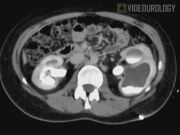
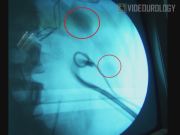
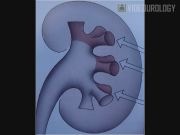
Two patients underwent multiple-access PCNL: a 22-year-old woman who was affected by bilateral complex stones, and a 54-year-old man affected by complex pielocaliceal lithiasis with upper hidrocalix. In both cases we performed ultrasound-fluoroscopy-guided access. The first was treated using a single access in the right kidney in two sessions because of the presence of residual stones after the first treatment. One month later we proceeded with treatment of the left side after placing two nephrostomies because of the onset of septic fever. Then, we carried out three accesses: two of 28F and one of 16F. We made a careful dilatation, exploring the tracts using 10F miniscope while proceeding, to be sure of the correct access and orientation with the axis of the calix. The 54-year-old man required two accesses, one in the lower calyceal group and the second in the upper pole tract because the infundibulum was very narrow and did not require further treatment.
Results:
The excretory cavities of both patients were revised with flexible instruments at the end of the procedures. We had no complications such as bleeding, and nephrostomies were removed on the third day. In both the discussed cases we carried out a 16F access with initial exploratory intent, which became operative afterward; so, we find that both 16F and 28F accesses are required for good stone clearance and to reduce secondary treatments.
Conclusion:
The use of flexible nephroscopes or the employment of endoscopic combined intrarenal surgery (ECIRS) in supine position have reduced the number of accesses in percutaneous treatments; however, when we face multiple, big, hard stones, in irregular anatomies, or narrow caliceal infundibulum, the use of the flexible ureteroscope, requiring little laser fibers, prolongs working time. In these cases the use of multiple tracts is still very effective, reducing working time and number of sessions. Risk of bleeding is linked to the accuracy of the puncture and the experience of the surgeon.
No competing financial interests exist.
Runtime of video: 5 mins
Get full access to this article
View all access options for this article.