





Abstract
Introduction:
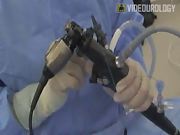
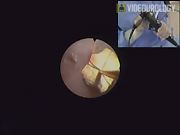
Ureteroscopes have evolved from purely diagnostic tools to key instruments in the management of stone disease and other pathology of the upper urinary tract. Despite these advances, problems related to visibility and maneuverability can hinder the goals of surgical intervention. In this study, we evaluate the capabilities of a modern dual-channel flexible ureteroscope and demonstrate novel techniques afforded by this technology. Using the Cobra dual-channel flexible ureteroscope (Richard Wolf), we performed patient-based case studies of stone basketing and laser lithotripsy in addition to laser excision and extraction of an upper tract renal lesion. A similar simulation-based scenario of stone basketing and fragmentation is also demonstrated.
Materials and Methods:
The dual-channel scope has two separate 3.3F channels. One is designed as a traditional working channel; the second provides a wheel-based laser advancement device and the option for simultaneous suction or additional flow. During extraction of a 1 cm calculus, we demonstrate the ability to simultaneously use a basket to secure the stone while performing laser lithotripsy. The dualchannel configuration allows the concomitant use of these two tools with good maneuverability and increased flow, providing improved visibility. For removal of an upper tract renal lesion, the basket can be used to put the mass on traction, which allows for improved excision with the laser. The operable improvements from improved flow and comparable deflection characteristics are demonstrated.
Results and Conclusions:
The single-channel scope has improved upward deflection both empty and with all but the largest single tool with an improved range of 4 to15 degrees. The dual-channel scope has improved downward deflexion across all comparisons and better upward deflexion with the largest tool and when multiple tools are used. Its improvement ranged from 6 to 40 degrees, with its greatest benefit seen in downward deflexion with an average increase of 23.9 degrees of movement. Overall, the deflection angle was comparable to that observed in other studies evaluating modern flexible ureteroscopes and demonstrates that the addition of the second channel should not decrease functional access to areas of the kidney that recent advancements have allowed. 1,2 For flow, the individual channels of the dual scope each provide slower flow than the larger single-channel ureteroscope, both empty and with all tested instruments. However, since flow can be provided through a dedicated port in the dual-channel configuration, overall flow can be up to 37 times faster than the single channel (range1.5–37) depending on the configuration of tools used. The dual-channel flexible ureteroscope allows for the simultaneous use of baskets and lasers, providing novel approaches such as stone stabilization and tissue traction to traditional procedures. With the aid of two working-sized channels, increased irrigant flow can be obtained using either one or two working instruments. This has the potential to speed up operative procedures, create more complete resections, and allow greater stone free-rates with improved visibility and handling.
No competing financial interests exist.
Run time of video: 6 min 49 sec

Get full access to this article
View all access options for this article.