





Abstract
Introduction:
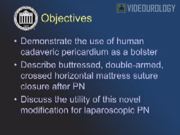
Open partial nephrectomy for appropriately selected renal parenchymal tumors results in equivalent oncologic outcomes with less morbidity than radical nephrectomy. 1 While bolsterless partial nephrectomy techniques exist for small tumors, 2 as urologic oncologists attempt to excise ever larger lesions, adequate hemostasis and secure closure of the parenchymal defect remain paramount to preventing significant complications. Human cadaveric pericardium has been used as an alternative material for grafting the tunica albugineal defect after Peyronie's plaque excision, with good long-term success. 3 This report and accompanying video demonstrate the novel use of human cadaveric pericardium as a bolster for buttressed horizontal mattress suture closure after partial nephrectomy.
Methods:
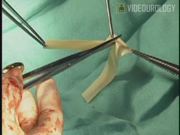
Three patients underwent open partial nephrectomy for renal cell carcinoma. Via the retroperitoneal approach, the kidney was completely mobilized with adequate exposure of the renal hilum, and vascular control was obtained. Renal hypothermia and temporary renal vascular occlusion preceded sharp dissection and excision of the tumor to negative margins. The cut surface of the parenchyma was cauterized with argon beam laser. One piece of hydrated cadaveric pericardium cut in a pantaloon configuration was placed circumferentially around the defect edges. Each leg of the bolster was approximately the length of the defect and 1.5 cm wide. Two crossed horizontal mattress sutures were used to anchor the cadaveric pericardium bolster and approximate the defect edges. The resultant parenchymal closure resembles a purse string with equally distributed, circumferential tension. No additional hemostatic or pelvicaliceal suture repairs were necessary. Thrombin/gelatin granules were applied and the renal hilum clamps were removed without evidence of bleeding. Ischemic time was <30 min in all cases.
Results:
With over a 1-year follow-up, all patients treated using this technique experienced no locoregional or metastatic recurrence. There were no postoperative urologic or hematologic complications related to closure, and serum creatinine levels returned to baseline after surgery in all patients.
Conclusions:
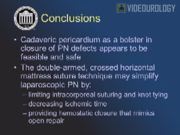
The novel use of cadaveric pericardium as an exogenous material to bolster closure of moderate to large parenchymal defects after partial nephrectomy appears to be safe and effective. This technique provides the benefits of a strong, pliable acellular bolster, adequate hemostasis, and limited suturing that might otherwise prolong ischemic time.
No competing financial interests exist.
Runtime of video: 7 mins
Get full access to this article
View all access options for this article.