




Abstract
We present a novel formulation of the problem of energy misbehavior and develop an analytical framework for quantifying its impact on other nodes. Specifically, we formulate two versions of the power control problem for wireless sensor networks with latency constraints arising from duty cycle allocations. In the first version, strategic power optimization, nodes are modeled as rational agents in a power game, who strategically adjust their powers to minimize their own energy. In the other version, joint power optimization, sensor nodes adjust their transmission powers to minimize the aggregate energy expenditure. Our analysis of these models yields insight into the different energy outcomes of strategic versus joint power optimization. We show that while joint power optimization fits the accepted paradigm of cooperation among sensor nodes (for example large number of sensor nodes cooperating for a task such as target tracking), it comes with both advantages and disadvantages when energy misbehavior is taken into account. One advantage is that it can (sometimes) be energy-dominant, i.e., the optimal energy cost for each node under joint energy minimization is lower than its strategically optimal energy cost. We then develop a model for characterizing energy misbehavior and show that joint optimization is disadvantageous because it is impossible to prevent misbehavior under any channel quality and load constraints, whereas strategic optimization is more resilient. We prove that it is impossible for a node to unilaterally and undetectably follow a different energy optimization strategy than the other nodes and hence the only threat to the network is misbehavior through false advertisement. We then provide sufficient conditions under which misbehavior through false advertisement can be prevented under a strategic optimization regime. Our analytical results reveal optimal strategies for attacking nodes in an enemy network through energy depletion and help develop effective defense mechanisms for protecting our own wireless network against energy attacks by an intelligent adversary.
Introduction
Energy-efficiency is a critical concern in many wireless networks, such as cellular networks, ad-hoc networks or wireless sensor networks (WSNs) that consist of a large number of sensor nodes equipped with unreplenishable and limited power resources. Since wireless communication accounts for a significant portion of node energy consumption, network lifetime and utility are dependent on the design of energy-efficient communication schemes, including low-power signaling and energy-efficient multiple access protocols.
Power-control multiple access (PCMA) schemes have become an essential feature of many energy-constrained interference-limited wireless networks. Several approaches for maximizing information transmission over a shared channel subject to average power constraints have been proposed [1–6], [7] addresses the issue of minimizing transmission power subject to a given amount of information being successfully transmitted, and derives PCMA algorithms for autonomous channel access. [4] describes an aggregate power control scheme for a group of interfering users subject to minimal signal-to-noise (SNR) constraints. They also show that this power vector solution is strictly Pareto-optimal since each individual nodes power is also minimized by this vector. In other words, the strategic or node-centric solution coincides with the aggregate or network-centric solution. [2, 3] then propose joint scheduling and power-control algorithms for wireless networks based on this system model.
A hidden feature of such PCMA schemes is the fact that they are based on implicit trust agreements between interfering nodes, which makes them highly vulnerable to energy-depletion attacks. Compromised nodes can mis-behave by maliciously adjusting their transmission powers in order to increase energy consumption at “good” nodes who are faithfully following a power-control regime. In this paper, we present a novel formulation of the problem of energy misbehavior and develop an analytical framework for quantifying its impact on other nodes. Our analytical results reveal optimal strategies for attacking nodes in an enemy network through energy depletion.
We consider misbehavior in the context of the following problem: minimizing transmission energy for users transmitting information to their receivers over a shared wireless channel over overlapping intervals or duty cycles, as in the case of wireless sensor networks. We formulate two versions of the power control problem for such duty-cycle constrained networks. In the first version, strategic power optimization, nodes are modeled as rational agents in a power game who adjust their powers strategically in response to the power behaviors of the other nodes, in order to minimize their own energy consumption. We also develop a second version of the power control problem called joint power optimization, in which nodes adjust their transmission powers to minimize the aggregate energy expenditure. For strategic energy minimization, we develop a simple game-theoretic model of a 2-player power game and analytically derive conditions for the existence of Nash equilibria in this game. We then derive the power vectors for joint energy minimization and then investigate the relationship between the energy outcomes of the two approaches.
Note that the model of joint power optimization fits the accepted paradigm of cooperative sensor network operation in which large numbers of sensor nodes are cooperatively working towards a group objective such as target tracking. Thus, while joint power optimization could result in higher energy depletion at some sensor nodes, it could be beneficial in improving overall sensor network lifetime, since the network contain a large number of redundant nodes that can afford to lose energies at differential rates. On the other hand, strategic power optimization could also increase network utility/performance since critical sensor nodes, for example, cluster-heads, or data aggregators might strategically consume less energy.
Our primary motivation for investigating these two optimization models is to gauge the energy outcome of selective node misbehavior. Misbehavior can occur in insecure networks if nodes are compromised by adversaries and then do not follow agreed upon transmission policies. In this paper, we develop a model for characterizing energy misbehavior by dishonest nodes, and find that the common sensor network operational paradigm of joint energy optimization comes with both advantages and disadvantages when misbehavior is taken into account. We show that while joint optimization can sometimes be energy-dominant and there exist channel and load conditions under which all nodes consume less energy as opposed to strategic optimization (i.e., the energy vector for joint energy minimization is strictly lesser than the energy vector for strategic energy minimization), it is however more vulnerable to misbehavior by compromised nodes. We also show that a useful side-effect of following a strategic energy optimization regime is the discouragement of node misbehavior, since it does not always lead to performance gains for the misbehaving node.
Motivation and Assumptions
We make several simplifying assumptions in order to gain fundamental theoretical insight into the problem of misbehavior by wireless nodes. First, similar to the approach followed by [8, 9] in which nodes periodically exchange duty-cycle information to enable the construction of interleaved duty-cycles, we assume that nodes exchange relevant information about duty-cycle lengths and traffic load with each other (though not necessarily in an honest manner). This information is then used by the nodes to calculate optimal solutions for both the strategic as well as joint energy minimization approach. We will show that this optimal solution (based on the advertised information) is sufficient to develop a strategy for preventing misbehavior. Second, rather than considering a general N-node scenario, we model wireless communication between two transmitter-receiver pairs over an interference channel: this model represents two strongly interfering nodes (close neighbors), who are also collaborating with each other by sharing information to solve the problem of mutual energy minimization (joint or strategic), i.e., each wireless node selects a close neighbor with whom it engages in energy optimization with the remaining nodes treated as background interference. As a simplifying assumption for obtaining theoretical insights, this is similar in philosophy to the single user receiver assumption used in multi-user communication networks, where the summation of remaining interfering signals is treated as Gaussian noise based on the central limit theorem. Third, our analysis focuses on the case of a slowly fading channel where the delay constraints are on the order of channel coherence time, i.e., these parameters remain fixed over the active periods. It is also assumed that these channels experience independent fading and channel state information at the receivers is known and advertised between the nodes.
System Model
Let

Duty cycle transmission model for interfering nodes.
Let α(i,j), i,j ∈
{1,2} be the channel attenuation factors between


where Rij = log2(1 +
ρ
ij
) is the rate of node i in the
jth interval with signal-to-interference-noise-ratio (SNR) defined as follows:
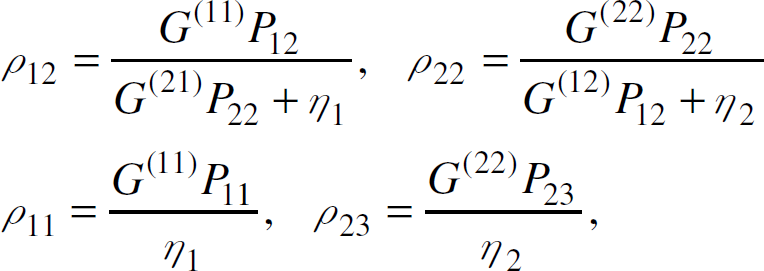
where G(ij) = |α(ij)|2. Further, let β1 = η1/G(11), α1 = G(21)/G(11), β2 = η2/G(22) and α2 = G(12)/G(22). Defining η12 = β1 + α1P22 and η22 = α2 + α2P12, we can more conveniently express ρ12 = P12/η12 and ρ22 = P22/η22.
We model the problem of duty-cycle constrained strategic energy minimization as a simple two player power game with the following parameters: node 1 selects its transmit power during periods T1 and T2 from the space ℙ of achievable transmit powers. Thus the strategy choice of node 1 is represented by l1 = (P11, P12) ∈ ℙ × ℙ. Likewise, the strategy choice of node 2 is given by l2 = (P22, P23) ∈ ℙ × ℙ. We consider only pure strategies here as opposed to the more general mixed strategy model where nodes choose their Pij s from a probability distribution. For notational simplicity, we define P13 = P23 = 0, since the nodes are not active during these time intervals.
Let E1 and E2 denote the transmission
energy functions

Let Rij represent the transmission rate of node i
during period Tj, where
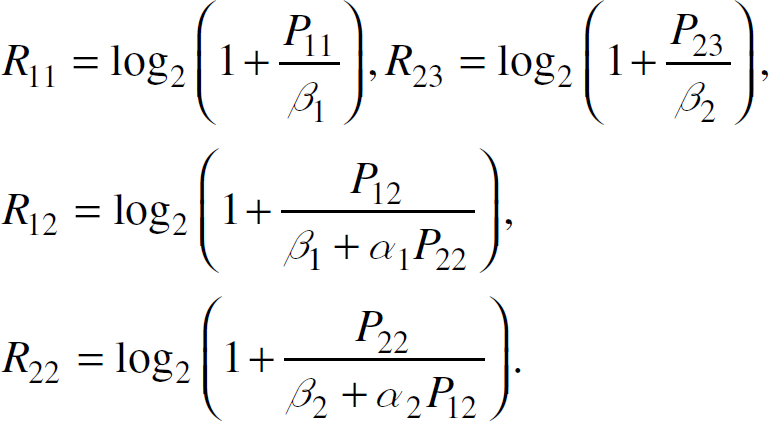
Also,

Let l = (l i , l −i ) represent a particular strategy profile of the power game. In this case, l−1 = l2, l−2 = l1 and l also represents a particular energy outcome of the game. We define the payoff at node i under strategy profile l as: Π i (l) = −Ei.
Strategy l i is defined to be the best response of player i to a given l −i if Π i (l′ i , l −i ) ≤ Π i (l i , l −i ) for all strategies l′ i .
Let BR i (l−i) denote the set of player i's best response to l −i . A strategy profile l = (l1, l2) is optimal if the nodes are playing a Nash Equilibrium [10] i.e., l i ∈ BR i (l−i) for each sensor node i.
Note that the best response power strategy of node 1 minimizes its individual energy consumption and satisfies its load constraint for a given power strategy employed by node 2, without accounting for the load constraint of the other node. However, at the Nash equilibrium point, node 2 is also playing its best response to node 1, i.e., both users are simultaneously satisfying their load constraints as well as minimizing their individual energies for each others power vector solutions. We will shortly identify system conditions (for example, load and channel quality) under which the two players arrive at Nash equilibrium in the power game.
We also consider the joint minimization approach in which nodes jointly adjust their powers during overlapping periods in order to minimize the aggregate energy, i.e., minimize Σ i E i , subject to the load constraints Li. Joint minimization is important in itself since there are circumstances under it is preferable from the application point of view, for example, data aggregation in sensor networks with large number of redundant nodes. More importantly, while strategic energy optimization naturally suggests energy benefits to some nodes, we investigate whether there are conditions under which joint energy minimization can strictly dominate the strategic approach, with respect to all individual node energies. This is indeed the case as shown below.
We first obtain optimal strategic power vectors followed by power vectors for joint energy
minimization. Optimal strategic power vectors correspond to the Nash equilibrium points of the two
player power game defined above. Let power vectors
Proposition 1
The Nash equilibria of the two player power game are determined by the solutions to the system of
bivariate functions

where xs ≥ 1, ys ≥ 1.
Proof
Please see Appendix.
Generally, games can have several Nash equilibria or none at all [10], depending on specific conditions (in this case, channel quality and load). If there is no solution to the above proposition, the two-player power game does not have explicit equilibria for the given parameters and the players cannot have meaningful overlapping periods. When Nash equilibrium does not exist, the nodes have several options. They can choose to change parameters such as μ values and use the above necessary conditions to ensure equilibrium. Alternately, they can choose TDM allocation in a ‘fair’ manner, or agree on a different energy optimization function. Since these options involve changing the definition of the game (non-cooperative to cooperative), they are beyond the scope of this article.
We now discuss under what conditions equilibria exist, and if so, how many. Meaningful equilibria
correspond to non-negative power allocations
Proposition 2
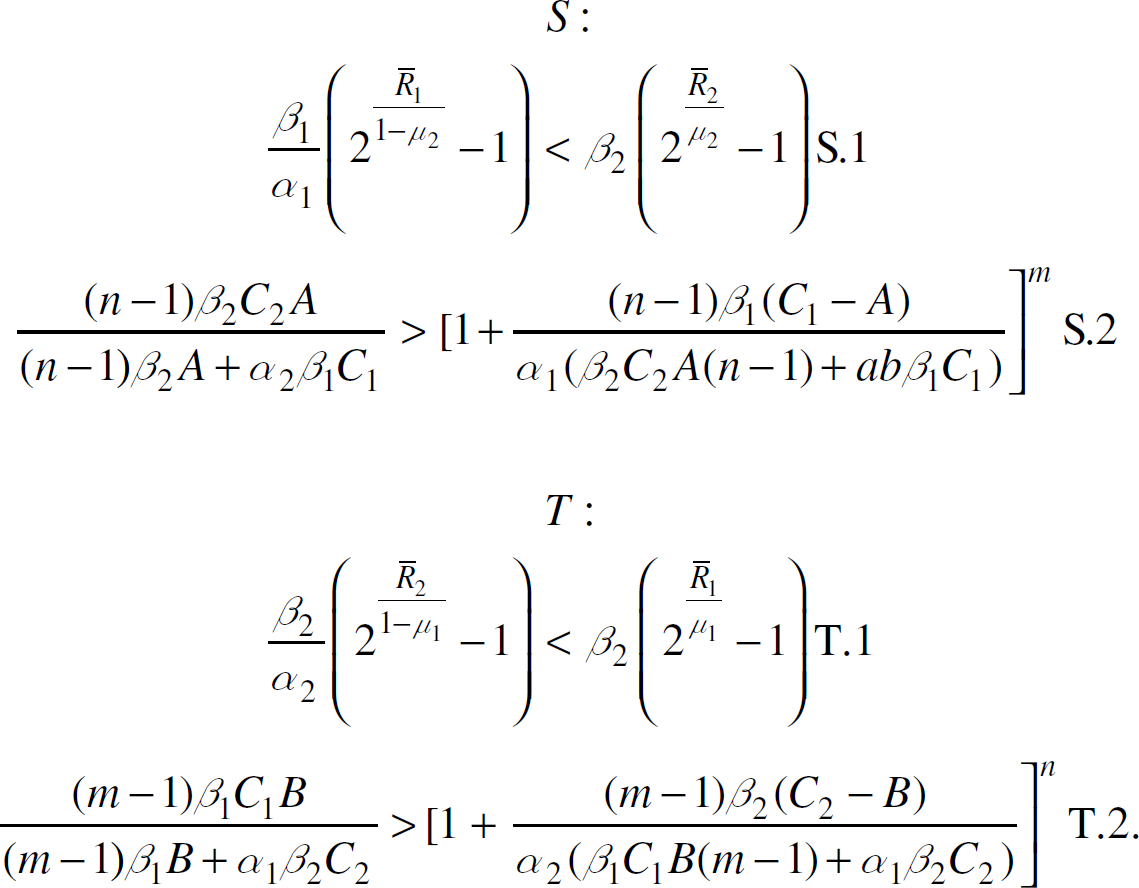
The strategic power game does not have Nash equilibrium points only if either S.1 and T.2
are simultaneously true or T.1 and S.2 are simultaneously true. However, if S.1 and T.1 are
simultaneously true or simultaneously false, then there exists at most three Nash
equilibria.
Proof
Please see Appendix.
Corollary 1
For given channel quality and load conditions, there always exist duty cycle values under which the nodes can find meaningful equilibrium.
As seen from conditions S.1 and T.1, for any channel quality and load, we can always find μ1 and μ2 such that the LSH of condition S.1 and T.1 exceed their RHS. Therefore, both S.1 and T.1 can be made false and thus equilibrium exists.
Next, we identify the power vectors for the case when the two nodes carry out joint energy
minimization. Let
Proposition 3
The optimal power vectors for joint energy minimization are determined by the
solutions (xj, y) to

Proof
Please see Appendix.
In the case of joint energy minimization, the non-existence of feasible power vectors, (i.e.,
Proposition 4
There exist load, channel quality, and duty-cycle conditions under which joint energy minimization is dominant over strategic energy minimization, i.e., the optimal energy cost for each node under joint energy minimization is strictly lower than its strategically optimal energy cost.
Proof
Consider n = m = 2 identical loads
(C1 = C2 = C)
and channel quality (α1 = α2 = α), and
normalized, β1 = β2 = T =
1 at each node. It can be easily seen that the optimal joint power allocation of node 1 is equal to
node 2, i.e.,
As will be seen from the examples in the numerical results section, joint energy minimization is not always dominant over strategic optimization. In such cases, one of the nodes consumes less energy, while the other consumes more. Thus, both joint as well as strategic optimization have their advantages. Either scheme can be preferable depending on the applications and specific parameters of data loads, channel qualities, and duty cycles.
Node Misbehavior and Impact on Energy Optimization
We now investigate the impact of misbehavior by sensor nodes in the network. We have assumed that
nodes share duty cycle, load, and channel quality parameters with each other so they can obtain the
optimal power allocations as specified by either the strategic or joint optimization regime. Under
these assumptions, it is possible for a sensor node to misbehave by selectively adjusting its power
output. In general, we define node misbehavior as follows: A node will misbehave only if it can
adjust its power output leading to lower transmission energy costs for itself, higher energy costs
for others,
There are two ways in which nodes can misbehave. Since nodes must share information, a misbehaving node can easily affect the optimal power vector solutions by falsely advertising its duty-cycle or load parameters. We consider this approach first. Later we show that it is impossible for a node to misbehave without false advertisement and thus the results in the first part are strict (i.e., apply to all misbehavior). Essentially, we show that without false advertisement, the only possibility is for the misbehaving node to unilaterally adopt strategic minimization when the other node is expecting joint energy minimization. We prove that such unilateral deviation from the agreed upon optimization strategy is always detectable and thus impossible.
Misbehavior through False Advertisement
We model misbehavior by assuming that a compromised node can falsely advertise its transmission
load but make misbehavior difficult by assuming that duty cycle lengths (μ1,
μ2), along with node power outputs during the
Using this model, we now analytically derive conditions for node misbehavior. First, we formally
define misbehavior as follows: WLOG, assume that node 1 is the good node while node 2 can misbehave.
Let
Definition. 1: The misbehavior gain of (the misbehaving) node 2 is defined as
We define the necessary condition for misbehavior as

Thus, node 2 will misbehave only if there exists
As shown previously, strategic transmission is energy optimal for one node in most cases (the exception being when joint energy optimization turns out to be strongly pareto-optimal). Thus, given freedom of choice, this node will choose to optimize transmission energy strategically thereby forcing the other node to minimize its energy by also performing strategic optimization. We show below that there can be an additional rationale for strategic optimization, namely preventing misbehavior. In particular, the following propositions show that joint energy optimization is conductive to misbehavior, while strategic energy optimization is not.
We summarize the main results in this section below. In the derivations, we assume normalized duty cycle interval T = 1 and background interference parameters β1 = 1 and β2 = 1.
Theorem 1
It is impossible to prevent misbehavior under joint energy optimization for all channel quality, duty-cycle and load values α1 α2, μ1, μ2, B1, B2, 0 < μ1, μ2 < 1.
Theorem 2
Under strategic energy optimization, both nodes can guarantee good behavior from each
other by choosing loads and duty-cycle lengths
B1
B2, μ1, μ2 0 <
μ1, μ2 < 1, such that


Misbehavior under Strategic Energy Optimization
We first consider misbehavior under strategic optimization. First, we show that it is necessary and sufficient for the bad node to advertise a larger false load, in order to penalize the good node (i.e., make EL1 < 0). This is not true under joint optimization, as we shall prove later. Later, we provide a necessary condition for profitable misbehavior at the bad node (EG1 < 0).
Proposition 5
If both nodes are following a strategic optimization regime, then EL1
< 0 if and only if
Proof
Let

where
We consider the rate of change of

where P′2 and
x′
f
are the partial derivatives with respect to

Thus, we have

To obtain P′22 and P′12
rewrite Eqs. (47) and
(48) as


Taking partial derivatives w.r.t


Solving for P′22 above we get

Using Eqs. (49) and
(50),

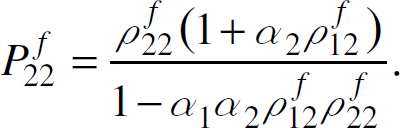
Thus
Thus, the good node is penalized if and only if the bad node falsely advertises a higher load. Next, we derive a necessary condition for the the bad node to also profit through misbehavior.
Proposition 6
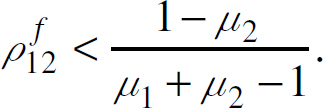
Under strategic energy optimization, the bad node can profit from misbehavior
(EG1 < 0), only if the equilibrium SNR of the good node during
the overlapping period satisfies
Proof
The energy consumed by the bad node can be expressed as

where m = μ2(1 − μ1) and
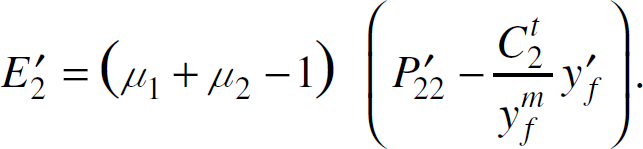
Next, taking the partial derivative of Eq. (50) and simplifying, we get
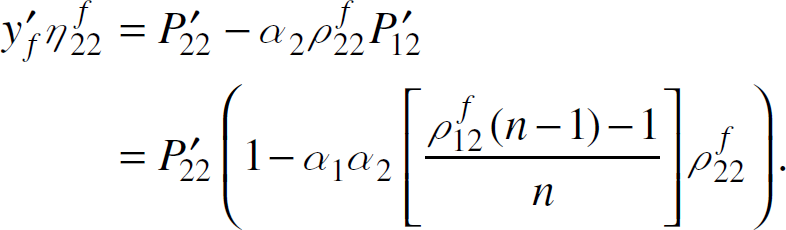
Note that

For the bad node to profit from misbehavior, it is necessary that
E′2 < 0, which reduces to

Since

Substituting n = μ1/(1 − μ2) leads to the proposition as stated.
Thus, if both nodes are following strategic energy optimization, there exist values of true-load at the good node for which the bad node cannot misbehave. Prop 6 shows that node 1 can defend against misbehavior by node 2 (make it less likely) by choosing larger loads and larger values of n. However, as we show below, there is no such defense against misbehavior under joint energy optimization.
Misbehavior under Joint Energy Optimization
We begin by proving the following useful result.
Lemma 1
If both nodes are following a joint energy optimization regime, then

and hence, EG1 = −EL2
for small values of
Proofs

E′1 at
Likewise,

Therefore, we have
Proposition 7
If both nodes are following a joint energy optimization regime, then for any channel
quality, duty-cycle and true-load values,
Proof
From lemma 1, it suffices to show
that E′2 ≠ 0 at

where P′22 and P′12 are
evaluated at
Simplifying Eqs. (60)
and (61) (using
normalized β1 = β2 = 1), we get


Differentiating both equations above with respect to C2, and after
some algebraic manipulation, we have

where


The C and D terms are obtained by interchanging
α1 with α2, n with m and the
12 subscripts with 22 in B and A, respectively. Consider two
cases:
Hence E′2 ≠ 0 at
Suppose a node cannot falsely advertise its load values as assumed in the previous section. In this case, the only way a node can misbehave is if it unilaterally follows an energy optimization strategy that is different from the one being followed by the other nodes. Clearly, if the good node is performing strategic optimization, then the bad node cannot decrease the good nodes energy by performing joint optimization (By definition of strategic optimization. Note that both nodes are using true load values). The only possibility is if the good node assumes that both nodes will follow the joint optimization regime, however the bad node unilaterally deviates and follows strategic optimization. We now show that it is impossible for the bad node to remain undetected and hence the only threat of energy misbehavior in the network is through false advertisement.
Proposition 8
If all nodes in the network are following a joint optimization regime, a bad node cannot undetectably obtain a misbehavior gain by unilaterally following strategic energy optimization.
Proof
WLOG, assume node 2 is the bad node performing unilateral strategic energy minimization while node 1 adheres to the power vectors produced under joint energy minimization. Clearly, due to the nature of strategic optimization, the bad node always has an energy gain from this type of misbehavior. Now assume that the good node cannot detect the others misbehavior provided the good node's packet can still be successfully transmitted. Based on our interference channel model, this is only possible when the good node's SNR during the overlapping period T2 is not decreased.
Let
Given

where the first equation is the load constraint, the second one comes from solving the Lagrange
multiplier equation for strategic minimization and

Combining these results, we solve Eq. (34) and obtain

Define

Next, from the Lagrangean for joint energy minimization, we have

which yields

Combining Eqs. (38)
and (36), we obtain

which is only true for x = 1 implying
Proposition 8 demonstrates that it is impossible for the bad node to misbehave using unilateral strategic approach without compromising the good nodes performance. Thus, a bad node can misbehave only by falsely advertising its load as analyzed in the previous section.
Numerical Results
This section contains numerical results for optimal power allocation and misbehavior given the duty cycle μ = μ1 = μ2 for both the strategic and total energy minimization approach. It is assumed normalized β1 = β2 = 1 and T = 1.
Figs. 2–5 compare individual energies E1 and E2, as well as the total energy E1 + E2, under both joint and strategic energy minimization schemes, respectively. It has been shown in [4] that joint energy minimization is strongly Pareto-optimal when duty-cycle overlap is complete, i.e., μ = 1. Figs. 2 and 3 demonstrate the case when joint energy minimization is still strongly Pareto-optimal even for partial overlap, i.e., μ < 1. These observations agree with Proposition 4. It can also be seen that the dominance of the joint minimization scheme over the strategic one becomes greater as overlap μ increases.

Energy versus active cycle length for joint versus strategic energy minimization. Figure shows joint energy dominance. B1/T = B2/T − 1, α1 = 1, α2 = 2.
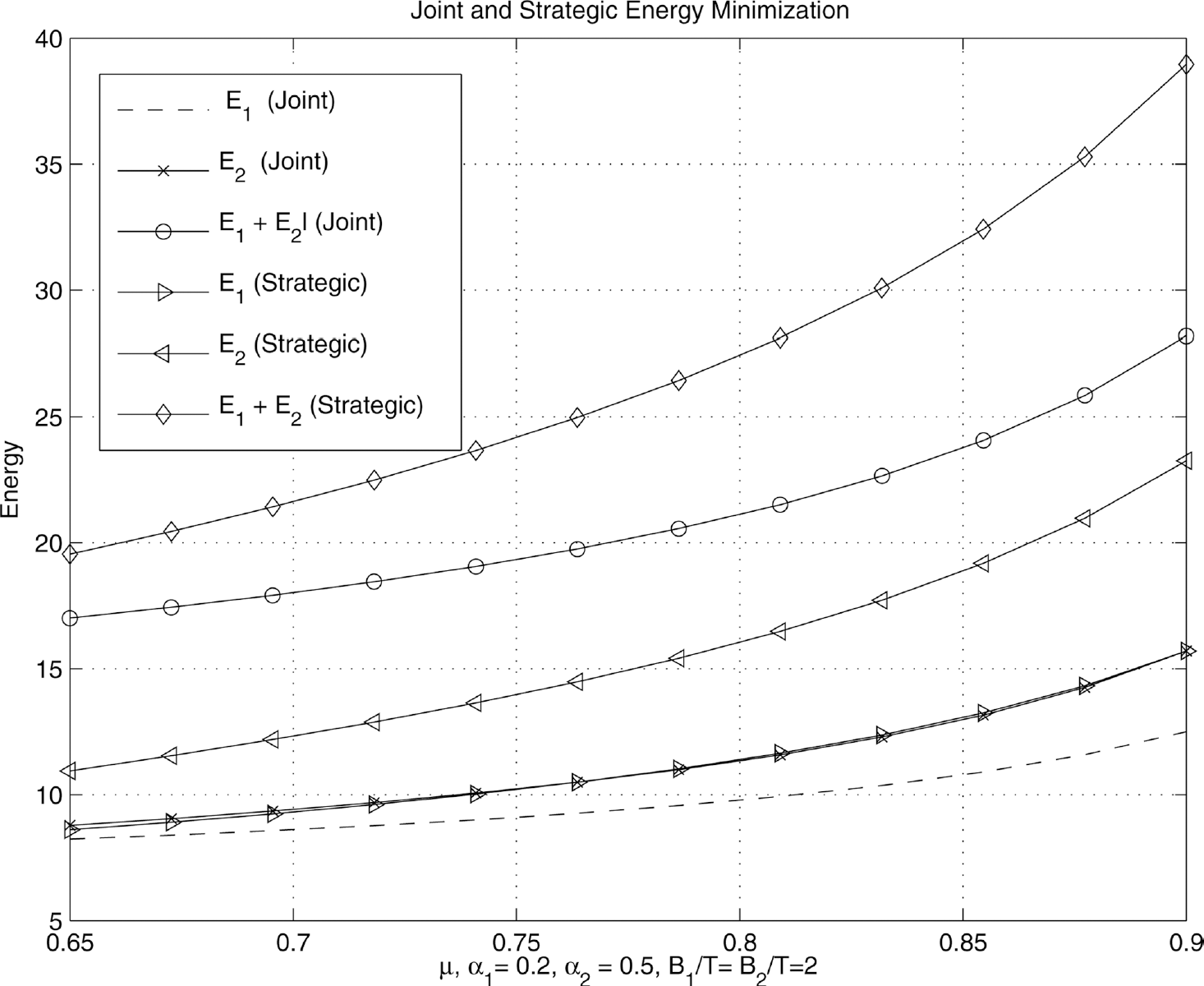
Joint energy dominance for B1/T = B2/T = 2, α1 = 0.2, α2 = 0.5.
For intermediate μ values, Fig. 4 illustrates the benefit of the strategic approach in terms of energy gains by the user having smaller load and higher interference. Since the goal of the strategic scheme is to minimize individual energies, node 1 saves its energy at the price of higher energy consumption by node 2 compared to the joint energy minimization scheme.
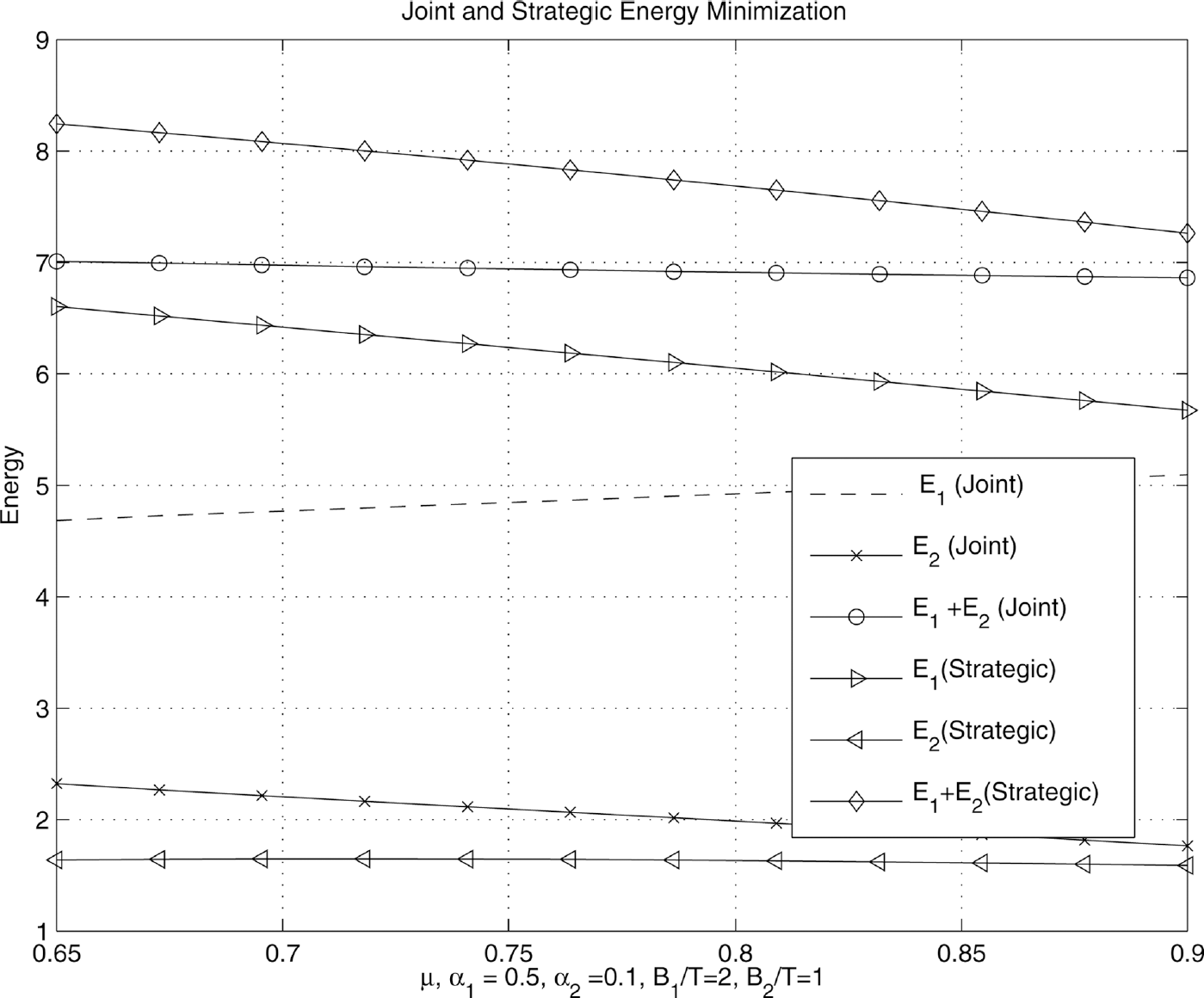
Joint versus strategic energy minimization. Node 1 benefits from strategic minimization. B1/T = 2, B2/T = 1, α1 = 0.1, α2 = 0.5, B1/T = 2, B2/T = 1, α1 = 0.5, α2 = 0.1.
Figs. 4 and 5 reflect the converging tendency of these two schemes in the sense that the difference between individual energies is decreasing. We could expect as μ → 1 (complete overlap of duty cycles), joint and strategic energy minimization will yield the same energy expenditures. If the node with higher load has better channel quality in terms of smaller α j , there exists a crossing point of μ, beyond which the joint minimization scheme becomes dominant, as shown in Fig. 5.

Joint versus strategic energy minimization. Both nodes benefit from strategic minimization at different μ values. B1/T = 2, B2/T = 1, α1 = 0.1, α2 = 0.5
Fig. 6 demonstrates misbehavior by node 2 when both nodes perform joint energy minimization. Node 2's misbehavior results in energy savings for itself while simultaneously leading to higher energy costs for the good node. However, as shown in Fig. 7 if both nodes perform strategic energy minimization, misbehavior through false advertisement not only increases the energy of the good node, but also that of the bad node.
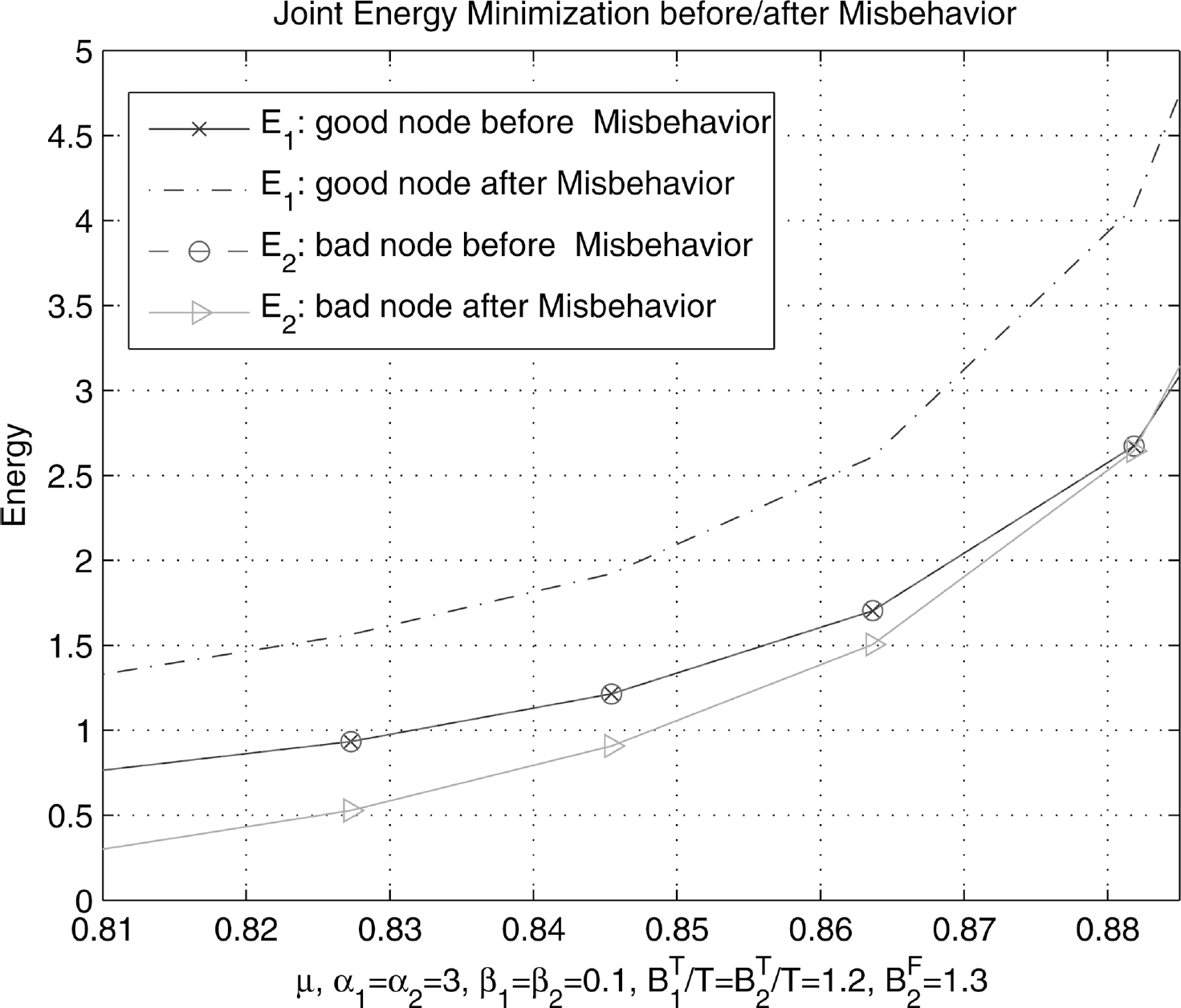
Impact of misbehavior by node 2 on E1 and
E2 for joint energy minimization by declaring false load

Impact of misbehavior by node 2 on E1 and
E2 for strategic energy minimization by declaring false load. Node 2
does not profit from misbehavior.
The figures show that both joint as well as strategic optimization have their advantages. Either scheme can be preferable depending on the applications, specific parameters of data loads, channel qualities and duty cycles and tolerance for misbehavior.
Conclusions
Power-control multiple access (PCMA) schemes have become an essential feature of many energy-constrained interference-limited wireless networks. A hidden feature of such PCMA schemes is the fact that they are based on implicit trust agreements between interfering nodes, which makes them highly vulnerable to energy-depletion attacks. Compromised nodes can maliciously adjust their transmission powers resulting in increased energy consumption at “good” nodes that are faithfully following a power-control regime. In this article, we present a novel formulation of the problem of energy misbehavior and develop an analytical framework for quantifying its impact on other nodes. Our analytical results reveal optimal strategies for attacking nodes in an enemy network through energy depletion. We also develop effective defense mechanisms for protecting our own wireless network against energy attacks by an intelligent adversary. Specifically, we formulate two versions of the power control problem for wireless networks with latency constraints arising from duty cycle allocations. In the first version, strategic power optimization, wireless nodes are modeled as rational agents in a power game, which strategically adjust their powers to minimize their own energy. In the other version, joint power optimization, wireless nodes jointly minimize the aggregate energy expenditure. We show that a node cannot unilaterally misbehave by transmitting strategically without being detected. We then show quantitatively how an enemy network can be attacked by falsely advertising traffic load information in order to minimize our energy consumption while maximally depleting the enemies. While joint energy optimization is sometimes energy dominant, it is more vulnerable to energy misbehavior than strategic optimization. We provide sufficient conditions under which strategic optimization inoculates our network against an enemy's misbehavior. Extensions of our misbehavior model to the case of multiple nodes is described in [11].