




Abstract
This paper reviews some of the recent advances in the development of algorithms for wireless sensor networks. We focus on sensor deployment and coverage, routing, and sensor fusion.
Introduction
A wireless sensor network may comprise thousands of sensor nodes. Each sensor node has a sensing capability as well as limited energy supply, compute power, memory, and communication ability. Besides military applications, wireless sensor networks may be used to monitor microclimates and wildlife habitats [45], the structural integrity of bridges and buildings, buildings security, location of valuable assets (via sensors placed on these valuable assets), traffic, and so on. However, realizing the full potential of wireless sensor networks poses myriad research challenges ranging from hardware and architectural issues, to programming languages and operating systems for sensor networks, to security concerns, to algorithms for sensor network deployment, operation, and management. Iyengar and Brooks [20], [21] and Culler and Hong [8] provide good overviews of the breadth of sensor network research topics as well as of applications for sensor networks.
This paper focuses on some of the algorithmic issues that arise in the context of wireless sensor networks. Specifically, we review algorithmic issues in sensor deployment and coverage, routing, and fusion. There is an abundance of algorithmic research related to wireless sensor networks. At a high level, the developed algorithms may be categorized as either centralized or distributed. Because of the limited memory, compute, and communication capability of sensors, distributed algorithms research has focused on localized distributed algorithms—distributed algorithms that require only local (e.g., nearest neighbor) information.
Sensor Deployment and Coverage
In a typical sensor network application, sensors are to be placed (or deployed) so as to monitor a region or a set of points. In some applications, we may be able to select the sites where sensors are placed, while in others (e.g., in hostile environments), we may simply scatter (e.g., airdrop) a sufficiently large number of sensors over the monitoring region with the expectation that the sensors that survive the airdrop will be able to adequately monitor the target region. When site selection is possible, we use deterministic sensor deployment, and when site selection is not possible, the deployment is nondeterministic. In both cases, it is often desirable that the deployed collection of sensors be able to communicate with one another, either directly or indirectly via multihop communication. So, in addition to covering the region or set of points to be sensed, we often require the deployed collection of sensors to form a connected network. For a given placement of sensors, it is easy to check whether the collection covers the target region or point set and also whether the collection is connected. For the coverage property, we need to know the sensing range of individual sensors. (We assume that a sensor can sense events that occur within a distance r, where r is the sensor's sensing range.) For the connected property, we need to know the communication range, c, of a sensor. Zhang and Lou [60] have established the following necessary and sufficient condition for coverage to imply connectivity.
Theorem 1
(Zhang and Lou [60]) When the sensor density (i.e., number of sensors per unit area) is finite, c ≥ 2r is a necessary and sufficient condition for coverage to imply connectivity.
Wang et al. [49] prove a similar result for the case of k-coverage (each point is covered by at least k sensors) and k-connectivity (the communication graph for the deployed sensors is k connected).
Theorem 2
(Wang et al. [49]) When c ≥ 2r, k-coverage of a convex region implies k-connectivity.
Notice that k-coverage with k > 1 affords some degree of fault tolerance. We are able to monitor all points so long as no more than k − 1 sensors fail. Huang and Tseng [19] develop algorithms to verify whether a sensor deployment provides k-coverage. Other variations of the sensor deployment problem are also possible. For example, we may have no need for sensors to communicate with one another. Instead, each sensor communicates directly with a base station that is situated within the communication range of all sensors. In another variant [17], [18], the sensors are mobile and self-deploy. A collection of mobile sensors may be placed into an unknown and potentially hazardous environment. Following this initial placement, the sensors relocate so as to obtain maximum coverage of the unknown environment. They communicate the information they gather to a base station outside of the environment being sensed. A distributed potential-field-based algorithm to self-deploy mobile sensors under the stated assumptions is developed in [18], and a greedy and incremental self-deployment algorithm is developed in [17]. A virtual-force algorithm to redeploy sensors so as to maximize coverage is developed by Zou and Chakrabarty [61]. Poduri and Sukhatme [38] developed a distributed self-deployment algorithm that is based on artificial potential fields and that maximizes coverage while ensuring that each sensor has at least k other sensors within its communication range.
Deterministic Deployment
Region Coverage
Kar and Banerjee [25] examined the problem of deploying the fewest number of homogeneous sensors so as to cover the plane with a connected sensor network. They assumed that the sensing range equals the communication range (i.e., r = c). Figure 1 gives their deployment algorithm. One may verify that the sensors deployed in Step 1 are able to sense the entire plane. So, these sensors satisfy the coverage requirement. However, the sensors placed in Step 1 define many rows of connected sensors with the property that two sensors in different rows are unable to communicate (i.e., there is no multihop path between the sensors such that adjacent sensors on this path are at most c apart). Step 2 creates a connected network by placing a column of sensors in such a way as to connect the connected rows that result from Step 1.

Kar and Banerjee's [25] sensor-deployment algorithm.
Kar and Banerjee [25] have shown that their algorithm of Fig. 1 has a sensor density that is within 2.6% of the optimal density. This algorithm may be extended to provide connected coverage for a set of finite regions [25].
Figure 2 gives the greedy algorithm of Kar and Banerjee [25] to deploy a connected sensor network so as to cover a set of points in Euclidean space. This algorithm, which assumes that r = c, uses at most 7.256 times the minimum number of sensors needed to cover the given point set [25]. It is easy to see that the constructed deployment covers all of the given points and is a connected network.

Greedy algorithm of [25] to deploy sensors.
Grid coverage is another version of the point coverage problem. In this version, Chakrabarty et al. [5], we are given a two- or three-dimensional grid of points that are to be sensed. Sensor locations are restricted to these grid points, and each grid point is to be covered by at least m, m ≥ 1, sensors (i.e., we seek m-coverage). For sensing, we have k sensor types available. A sensor of type i costs ci dollars and has a sensing range ri. At most, one sensor may be placed at a grid point. In this version of the point coverage problem, the sensors do not communicate with one another and are assumed to have a communication range large enough to reach the base station from any grid position. So, network connectivity is not an issue. The objective is to find a least-cost sensor deployment that provides m-coverage.
Chakrabarty et al. [5] formulated this m-coverage deployment problem as an integer linear program (ILP) with O(kn2) variables and O(kn2) equations, where n is the number of grid points. Xu and Sahni [54] reduce the number of variables to O(kn) and the number of equations to O(n). Also, their formulation does not require the sensor locations and points to be sensed to form a grid. Let sij be a 0/1-valued variable with the interpretation sij = 1 iff a sensor of type i is placed at point j, 1 ≤ i ≤ k, 1 ≤ j ≤ n. The solution to the following ILP describes an optimal sensor deployment.

Even with this reduction in the number of variables and equations, the ILP is practically solvable only for a small number of points n. For large n, Chakrabarty et al. [5] proposed a divide-and-conquer “near-optimal” algorithm in which the base case (small number of points) is solved optimally using the ILP formulation.
When sensors are deployed in difficult-to-access environments, as is the case in many military applications, a large number of sensors may be airdropped into the region that is to be sensed. Assume that the sensors that survive the airdrop cover all targets that are to be sensed. Because the power supply of a sensor cannot be replenished, a sensor becomes inoperable once it runs out of energy. Define the life of a sensor network to be the earliest time at which the network ceases to cover all targets. The life of a network can be increased if it is possible to put redundant sensors (i.e., sensors not needed to provide coverage of all targets) to “sleep” and awaken these sleeping sensors when they are needed to restore target coverage. Sleeping sensors are inactive, while sensors that are awake are active. Inactive sensors consume far less energy than active ones.
Cardei and Du [3] proposed partitioning the set of available sensors into disjoint sets such that each set covers all targets. Let T be the set of targets to be monitored, and let Si denote the subset of T in the range of sensor i, 1 ≤ i ≤ n. Let P1, P2, …, Pk be disjoint partitions of the set of n sensors such that
Several decentralized localized protocols to control the sleep/awake state of sensors so as to increase network lifetime have been proposed. Ye, Zhong, Lu, and Zhang [58] proposed a simple protocol. In this protocol, the set of active nodes provides the desired coverage. A sleeping node wakes up when its sleep timer expires, and it broadcasts a probing signal a distance d (d is called the probing range). If no active sensor is detected in this probing range, the sensor moves into the active state. However, if an active sensor is detected in the probing range, the sensor determines how long to sleep, sets its sleep timer, and goes to sleep. Techniques to dynamically control the sleep time and probing range are discussed in [58]. Simulations reported in [58] indicate that this simple protocol outperforms the GAF protocol of [55]. However, experiments conducted by Tian and Georganas [46] reveal that the protocol of Ye et al. [58] “cannot ensure the original sensing coverage and blind spots may appear after turning off some nodes.” Tian and Georganas [46] proposed an alternative distributed localized protocol that sensors may use to turn themselves on and off. The network operates in rounds, where each round has two phases—self-scheduling and sensing. In the self-scheduling phase, each sensor decides whether or not to go to sleep. In the sensing phase, the active/awake sensors monitor the region. Sensor s turns itself off in the self-scheduling phase if its neighbors are able to monitor the entire sensing region of s. To make this determination, every sensor broadcasts its location and sensing range. A back-off scheme is proposed to avoid blind spots that would otherwise occur if two sensors turn off simultaneously, each expecting the other to monitor part or all of its sensing region. In this back-off scheme, each active sensor uses a random delay before deciding whether or not it can go to sleep without affecting sensing coverage.
The decentralized algorithm OGDC (optimal geographical density control) of Zhang and Hou [60] guarantees coverage, which by Theorem 1 implies connectivity, whenever the sensor communication range is at least twice its sensing range. Experimental results reported in [60] suggest that when OGDC is used, the number of active (awake) nodes may be up to half that when the PEAS [57] or GAF [55] algorithms are used to control sensor state. The Coverage Configuration Protocol (CCP) to maximize lifetime while providing k-coverage (as well as k-connectivity when c ≥ 2r, Theorem 2) is developed in [49]. A distributed protocol for differentiated surveillance is proposed by Yan, He, and Stankovic [56].
Assume that the probability that sensor s detects an event at a distance d is P(s,x) = 1/(1 + αd)β. The probability P(x) that an event at x is detected by the sensor network is

Deployment Quality
The quality of a sensor deployment may be measured by the minimum k for which the deployment provides k-coverage as well as by the minimum k for which we have k-connectivity. By Theorem 2, the first metric implies the second when the communication range c is at least twice the sensing range r. Meguerdichian et al. [33] formulated additional metrics suitable for a variety of sensor applications. In these applications, the ability of a sensor to detect an activity a distance d from the sensor is given by the function α/(1 + d),β where α and β are constants. So, sensing ability is at a maximum when d = 0 and declines as we get farther from the sensor.
Let P be a path that connects two points u and v. (These points may be within or outside the region being sensed.) The breach weight, BW(P, u, v), of P is the closest path P gets to any of the deployed sensors. The breach weight, BW(u, v), of the points u and v is the maximum of the breach weights of all paths between u and v:

The breach weight or breachability, BW, of a sensor network is the maximum of the breach weights of all point pairs:

When the ability of a sensor to detect an activity is inversely proportional to some power k of distance, sensor deployments that minimize breach weight are preferred. The breachability of a network gives us an indication of how successful an intruder could be in evading detection. Suppose we have an application in which items are being transported between pairs of points, and our sensors track the progress of these shipments. Now we wish to use maximally observable paths, that is, paths that remain as close to a sensor as possible. Let d(x) be the distance between a point x and the sensor nearest to x. Meguerdichian et al. [33] define the support weight, SW(P, u, v), of a path P between u and v as



Although Meguerdichian et al. [33] developed centralized algorithms to compute BW(u, v) and SW(u, v), these algorithms are flawed [28]. Li, Wan and Frieder [28] described a distributed localized algorithm to determine SW(u, v). This algorithm is given in Fig. 3. In this algorithm, |sa| is the Euclidean distance between the sensors s and a. The algorithm assumes that u and v are in the convex hull of the sensor locations.

Distributed algorithm of [28] to compute SW(u, v).
Because there may be several paths with the computed SW(u, v) value, we may be interested in finding, say, a best support path from u to v that has minimal length. Li et al. [28] developed a localized distributed algorithm to find an approximately minimal length path with support SW(u, v).
The exposure E(P, u, v) of a path P from u to v is defined as


Algorithm of [34] to find an approximate minimal-exposure path.
Veltri et al. [47] developed a distributed localized algorithm to find an approximate minimal-exposure path. Also, they showed that finding a maximal-exposure path is NP-hard, and they proposed several heuristics to construct approximate maximal-exposure paths. Additionally, a linear programming formulation for minimal- and maximal-exposure paths was obtained. Kanan et al. [23] developed polynomial time algorithms to compute the maximum vulnerability of a sensor deployment to attack by an intelligent adversary, and they used this to compute optimal deployments with minimal vulnerability.
Traditional routing algorithms for sensor networks are datacentric in nature. Given the unattended and untethered nature of sensor networks, datacentric routing must be collaborative as well as energy-conserving for individual sensors. Kannan et al. [22], [24] have developed a novel sensor-centric paradigm for network routing using game theory. In this sensor-centric paradigm, the sensors collaborate to achieve common network-wide goals, such as route reliability and path length, while minimizing individual costs. The sensor-centric model can be used to define the quality of routing paths in the network (also called path weakness). Kannan et al. [24] described inapproximability results on obtaining paths with bounded weakness along with some heuristics for obtaining strong paths. The development of efficient distributed algorithms for approximately optimal strong routing is an open issue that can be explored further.
Energy conservation is an overriding concern in the development of any routing algorithm for wireless sensor networks. This is because such networks are often located where it is difficult, if not impossible, to replenish the energy supply of a sensor. Three forms—unicast, broadcast, and multicast—of the routing problem have received significant attention in the literature. The overall objective of these algorithms is to maximize the lifetime (earliest time at which a communication fails) or the capacity of the network (amount of data traffic carried by the network over some fixed period of time).
Assume that the wireless network is represented as a weighted directed graph G that has n vertices/nodes and e edges. Each node of G represents a node of the wireless network. The weight w(i,j) of the directed edge (i,j) is the amount of energy needed by node i to transmit a unit message to node j.
In the most common model used for power attenuation, signal power attenuates at the rate a/rd, where a is a media-dependent constant, r is the distance from the signal source, and d is another constant between two and four [39]. So, for this model, w(i, j) = w(j, i) = c ∗ r(i, j) d , where r(i,j) is the Euclidean distance between nodes i and j, and c is a constant. In practice, however, this nice relationship between w(i,j) and r(i,j) may not apply. This may, for example, be due to obstructions between the nodes that may cause the attenuation to be larger than predicted. Also, the transmission properties of the media may be asymmetric, resulting in w(i, j) ≠ w(j, i).
Unicast
In a unicast, we wish to send a message from a source sensor s to a destination sensor t. Singh, Woo, and Raghavendra [42] proposed five strategies that may be used in the selection of the routing path for this transmission. The first of these is to use a minimum-energy path (i.e., a path in G for which the sum of the edge weights is minimum) from s to t. Such a path may be computed using Dijkstra's shortest-path algorithm [40]. However, because, in practice, messages between several pairs of source–destination sensors need to be routed in succession, using a minimum-energy path for a message may prevent the successful routing of future messages. As an example, consider the graph of Fig. 5. Suppose that sensors x, b1, …, bn initially have 10 units of energy each and that u1, …, un each have one unit. Assume that the first unicast is a unit-length message from x to y. There are exactly two paths from x to y in the sensor network of Fig. 5. The upper path, which begins at x, goes through each of the uis, and ends at y, uses n + 1 energy units; the lower path uses 2(n + 1) energy units. Using the minimum-energy path depletes the energy in node ui, 1 ≤ i ≤ n. Following the unicast, sensors u1, …, un are unable to forward any messages. So, an ensuring request to unicast from ui to uj, i < j will fail. On the other hand, had we used the lower path, which is not a minimum-energy path, we would not deplete the energy in any sensor, and all unit-length unicasts that could be done in the initial network also can be done in the network following the first x to y unicast.
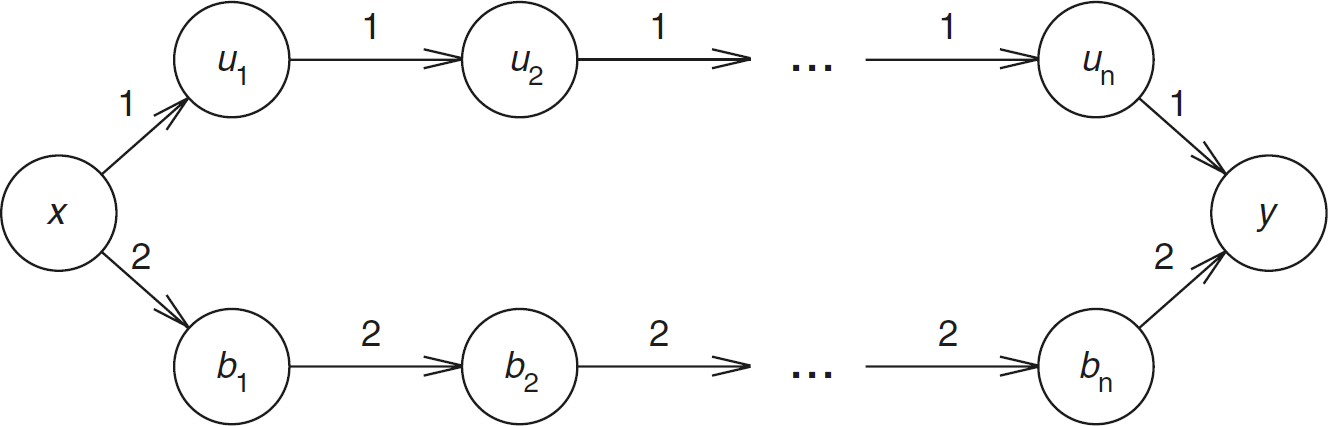
A sensor network.
The remaining four strategies proposed in [42] attempt to overcome the myopic nature of the minimum-energy-path strategy, which sacrifices network lifetime and capacity in favor of total remaining energy. Because routing decisions must be made in an online fashion (i.e., if the ith message is to be sent from si to ti, the path for message i must be decided without knowledge of sj and tj, j > i), we seek an online algorithm with a good competitive ratio. It is easy to see that there can be no online unicast algorithm with constant competitive ratio with respect to network lifetime and capacity [1]. For example, consider the network of Fig. 5. Assume that the energy in each node is one unit. Suppose that the first unicast is from x to y. Without knowledge of the remaining unicasts, we must select either the upper or lower path from x to y. If the upper path is chosen and the source–destination pairs for the remaining unicasts turn out to be (u1, u2), (u2, u3), …, (un−1, un), (un, y), then the online algorithm routes only the first unicast, whereas an optimal off-line algorithm would route all n + 1 unicasts, giving a competitive ratio of n + 1. The same ratio results when the lower path is chosen and the source–destination pairs for the remaining unicasts are (b1, b2), (b2, b3), …, (bn−1, bn), (bn, y).
Theorem 3
There is no online algorithm to maximize lifetime or capacity that has a competitive ratio smaller than Ω(n).
To maximize lifetime and capacity, we need to achieve some balance between the energy consumed by a route and the minimum residual energy at the nodes along the chosen route. Aslam, Li, and Rus [1] proposed the max–min zPmin-path algorithm to select unicast routes that attempt to make this balance. This algorithm selects a unicast path that uses, at most, z ∗ Pmin energy, where z is a parameter to the algorithm, and Pmin is the energy required by the minimum-energy unicast path. The selected unicast path maximizes the minimum residual energy fraction (energy remaining after unicast/initial energy) for nodes on the unicast path. Notice that the possible values for the residual energy fraction of node u may be obtained by computing (ce(u) – w(u, v) ∗ l)/ie(u), where l is the message length, ce(u) is the (current) energy at node u just before the unicast, ie(u) is the initial energy at u, and w(u, v) is the energy needed to send a unit-length message along the edge (u, v). This computation is done for all vertices v adjacent from u. Hence, the union, L, of these values taken over all u gives the possible values for the minimum residual-energy fraction along any unicast path. Figure 6 gives the max–min zPmin algorithm.
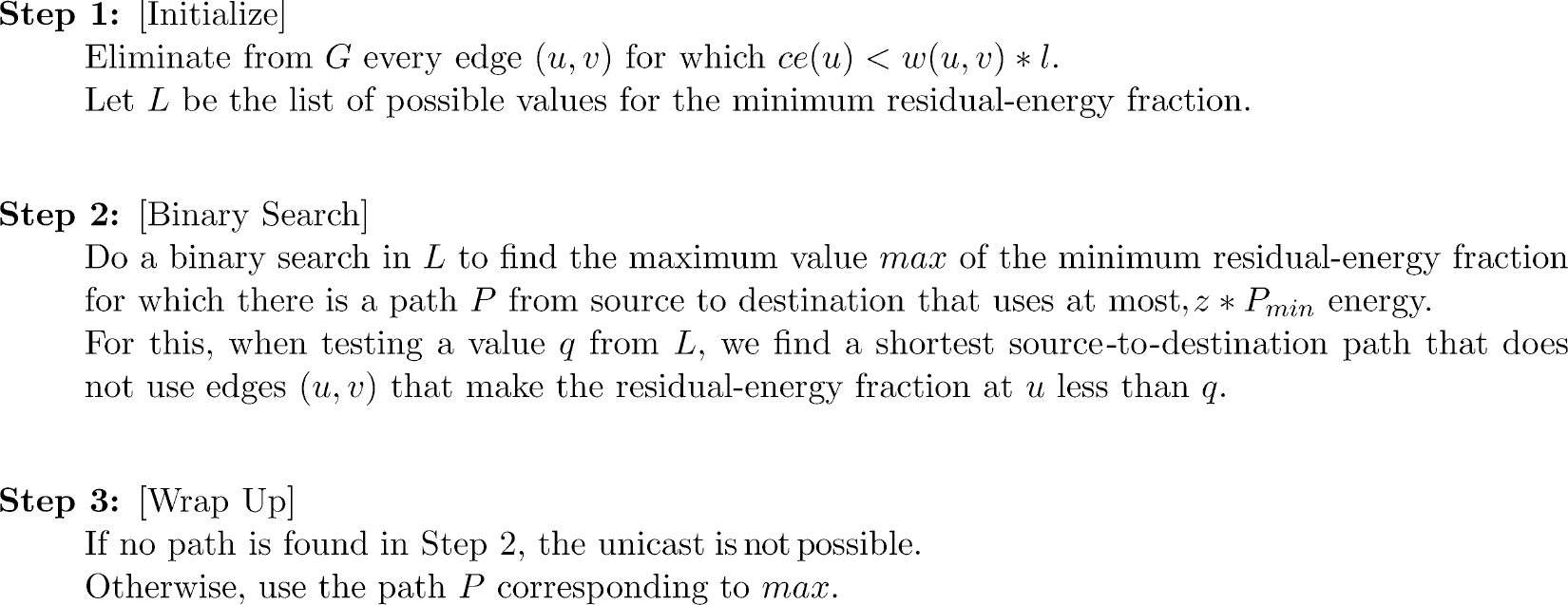
The max–min zPmin unicast algorithm of [11].
Several adaptations to the basic max–min zPmin algorithm, including a distributed version, are described in [1]. Kar et al. [42] developed an online capacity-competitive algorithm, CMAX, with a logarithmic competitive ratio. On the surface, this would appear to violate Theorem 3. However, to achieve this logarithmic competitive ratio, the algorithm CMAX does admission control. That is, it rejects some unicasts that are possible. The bound of Theorem 3 applies only for online algorithms that must perform every unicast that is possible.
Let ce, E, and l be as for the max–min zPmin algorithm. Let α(u) = 1 – ce(u)/ie(u) be the fraction of u's initial energy that has been used so far. Let λ and σ be two constants. In the CMAX algorithm, the weight of every edge (u, v) is changed from w(u, v) to w(u, v) ∗ (λα(u) − 1). The shortest source-to-destination path P in the resulting graph is determined. If the length of this path is more than σ, the unicast is rejected (admission control); otherwise, the unicast is done using path P. Figure 7 gives the algorithm.
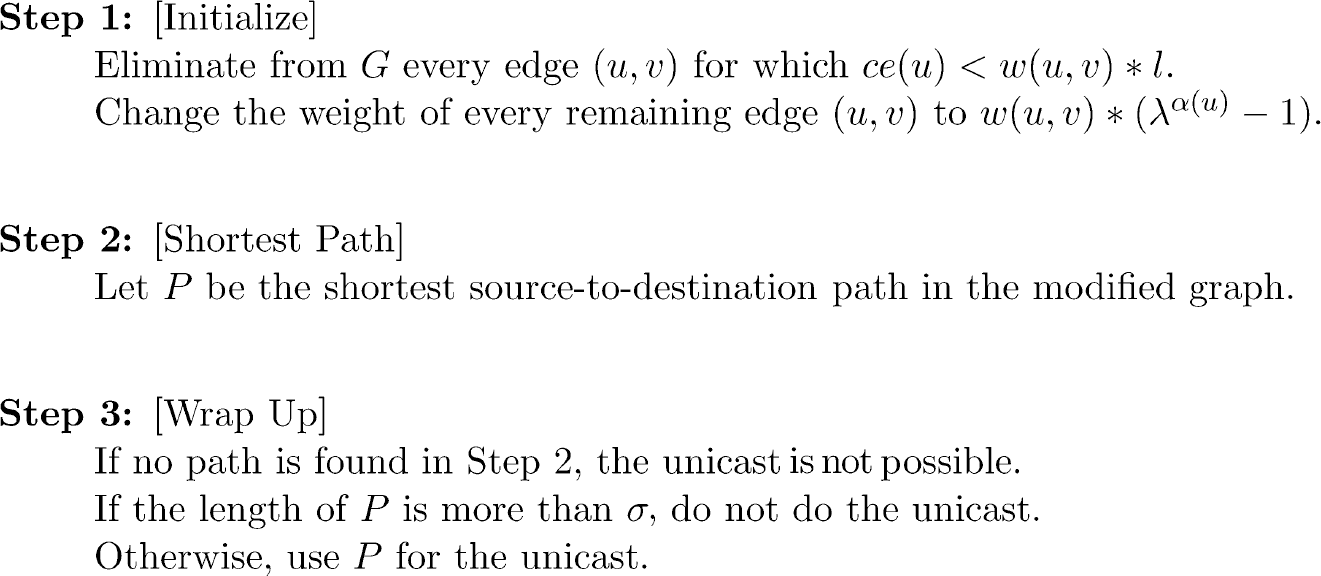
CMAX algorithm of [26] for unicasts.
The CMAX algorithm of Fig. 7 has a complexity advantage over the max–min zPmin algorithm of Fig. 6. The former does only one shortest-path computation per unicast, while the latter does O(logn), where n is the number of sensor nodes. Although admission control is necessary to establish the logarithmic competitive-ratio bound for CMAX, we may use CMAX without admission control (i.e., route every unicast that is feasible) by setting σ = ∞. Experimental results reported in [26] suggest that CMAX with no admission control outperforms max–min zPmin on both the lifetime and capacity metrics.
In the MRPC lifetime-maximization algorithm of Misra and Banerjee [36], the capacity, c(u, v) of edge (u, v) is defined to be ce(u)/w(u, v). Note that c(u, v) is the number of unit-length messages that may be transmitted along (u, v) before node u runs out of energy. The lifetime of path P, life(P) is defined to be the minimum edge capacity on the path. In MRPC, the unicast is done along a path P with maximum lifetime. Figure 8 gives the MRPC unicast algorithm. A decentralized implementation as well as a conditional MRPC in which minimum-energy routing is used so long as the selected path has a lifetime that is greater than or equal to a specified threshold. When the lifetime of the selected path falls below this threshold, we switch to MRPC routing.

MRPC algorithm of [36] for unicasts.
Chang and Tassiulas [6], [7] developed a linear-programming formulation for lifetime maximization. This formulation requires knowledge of the rate at which each node generates unicast messages. Wu, Gao, and Stojmenovic [53] proposed unicast routing based on connected dominating sets to maximize network lifetimes. Stojmenovic and Lin [44] and Melodia et al. [35] developed localized unicast algorithms to maximize lifetime, and Heinzelman, Chandrakasan, and Balakrishnan [16] developed a clustering-based routing algorithm (LEACH) for sensor networks.
Using an omnidirectional antenna, node i can transmit the same unit message to nodes j1, j2, …, jk, using


Because of the similarity between multicast and broadcast algorithms for wireless sensor networks, we need to focus on just one of multicast and broadcast. In this paper, our explicit focus is broadcast. To broadcast from a source s, we use a broadcast tree T, which is a spanning tree of G that is rooted at s. The energy, e(u), required by a node of T to broadcast to its children is

Note that for a leaf node u, e(u) = 0. The energy, e(T), required by the broadcast tree to broadcast a unit message from the source to all other nodes is

For simplicity, we assume that only unit-length messages are broadcast. So, following a broadcast using the broadcast tree T, the residual energy, re(i, T), at node i is

The problem, MEBT, of finding a minimum-energy broadcast tree rooted at a node s is NP-hard, because MEBT is a generalization of the connected dominating set problem, which is known to be NP-hard [14]. In fact, MEBT cannot be approximated in polynomial time within a factor (1 − ∊)Δ, where ∊ is any small positive constant, and Δ is the maximal degree of a vertex, unless NP ⊆ DTIME[nO(loglogn)] [15]. Marks et al. [31] proposed a genetic algorithm for MEBT, and Das et al. [9] proposed integer programming formulations.
Wieselthier et al. [50], [51] proposed four centralized greedy heuristics—DSA, MST, BIP, BIPPN—to construct minimum-energy broadcast trees. The DSA (Dijkstra's shortest-path algorithm) heuristic (this is the BLU of [50], [51] augmented with the sweep pass of [50], [51]) constructs a shortest path from the source node s to every other vertex in G. The constructed shortest paths are superimposed to obtain a tree T rooted at s. Finally, a sweep is performed over the nodes of T. In this sweep, nodes are examined in ascending order of their index (i.e., in the order 1, 2, 3, …, n). The transmission energy τ(i) for node i is determined to be

If using τ(i) energy, node i is able to reach any descendents other than its children, then these descendents are promoted in the broadcast tree T and become additional children of i.
The MST (minimum spanning tree) (this is the BLiMST heuristic of [50] augmented with a sweep pass) uses Prim's algorithm [40] to construct a minimum-cost spanning tree (the cost of a spanning tree is the sum of its edge weights). The constructed spanning tree is restructed by performing a sweep over the nodes to reduce the total energy required by the tree.
The BIP (broadcast incremental power) heuristic (this is the BIP heuristic of [50], [51] augmented with a sweep pass) begins with a tree T that comprises only the source node s. The remaining nodes are added to T one node at a time. The next node u to add to T is selected so that u is a neighbor of a node in T, and e(T ∪ {u})–e(T) is minimum. Once the broadcast tree is constructed, a sweep is done to restructure the tree so as to reduce the required energy.
The BIPPN (broadcast incremental power per node) heuristic (this is the node-based MST heuristic of [51] augmented with a sweep pass) begins with a tree T that comprises only the source node s and uses several rounds to grow T into a broadcast tree. To describe the growth procedure, we define e(T, v, i), where v ∊ T, to be the minimum incremental energy (i.e., energy above the level at which v must broadcast to reach its present children in T) needed by node v so as to reach i of its neighbors that are not in T [of course, only neighbors j such that ce(v) ≥ w(v, j) are to be considered]. Let R(T, v, i) = i/e(T, v, i). Note that R(T, v, i) is the inverse of the incremental energy needed per node added to T. In each round of BIPPN, we determine v and i such that R(T, v, i) is maximum. Then, to T, we add the i neighbors of v that are not in T and can be reached from v by incrementing v's broadcast energy by e(T, v, i). The i neighbors are added to T as children of v. Once the broadcast tree is constructed, a sweep is done to restructure the tree so as to reduce the required energy.
Wan et al. [48] showed that when w(i, j) = c∗rd, the MST and BIP heuristics have constant approximation ratios, and that the approximation ratio for DSA is at least n/2. Park and Sahni [37] described two additional centralized greedy heuristics—maximum energy node (MEN) and broadcast incremental power with look ahead (BIPWLA)—to construct minimum-energy broadcast trees. The second of these (BIPWLA) is an adaptation of the modified greedy algorithm proposed by Guha and Khuller [15] for the connected dominating set problem.
The MEN heuristic attempts to use nodes that have more energy as non-leaf nodes of the broadcast tree [note that when i is a nonleaf, re(i) < ce(i), whereas when i is a leaf, re(i) = ce(i)). In MEN, we start with T = {s}. At each step, we determine Q such that

From Q, we select the node u that has maximum energy ce(u). All neighbors j of u not already in T and that satisfy w(u, j) ≤ ce(u) are added to T as children of u. This process of adding nodes to T terminates when T contains all nodes of G (i.e., when T is a broadcast tree). Finally, a sweep is done to restructure the tree so as to reduce the required energy.
The BIPWLA heuristic is an adaptation of the look-ahead heuristic proposed in [15] for the connected dominating set problem. This heuristic may also be viewed as an adaptation of BIPPN. In BIPWLA, we begin with a tree T that comprises the source node s together with all neighbors of s that are reachable from s using ce(s) energy. Initially, the source node s is colored black; all other nodes in T are gray, and nodes not in T are white. Nodes not in T are added to T in rounds. In a round, one gray node will have its color changed to black, and one or more white nodes will be added to T as gray nodes. It will always be the case that a node is gray iff it is a leaf of T; it is black iff it is in T but not a leaf; it is white iff it is not in T. In each round, we select one of the gray nodes g in T; color g black; and add to T all white neighbors of g that can be reached using ce(g) energy. The selection of g is done in the following manner. For each gray node u ∊ T, let nu be the number of white neighbors of u reachable from u by a broadcast the uses ce(u) energy. Let pu be the minimum energy needed to reach these nu nodes by a broadcast from u. Let,

We see that nu = |A(u)|, and pu = max{w(u, j)| j ∊ A(u)}.
For each j ∊ A(u), we define the following analogous quantities:

Node g is selected to be the gray node u of T that maximizes

Once the broadcast tree is constructed, a sweep is done to restructure the tree so as to reduce the required energy.
A localized distributed heuristic for MEBT that is based on relative neighborhood graphs has been proposed by Cartigny, Simplot, and Stojmenovic [4]. Wu and Dai [52] developed an alternative localized distributed heuristic that uses k-hop neighborhood information.
In a real application, the wireless network will be required to perform a sequence B = b1, b2, …, bi; of broadcasts. Broadcast bi will specify a source node si and a message length li. Assume, for simplicity, that li = 1 for all i. For a given broadcast sequence B, the network lifetime is the largest i such that broadcasts b1, b2, …, bi are successfully completed. The six heuristics of [50], [51], [37] may be used to maximize lifetime by performing each bi using the broadcast tree generated by the heuristic. (The broadcast trees are generated in sequence using the residual node energies.) However, because each of these heuristics is designed to minimize total energy consumed by a single broadcast, it is entirely possible that the very first broadcast depletes the energy in a node, making subsequent broadcasts impossible.
Singh, Raghavendra, and Stepanek [41] proposed a greedy heuristic for a broadcast sequence. The source node broadcasts to each of its neighbors resulting in a two-level tree T with the source as root. T is expanded into a broadcast tree through a series of steps. In each step, a leaf of T is selected, and its nontree network neighbors are added to T. The leaf selection is done using a greedy strategy—select the leaf for which the ratio (energy expended by this leaf so far)/(number of nontree leaves) is minimum.
The critical energy, CE(T), following a broadcast that uses the broadcast tree T is defined to be

Park and Sahni [37] suggested the use of broadcast trees that maximize the critical energy following each broadcast. Let MCE(G, s) be the maximum critical energy following a broadcast from node s. For each node i of G, define a(i) as below:

Let l(i) denote the set of all possible values for re(i) following the broadcast. We see that

Consequently, the sorted list of all possible values for MCE(G, s) is given by

We may determine whether G has a broadcast tree rooted at s such that CE(T) ≥ q by performing either a breadth-first or depth-first search [40] starting at vertex s. This search is forbidden from using edges (i, j) for which ce(i) – w(i, j) < q. MCE(G, s) may be determined by performing a binary search over the values in L [37].
Each of the heuristics described in [50], [51], [37] to construct a minimum-energy broadcast tree may be modified so as to construct a minimum-energy broadcast tree T for which CE(T) = MCE(G, s). For this modification, we first compute MCE(G, s) and then run a pruned version of the desired heuristic. In this pruned version, the use of edges for which ce(i) - w(i, j) < MCE(G, s) is forbidden. Experiments reported in [37] indicate that this modification significantly improves network lifetime, regardless of which of the six base heuristics is used. Lifetime improved, on average, by a low of 48.3% for the MEN heuristic to a high of 328.9% for the BIPPN heuristic. The BIPPN heuristic modified to use MCE(G, s), as above, results in the best lifetime.
In the data collection problem, a base station is to collect sensed data from all deployed sensors. The data distribution problem is the inverse problem, in which the base station has to send data to the deployed sensors (different sensors receive different data from the base station). In both of these problems, the objective is to complete the task in the smallest amount of time. Florens and McEliece [11], [12] have observed that the data collection and distribution problems are symmetric. Hence, one can derive an optimal data collection algorithm from an optimal data distribution algorithm and vice versa. Therefore, it is necessary to study just one of these two problems explicitly. In keeping with [11], [12], we focus on data distribution.
Let S1, …, Sn be n sensors, and let S0 represent the base station. Let pi be the number of data packets the base station has to send to sensor i, 1 ≤ i ≤ n. p = [p1, p2, …, pn]is the transmission vector. We assume that the distribution of these packets to the sensors is done in a synchronous time-slotted fashion. In each time slot, an si may either receive or transmit (but not both) a packet. To facilitate the transmission of the packets, each Si has an antenna with a range of r. In the unidirectional antenna model, Si receives a packet only if that packet is sent in its direction from an antenna located, at most, r away. Because of interference, a transmission from Si to Sj is successful iff the following are true:
j is in range, that is, d(i, j) ≤ r, where d(i, j) is the distance between Si and Sj. j is not, itself, transmitting in this time slot. There is no interference from other transmissions in the direction of j. Formally, every Sk, k ≠ i, that is transmitting in this time slot in the direction of Sj is out of range. Here, out of range means d(k, j) ≥ (1 + δ)r, where δ > 0 is an interference constant.
In the omnidirectional antenna model, a packet transmitted by an Si is received by all Sj (regardless of direction) that are in the antenna's range. The constraints on successful transmission are the same as those for the unidirectional antenna model, except that all references to “direction” are dropped. Our objective is to develop an algorithm to complete the specified data distribution using the fewest number of time slots. A related data-gathering problem for wireless sensor networks is considered in [59].
Unidirectional Antenna Model
Florens and McEliece [11] developed an efficient algorithm to distribute data in a tree network using the fewest number of time slots. This algorithm is an extension of their data-distribution algorithm for a line network. We look only at the details of the line-network algorithm here. In a line network, S0, …, Sn are uniformly spaced on a straight line as in Fig. 9. The base station, S0, is at the left end of the line, and the spacing is g. We assume that (1 + δ)r/2 ≤ g ≤ r. Hence, when Si transmits a packet to its right, the packet can be received by Si+1 but not by Si+2.

A three-sensor line network; S0 is the base station.
Consider the transmission vector [2, 0, 0] that requires two packets to be sent to S1 and zero to the remaining sensors. This transmission may be completed in two time slots. S0 sends a packet in each of these two time slots to S1. The transmission vector [0, 2, 0] requires four time slots. In the first, S0 sends the first packet to S1. In the second time slot, only one of S0 and S1 may transmit, as if both transmit, then S1 will need to receive (from S0) and send (to S1) in the second time slot. This violates the restriction that a sensor cannot receive and send in the same time slot. To avoid buffering problems at a sensor, we adopt a transmission discipline in which a packet is routed in consecutive slots until it reaches its destination. Adhering to this discipline requires that S1 transmit, in slot 2, the packet it received in slot 1. So, in slot 2, the base station S0 is idle. The remaining packet that is to be sent to S2 is sent in slots 3 and 4. Notice that [2, 0, 1] can be done in four slots—in slot 1, S0 sends to S1; in slot 2, S1 sends to S2; in slot 3, S0 sends to S1 and S2 sends to S3; and in slot 4, S0 sends to S1.
With the no-buffering discipline, it is only the base station that has to make a decision for each time slot. If a sensor receives a packet that is destined for a sensor further down the line, it simply retransmits this packet in the next time slot. From our simple examples, it follows that the base station can transmit a packet in slot i + 1 iff it either did not transmit a packet in slot i, or the packet transmitted in slot i was destined for S1. This feasibility constraint coupled with the greedy strategy to transmit packets in nonincreasing order of destination distance results in the greedy base-station algorithm of Florens and McEliece [11] (Fig. 10).

Base station algorithm of [11] for unidirectional antennas.
Let L(p) be the last slot in which any of the Sis transmits a packet when the base-station algorithm of Fig. 10 is used. Florens and McEliece [11], [13] have shown that

Notice that the transmission schedule for the data distribution task defined by p may be converted into a data collection schedule with the same L(p) value. (For the data collection problem, pi is the number of packets that the base station is to collect from the base station from Si.) As noted in [11], each data distribution transmission from Si to Si+1 in time slot j becomes a data collection transmission from Si+1 in time slot j becomes a data collection transmission from Si+1 to Si in time slot L(p)+1 – j.
The greedy unidirectional-antenna line-network algorithm of Fig. 10 may be modified to obtain an optimal distribution algorithm for a line network that employs omnidirectional antennas (Florens and McEliece [12]). This modified line-network algorithm may then be extended to obtain an optimal distribution algorithm for trees [12]. Florens and McEliece [12] also proposed a distribution algorithm for general networks. This distribution algorithm is within a factor 3 of optimal.
As we did for the unidirectional antenna model, we consider only the case of line networks here. Consider the line network of Fig. 9. We make the same assumptions as we did for the unidirectional model—synchronous time-slotted transmissions, a sensor cannot transmit and receive a packet in the same slot, and sensors do not buffer packets destined for other sensors. The unidirectional-antenna distribution strategy for p = [2, 0] and p = [0, 2] may be used for the omnidirectional-antenna case as well. However, the unidirectional strategy for p = [2, 0, 1] fails when applied to the case of omnidirectional antennas because of interference. In slot 3 of the unidirectional strategy, both S0 and S2 transmit a packet. Because S1 is within range of both S0 and S2 (when omnidirectional antennas are used), the interference at S1 causes the transmission from S0 to S1 to fail. In fact, every successful distribution strategy for [2, 0, 1] must use at least five slots when the Si employ omnidirectional antennas. A possible five-slot distribution strategy is to use the first three slots to send S3's packet (from S0 to S1 to S2 to S3) and then use slots 4 and 5 to send the two packets for S1.
With the no-buffering constraint, each sensor is required to forward, in the next slot, each packet it receives that is destined for another sensor. Only the base station has flexibility in operation. So, we need only develop a base-station algorithm that determines the slot in which each packet (regardless of its destination) is transmitted to S1. Because of the omnidirectional interference properties, we see that packets destined for S1 may be transmitted in successive slots; those destined for S2 may be transmitted in alternate slots; and those destined for Si, i > 2 may be transmitted only in every third slot. Coupling this observation with the greedy strategy of transmitting packets in nonincreasing order of destination distance results in the greedy algorithm of Fig. 11 [12]. The optimality of this algorithm is established in [12].
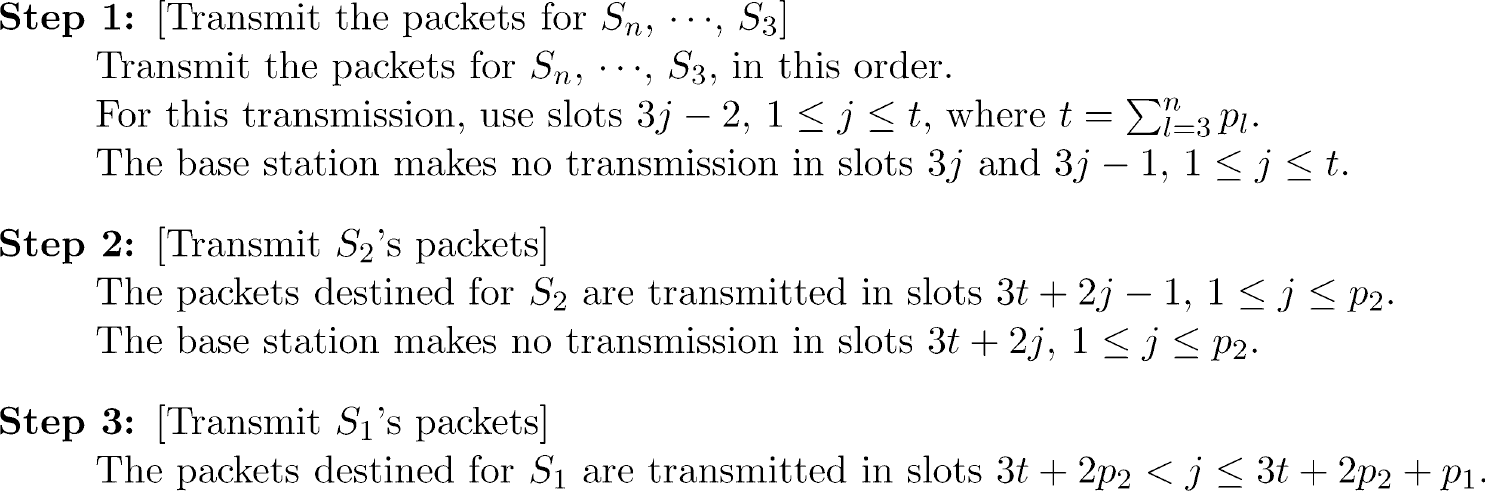
Base-station algorithm of [12] for omnidirectional antennas.
The reliability of a sensor system is enhanced through the use of redundancy. That is, each point or region is monitored by multiple sensors. In a redundant sensor system, we are faced with the problem of fusing or combining the data reported by each of the sensors monitoring a specified point or region. Suppose that k > 1 sensors monitor point p. Let mi, 1 ≤ i ≤ k be the measurement recorded by sensor i for point p. These k measurements may differ because of inherent differences in the k sensors, the relative location of a sensor with respect to p, as well as because one or more sensors is faulty. Let V be the real value for p. The objective of sensor fusion is to take the k measurements, some of which may be faulty, and determine either the correct measurement V or a range in which the correct measurement lies.
The sensor fusion problem is closely related to the Byzantine agreement problem that has been extensively studied in the distributed computing literature [27], [10]. Brooks and Iyengar [2] have proposed a hybrid distributed sensor-fusion algorithm that is a combination of the optimal region algorithm of Marzullo [32] and the fast convergence algorithm proposed by Mahaney and Schneider [30] for the inexact agreement version of the Byzantine generals problem. Let δ i be the accuracy of sensor i. So, as far as sensor i is concerned, the real value at p is m i ± δ i (i.e., the value is in the range [mi – δi, mi + δ i ]). Each sensor needs to compute a range in which the true value lies as well as the expected true value. For this computation, each sensor sends its mi and δ i values to every other sensor. Suppose that sensor i is nonfaulty. Then, every nonfaulty processor receives the correct values of mi and δi. Faulty sensors may receive incorrect values. Similarly, if processor i is faulty, the remaining processors may receive differing values of mi and δi. Figure 12 gives the Brooks–Iyengar hybrid algorithm [2]. This algorithm is executed by every sensor using as data the measurement ranges received from the remaining sensors monitoring point p plus the sensor's own measurement.

Brooks–Iyengar hybrid algorithm to estimate V and range for V.
As an example computation, suppose that four sensors S1, S2, S3, and S4 monitor p, and that the four measurement ranges are [2], [6], [3], [8], [4], [10], and [1], [7]. To perform the computation specified by the Brooks–Iyengar hybrid algorithm, the four sensors communicate their measurement ranges to one another. Assume that S4 is the only faulty sensor. So, sensors S1, S2, and S3 correctly communicate their measurements to one another. However, these sensors may receive differing readings from S4. Likewise, S4 may record different receptions from S1, S2, and S3. Let the S4 measurement received by S1, S2, and S3 be [1], [3], [2], [7], [7], [12], respectively. The V and range computed at each of the four sensors are given in Fig. 13. Note that k = 4, and τ = 1.

Example for Brooks–Iyengar hybrid algorithm.
We reviewed some of the recent advances made in the development of algorithms for wireless sensor networks. This paper has focused on sensor deployment and coverage, routing (specifically, unicast and broadcast), and sensor fusion. Both centralized and distributed localized algorithms have been considered.