




Abstract
The results of a survey of 54 persons with upper limb amputations who anonymously completed a questionnaire on an Internet homepage are presented. The survey ran for four years and the participants were divided into groups of females, males, and children. It was found that the most individuals employ their myoelectric hand prosthesis for 8 hours or more. However, the survey also revealed a high level of dissatisfaction with the weight and the grasping speed of the devices. Activities for which prostheses should be useful were stated to include handicrafts, personal hygiene, using cutlery, operation of electronic and domestic devices, and dressing/undressing. Moreover, additional functions, e.g., a force feedback system, independent movements of the thumb, the index finger, and the wrist, and a better glove material are priorities that were identified by the users as being important improvements the users would like to see in myoelectric prostheses.
Introduction
According to the data published by the Federal Statistical Office in Germany, 22,608 individuals with upper limb deficiency are registered (Statistisches Bundesamt 2006).
In many industrialized countries, an increasing number of patients with upper limb amputation have been fitted with myoelectrical hand prostheses over the last three decades. To investigate the use of prosthetic hands, several surveys have been made in different countries (Atkins et al. 1996; Burger and Marinček 1994; Dudkiewicz et al. 2004; Fraser 1993; Gaine et al. 1997; Kejlaa 1993; Kyberd et al. 1998; Silcox et al. 1993). In addition, factors related to a successful prosthetic hand use were evaluated (Burger and Marinček 1994; Dudkiewicz et al. 2004; Kyberd et al. 1998; Roeschlein and Domholdt 1989, Silcox et al. 1993) and the functional improvements of patients with a proximal upper limb deficiency were assessed (Datta et al. 2004). Finally, the post-amputation type and level of pain were investigated (Dudkiewicz et al. 2004). However, all surveys were accomplished either by interviews at the supplying limb-fitting centre or at the patients' homes (Atkins et al. 1996; Kejlaa 1993) or questionnaires were sent to potential users (Atkins et al. 1996, Burger and Marinček 1994; Kyberd et al. 1998; Datta et al. 2004; Fraser 1993; Roeschlein and Domholdt 1989). In most surveys, the persons to be questioned were pre-selected by the interviewer using different inclusion criteria, e.g., time lapse from amputation to survey, age, last contact with the limb-fitting centre in a certain period or affiliation to the scope of a special limb-fitting centre (that conducts the survey) (Burger Marinček 1994; Datta et al. 2004; Fraser 1993; Kejlaa 1993; Kyberd et al. 1998; Roeschlein and Domholdt 1989; Silcox et al. 1993). Return rates of completed questionnaires by mail typically range from 38% (Atkins et al. 1996) to 69% (Kyberd et al. 1998). Some of the patients who did not respond had broken ties with the facility that supplied the prosthetic hand and little is known about their usage, desires or reasons for non-use. Furthermore, studies that addressed user preferences for prosthetic hand improvements and presented recommendations for future developments (Atkins et al. 1996; Burger and Marinček 1994; Kejlaa 1993; Kyberd et al. 1998) had been conducted several years before new speedy myoelectric hands became available. The aim of the present study was to gain up-to-date information from both prosthetic hand users and non-users about usage of present myoelectric hands as well as critical comments and wishes for the development of new and improved hand prostheses. By providing a questionnaire on an Internet homepage, which can be completed anonymously, information on consumers' concerns was collected and shall be presented below. The presented survey is part of a research project related to an advanced multifunctional prosthetic hand (Pylatiuk et al. 2004), and the results will be incorporated in the design of new prototypes.
Methods
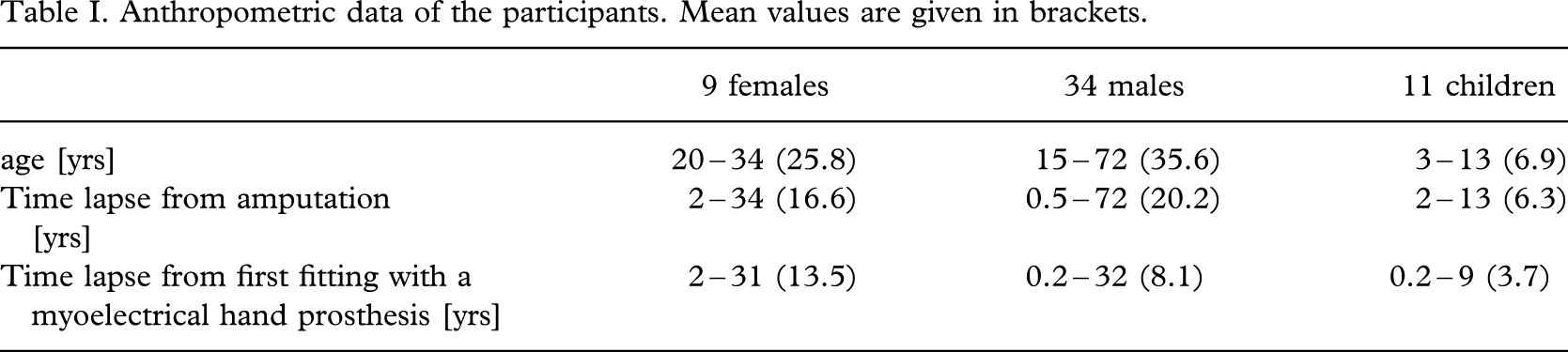
A survey was designed such that German-speaking persons could answer it easily, regardless of technical knowledge, by completing a questionnaire on an Internet homepage. The questions were compiled by the former head of the upper limb section from the limb fitting centre of the Orthopaedic University Hospital Heidelberg, Mr Joachim Frühauf, and the authors. The questions were divided into four sections. First general facts about the age and gender of the user; the date, reason, and level of amputation; and the kind of prosthesis provided. Then, the hours of use of the prosthesis in recreation and work were addressed. The questions of the third section referred to the subjectively perceived noise, weight, and cosmetic appearance of the prosthesis. These questions were based on a Likert-scale format; the respondents could specify their level of agreement with a statement by choosing from a multiple-point scale. For example, the question: “How do you evaluate the weight of your current prosthetic hand/arm?” could either be completed with: (a) acceptable, (b) a little too heavy, or (c) much too heavy. Finally, types of activities for which prostheses should be used were asked for and space was left for comments and requirements for future developments. During a brief pilot phase, the questionnaire was distributed to 10 female and 13 male patients who routinely visited the prosthetic fitting centre at the University Hospital of Heidelberg. Five questions were considered to be imprecise and replaced by modified versions after discussion among the authors. One question on additional functions of an advanced prosthesis was removed to shorten the questionnaire. Afterwards, the survey was accessible for completion on a non-commercial Internet homepage (www.handprothese.de/umfrage.htm) between April 2002 and April 2006. The link to the homepage was presented in several German TV programmes about hand prostheses and can also be found by entering the keyword “Handprothese” into Internet search engines. All questionnaires with a minimum of 50% completed answers were used. All questions were not answered, so the number of responders who answered a specific question is indicated in the results if it was not answered by all the individuals. The responders were divided into groups according to their gender and those who indicated an age of 14 years or less were subsumed into a third group of children. Responses to single Likert items were treated as ordinal data and analysed using a non-parametric test (Mann-Whitney U test) for assessing whether the differences in medians between three sample groups (male, female, and children) were statistically significant. A total of 54 persons answered the questionnaire: 34 males, 9 females, and 11 children (or their parents). The larger number of males and their high ages in this survey reflects both the larger number of males who lose limbs through accidents, and those who have had limbs amputated as a result of warfare. The anthropometric data on age, gender, and time lapses from amputation and first fitting with a myoeletric prosthesis are depicted in Table I.
Anthropometric data of the participants. Mean values are given in brackets.
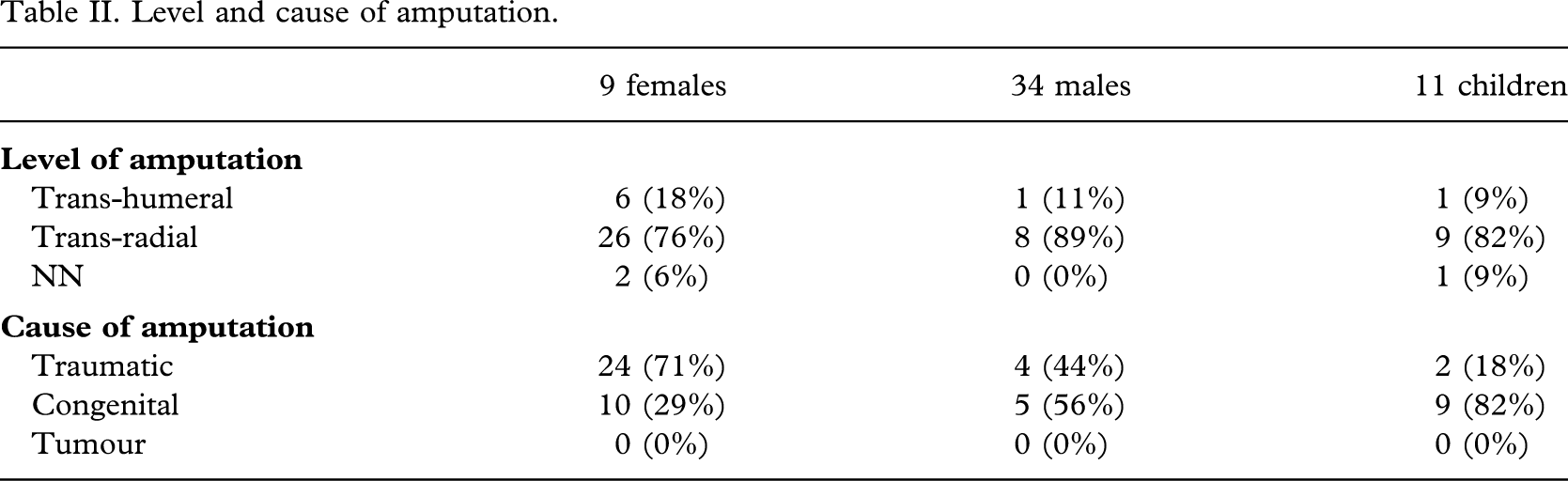
In agreement with other statistics (Atkins et al. 1996; Fraser 1993; Silcox et al. 1993), the number of individuals with trans-radial amputations exceeds that of individuals with trans-humeral amputations (Table II).
Level and cause of amputation
Results
Prosthesis usage
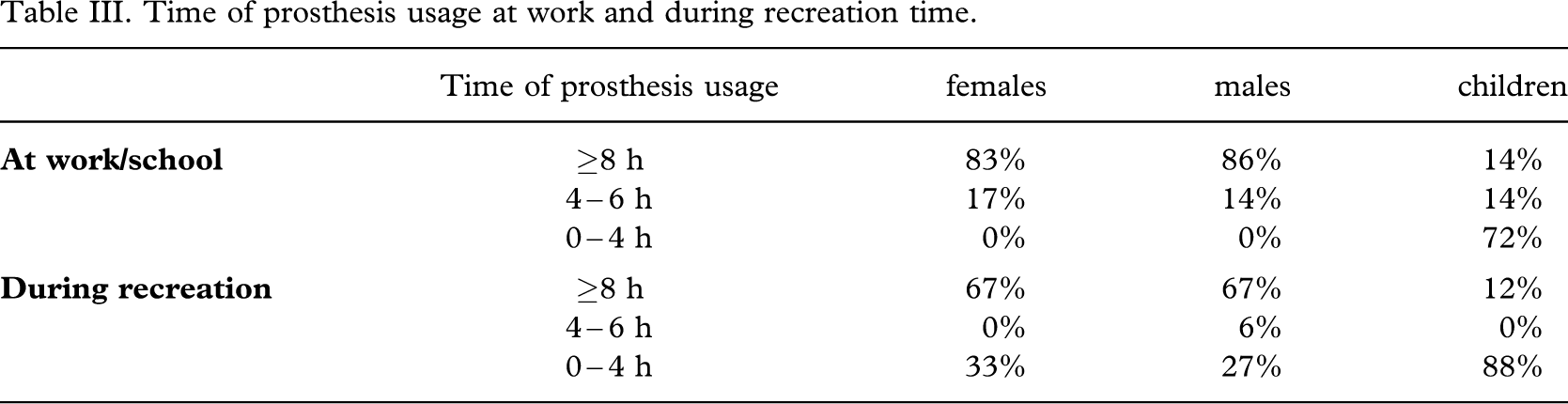
The question “For how many hours do you employ your prosthetic hand at work or at school” was answered by 22 males, 6 females, and 7 children (Table III). Most adult responders use their prosthetic hand at work or at school for at least 8 hours daily; whereas most children use their myoelectric hand for less than 4 hours. Even more persons (33 males, 9 females, and 8 children) answered the question “For how many hours do you employ your prosthetic hand in recreation time” (Table III). The daily time of myoelectric hand usage during recreation is shorter for both the adult and the children group.
Time of prosthesis usage at work and during recreation time
Subjective evaluation
In four questions the individuals were asked to evaluate the appearance and performance of conventional myoelectric prostheses. These questions were completed by 26 males, 4 females, and 7 children and the results are depicted in Figures 1(a – d). Some 77% of the male respondents, every second female, and all children judged the weight of the prosthesis as being a little or much too high (Figure 1a). The answers of the three sample groups (female, male, and children) did not differ significantly, indicated by p > 0.05 obtained from the two-tailed Mann-Whitney U Test. The influence of the level of amputation or the length of the stump on the result of the subjective evaluation of the prosthesis weight has not been analysed, as this item was only answered by every second individual with a trans-humeral amputation. However, of all 33 persons with trans-radial amputation, who answered this question, 7 (21%) accept the weight of their prosthesis, 18 (55%) consider it being a little too heavy, and 8 persons (24%) judge it as being much too high.
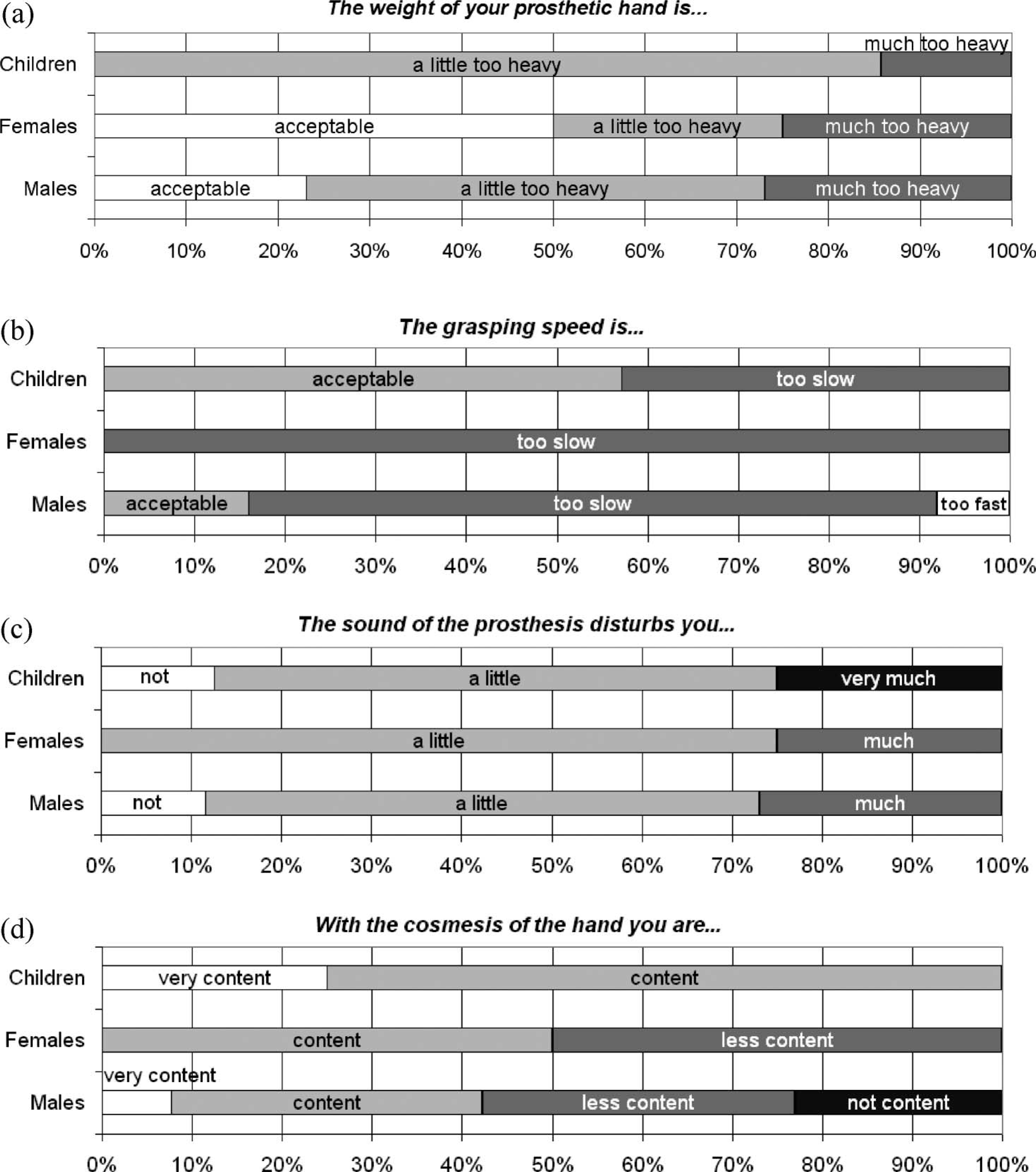
(a – d) Percentage distribution of individuals who answered questions on their prosthesis weight, noise level, cosmetic appearance or grasping speed.
All females, 76% of the male respondents, and every second child assessed the grasping speed of their electrically driven hand as being too slow. Two males (8%) rated the grasping speed as “too fast”. Again, the answers of the three sample groups did not differ significantly.
Only 13% of the children and 12% of the males rated the sound of the myoelectric prosthesis not a nuisance. At least one quarter of every group, however, felt much distracted by the sound. No significant difference of the percentage distribution between the three sample groups was found.
The highest degree of content was found with the cosmetic appearance of the prosthesis. Every second female respondent was less content and 58% of the males were “less content” or “not content” with the cosmesis of their prosthetic hand. The answers given by the group of children differed significantly (p < 0.05) from those of the two other groups and presented the highest degree of content with the cosmesis.
Activities
The question “which of the following activities would you like to perform with your prosthesis?” was aimed at gaining greater insight into the types of activities for which prostheses should be useful. The results of the respondents are depicted in Figure 2. Females most frequently chose “Handicrafts” (89%), followed by “Personal hygiene”, “Using cutlery”, and “Operation of electronic and domestic devices” (each 78%). Males favoured “Using cutlery” (76%), followed by “Handicrafts” and “Opening and closing a door” (71% each). Children wanted their prosthetic hand to be useful in “Personal hygiene”, “Using cutlery”, and “Dressing and undressing” (83% each). In all three groups “writing with the prosthesis” always was the least wanted activity.
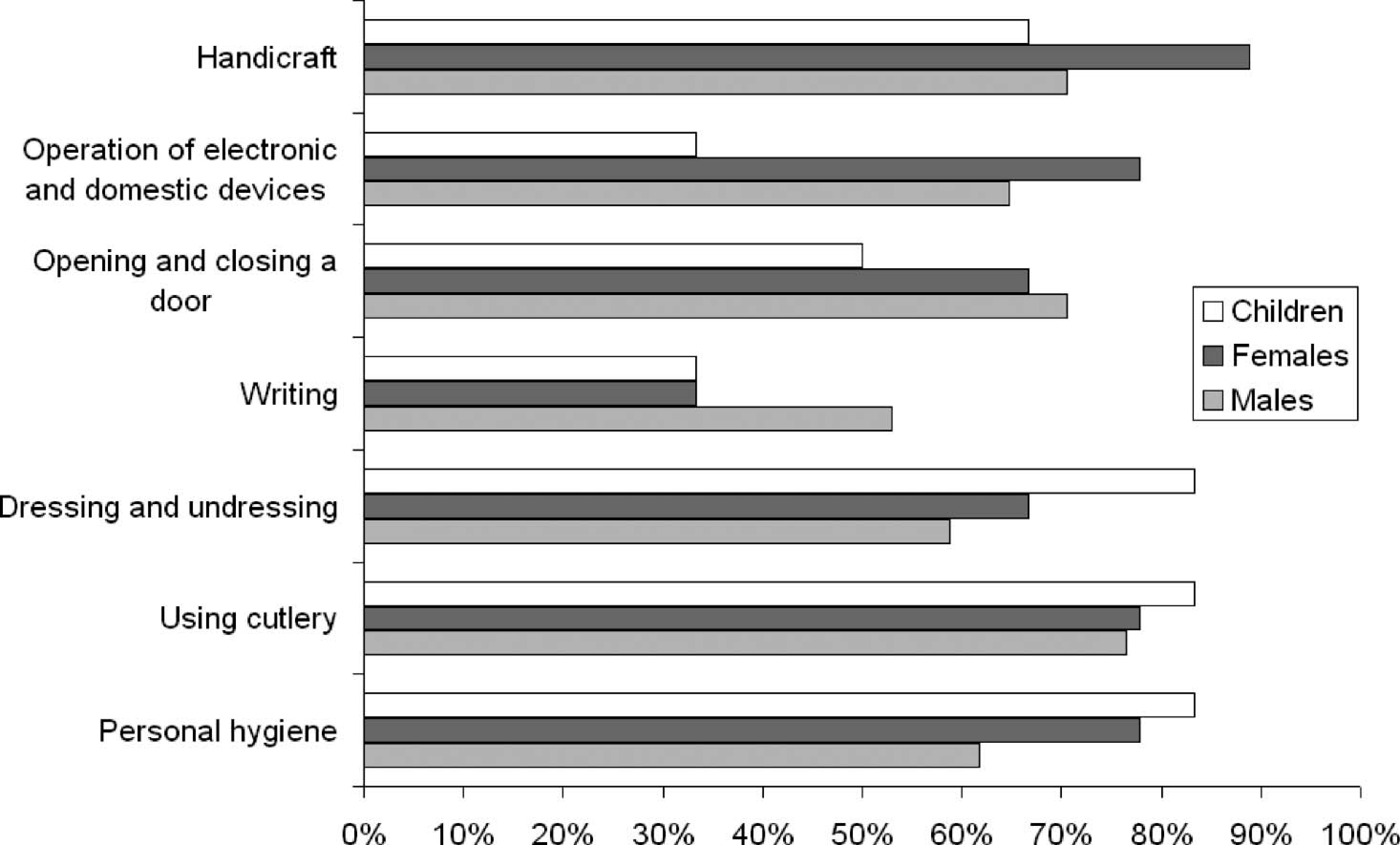
Types of activities for which prostheses should be useful, indicated by percentage of respondents.
Additional functions
The questions concerning additional functions desired for future prosthetic hand developments were answered by 22 males, 4 females, and 7 children. The most wanted feature is to feel the force the artificial hand is grasping with, this answer being given by 100% of all children and 95% of all male adults, whereas it was only wanted by half of the females (Figure 3). Feeling the temperature with the prosthesis was wanted by 63% of the male adult individuals, 71% of the children, and by only one female.
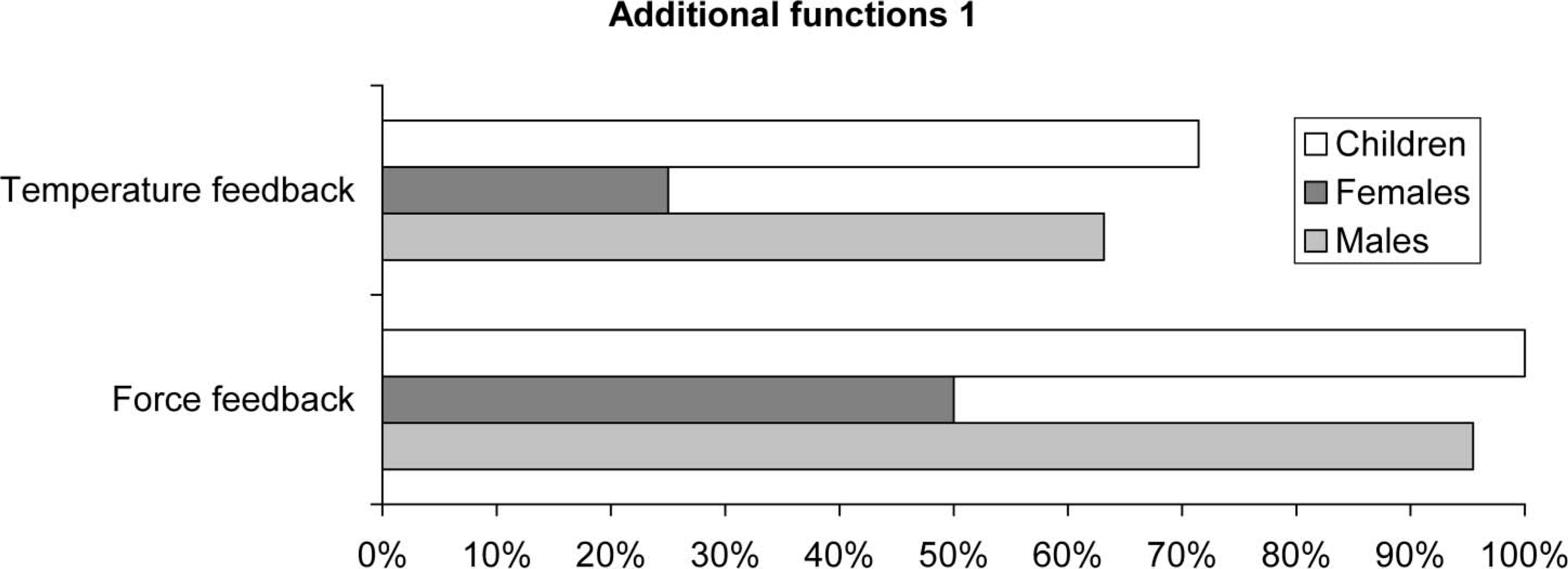
Percentage of individuals that wanted force feedback or temperature feedback in a prosthetic hand.
In a pilot study of the present survey ten individuals with an upper limb deficiency were asked for additional hand movements or features they wanted for future prosthetic hand developments. All respondents wanted to point with the extended index finger, 90% would like to move individual fingers, and 70% rated wrist flexion and extension movements to be useful (Figure 4).
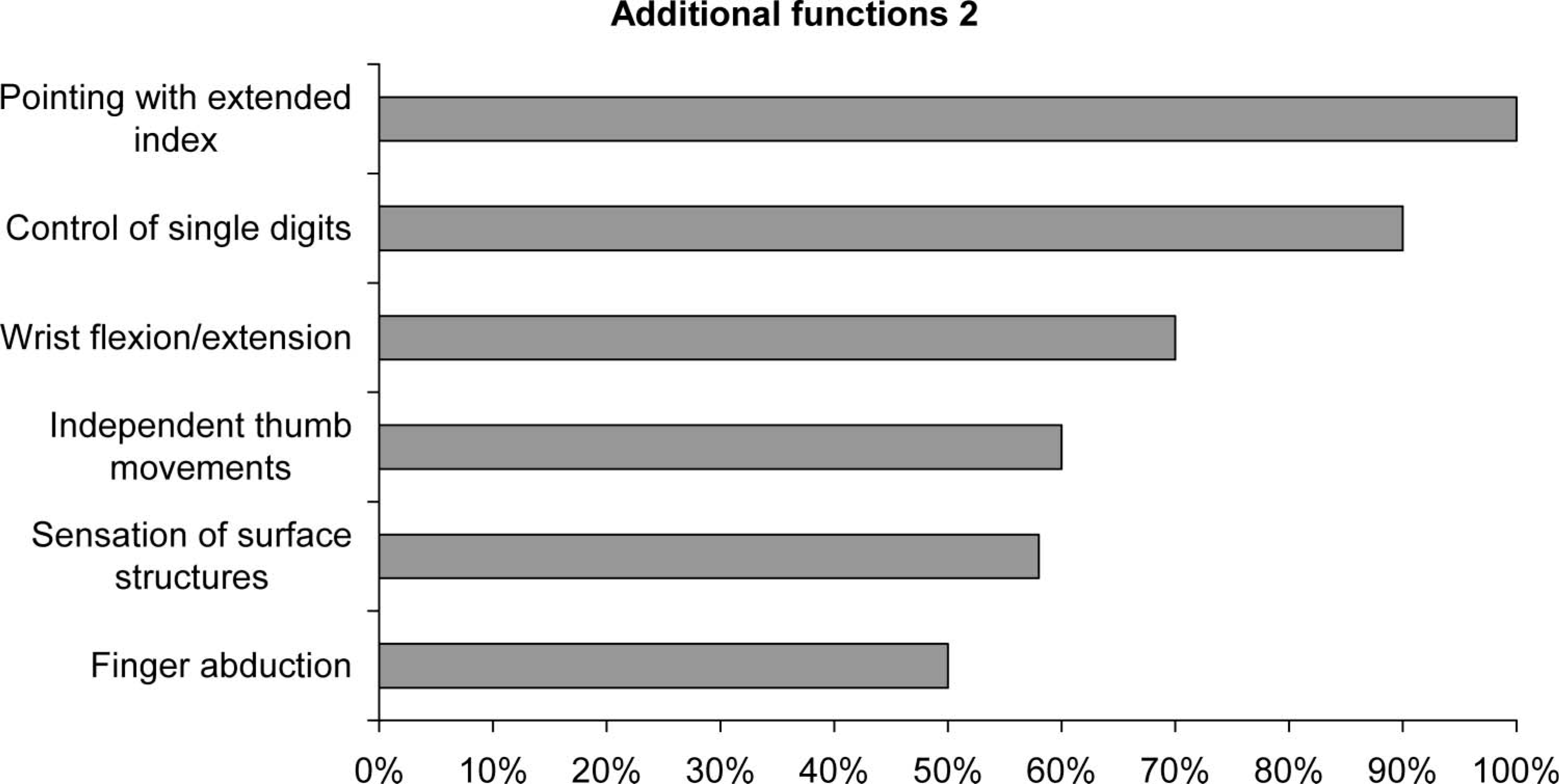
Different additional hand movements or features that were wanted by individuals. Note: This question was part of the pilot study only and therefore answered by ten individuals.
User concerns and suggestions
Several individuals would like to attract less attention with their prosthetic hand and be more independent and self-supporting. One positive comment welcomed that the back is relieved when riding a bicycle. In contrast to this, the most frequently mentioned consumer's criticism that should be considered when designing an advanced prosthetic hand concerns the glove material which should be more resistant to dirt and easier to clean. Several users complained about the weight of the prosthesis being much too high and resulting in back pain. Others wish for a sensory feedback that enhances the control so that less visual control is required to operate the hand. Two respondents complained about the electrodes being too sensitive to interference. Several individuals would like to move a single digit of the prosthesis, in particular to operate a computer keyboard, and others prefer flexion and extension movements of the wrist.
Discussion
Although the method of questioning presented differs significantly from other surveys, a comparison of the patient groups and the results reveals consistencies: the majority of adult respondents reported a traumatic cause of upper limb amputation, whereas most children had a congenital limb deficiency. However, a slight imbalance of females with traumatic upper limb amputation was found. The bias towards the male population participating in the survey agrees with other studies. In the present study, however, the results obtained from both genders are not summarized in one group, but displayed separately, and the results from children are also included. Corresponding with the findings of (Fraser 1993; Kyberd et al. 1998; Silcox et al. 1993) it can be confirmed that, if a prosthetic hand is employed, the majority of patients wear and utilize it for 8 hours or more on an average working day. During recreation, the average time of prosthesis usage decreases, which tallies with the data published by (Kyberd et al. 1998; Silcox et al. 1993). Nevertheless, the rate of prosthesis usage is difficult to measure (Fraser 1993) and wearing a prosthesis does not imply using the device for grasping and holding, as shown in a study from Slovenia (Burger and Marinček 1994), where 70% of the assessed limb-deficient persons wear a prosthesis only for attaining a better cosmesis. As a result, (Roeschlein and Domholdt 1989) proposed a category of “partially successful users” for those who wear and use their prosthetic hands just occasionally.
The patient group in the present study, however, differs from those of other surveys as far as the major level of amputation is concerned. The rate of individuals that are amputated at a trans-radial level and fitted with a myoelectric hand prosthesis is higher than in comparative surveys, where rates range from 29% (Dudkiewicz et al. 2004) to 69% (Silcox et al. 1993). As accurate data about national upper limb prosthetic fitting statistics are lacking, it can be hypothesized that in Germany a higher rate of individuals with trans-radial amputation were fitted with myoelectric prostheses than in other countries. The need for a force feedback system integrated in an externally powered prosthetic hand is supported by the high rate of respondents wanting this feature, whereas temperature sensing and surface sensation are second-order requirements. The capability of feeling the grasping force with a prosthetic hand can help decrease the degree of visual attention that is required to control grasping with a prosthesis. Other priorities that were identified by the users to be most important for an improvement of prosthetic hands concern the weight, grasping speed, and the cosmetic appearance of the device. All children and 73% of all adult individuals complained about the prosthesis weight being too heavy, which agrees very well with the major reasons found by Silcox et al. (1993) for non-use of myoelectric prostheses. As a result the use of lightweight materials and components should be considered when designing innovative prosthetic hands. In line with the results published by Atkins et al. (1996), Kejlaa (1993), and Silcox et al. (1993), it was also found that speed, additional wrist movements, better gloving material, and better reliability of the electrodes are important issues to be raised when designing a new prosthetic hand. All these features were realised most recently in new components for upper limb prosthetic fitting and further evaluation is required to validate consumers' concerns.
Limits of the survey
The advantage of the present survey to be answered anonymously also limits the results, as there is no certainty that only limb-deficient persons have completed the questionnaire. However, there is no evidence of manipulation that might be indicated by a certain repeated pattern of answering questions. Additionally, a revised survey should include a question for the exact type of myoelectrical prosthesis that is used. In the last few years, fast-acting myoelectric hand prostheses have become available and an increasing number of persons in Germany were fitted with them. The results of the present survey indicate that a higher grasping speed is wanted by most prosthesis users. This grasping speed of the prosthesis should be considered in a revised survey when analysing the degree of contentment with this feature.
Conclusions
Several recommendations for future externally powered prosthetic hand designs can be derived from the answers given in the survey. The results can be summarized as follows:
Activities for which prostheses should be useful include: Handicrafts, personal hygiene, using cutlery, operation of electronic and domestic devices, and dressing/undressing. If a prosthetic hand is worn, it is used for 8 hours or more. It was found that light weight, easiness of cleaning, and additional functions, such as force feedback and independent movements of the thumb, the index finger, and the wrist, were highlighted as priorities for the design of new externally powered prosthetic hands. Consistencies were found with the results of previous studies, although fast-acting myoelectric hands have been made available in the meantime.
It is recommended these consumers' concerns and preferences are considered in the design of improved prosthetic hands.