




Abstract
Study Design
Literature review.
Objective
To identify and analyze the top 100 cited articles in cervical spine surgery.
Methods
The Thomson Reuters Web of Knowledge was searched for citations of all articles relevant to cervical spine surgery. The number of citations, authorship, year of publication, journal of publication, country of publication, and institution were recorded for each article.
Results
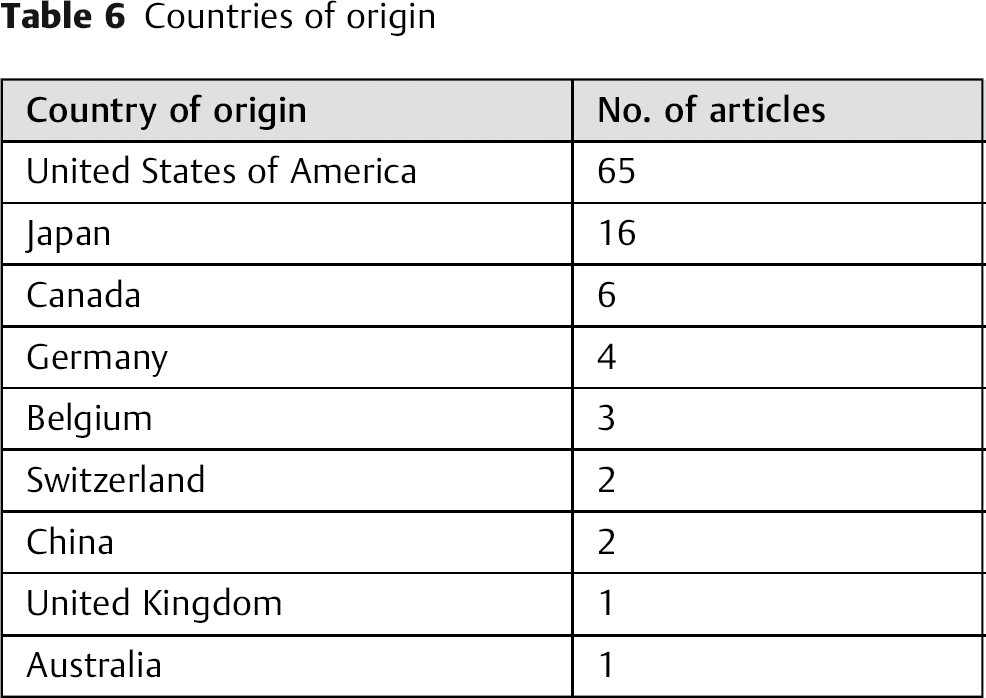
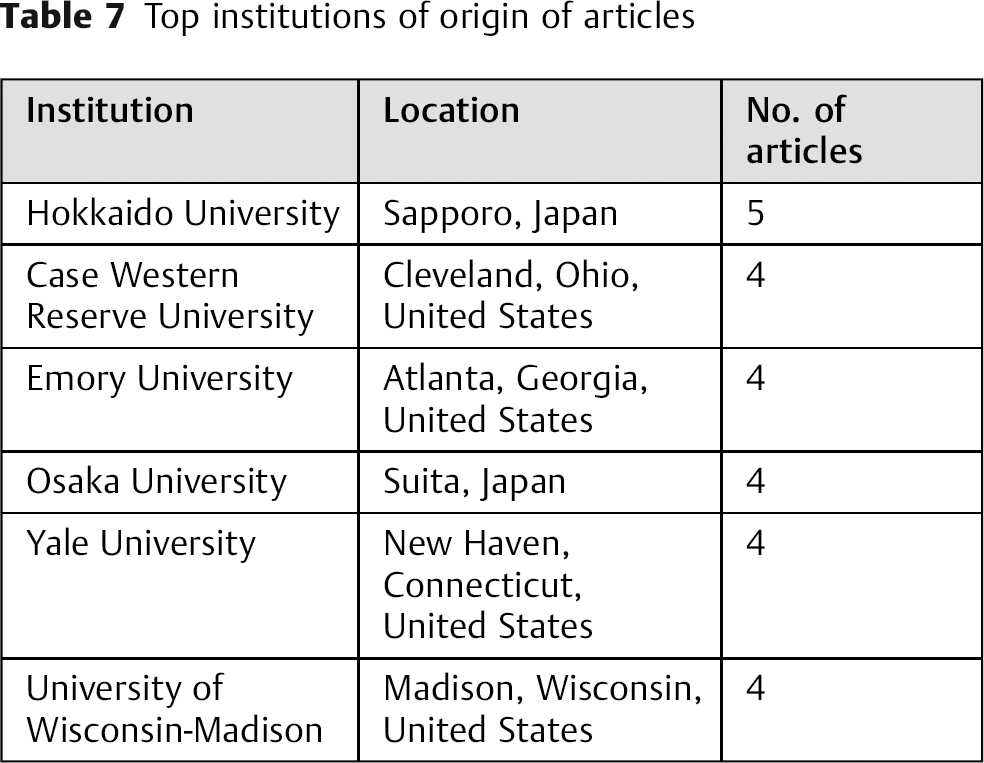
The most cited article was the classic from 1991 by Vernon and Mior that described the Neck Disability Index. The second most cited was Smith's 1958 article describing the anterior cervical diskectomy and fusion procedure. The third most cited article was Hilibrand's 1999 publication evaluating the incidence, prevalence, and radiographic progression of symptomatic adjacent segment disease following anterior cervical arthrodesis. The majority of the articles originated in the United States (65), and most were published in Spine (39). Most articles were published in the 1990s (34), and the three most common topics were cervical fusion (17), surgical complications (9), and biomechanics (9), respectively. Author Abumi had four articles in the top 100 list, and authors Goffin, Panjabi, and Hadley had three each. The Department of Orthopaedic Surgery at Hokkaido University in Sapporo, Japan, had five articles in the top 100 list.
Conclusion
This report identifies the top 100 articles in cervical spine surgery and acknowledges those individuals who have contributed the most to the advancement of the study of the cervical spine and the body of knowledge used to guide evidence-based clinical decision making in cervical spine surgery today.
Introduction
Cervical spine surgery is a rapidly evolving and challenging subspecialty that owes its advancements to many individuals and their pioneering works that have shaped the way we practice modern cervical spine surgery today. One way to distinguish and honor these individuals is by recognizing the impact of their scientific publications. This study is the first to analyze and quantify the most highly cited articles in cervical spine surgery and to measure their impact on the entire cervical spine literature.
A citation acknowledges the relevance given by the author to the work of others on a topic of interest in which the citation appears. 1 The primary goal of a citation is to credit an author on the work, which they have previously published. The greater the number of citations an author has, the more esteemed that author becomes in their particular field of practice. Citation analysis is used to determine the relative importance of medical journals by means of the impact factor, which is determined from the ratio of the number of citations in the current year to articles published in the journal in the 2 preceding years, divided by the number of citable items published in the same 2 years. 2 , 3 , 4 The impact factor has emerged as the marker of the quality and rank of a journal.
A recent publication identified the most cited articles related to the care of spine patients, recognizing the historical advances of this field and allowing for insights into the types of articles that have provided these advances. 5
The goal of this study is to identify the top 100 articles relevant to cervical spine surgery published in surgical and non-surgery-related journals through an extensive search of the literature using methods validated in other similar, previously published studies. 6 , 7 , 8 , 9 , 10 , 11
Methods
The Thomson Reuters Web of Knowledge, a research platform that provides bibliographic database services, was used to search for citations of all articles from 1900 to 2014 relevant to the cervical spine and published in surgical and nonsurgical journals. The decision on which journals to search was made with the use of Thomson Reuters Journal Citation Report database, which ranks journals according to impact factor.
The search limits and sorting options in the Thomson Reuters Web of Knowledge were used to rank all articles from each journal according to the number of citations. The results were then carefully reviewed and only those relevant to cervical spine surgery were selected. The 100 articles that matched the search criteria were then further analyzed, and the title, first author, journal, year of publication, number of citations, and country and institution of origin were recorded.
Results
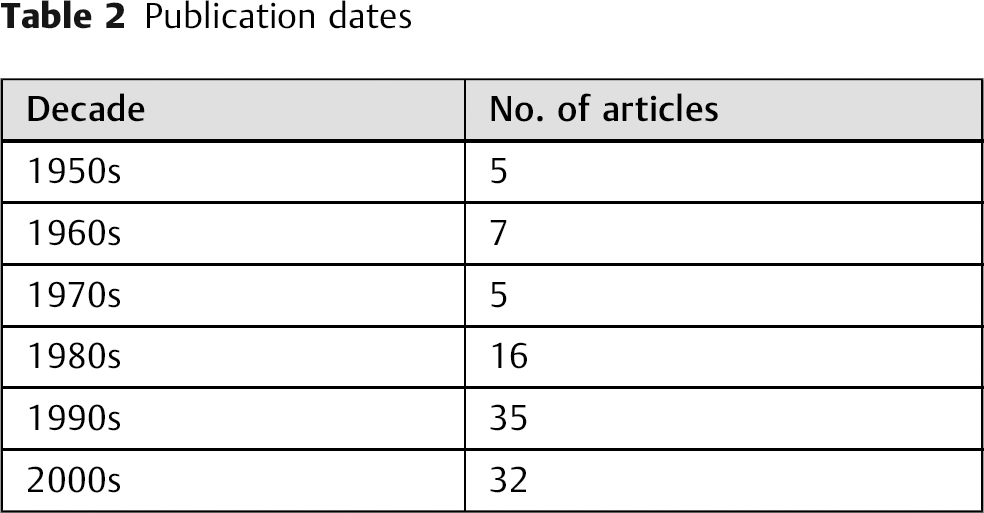
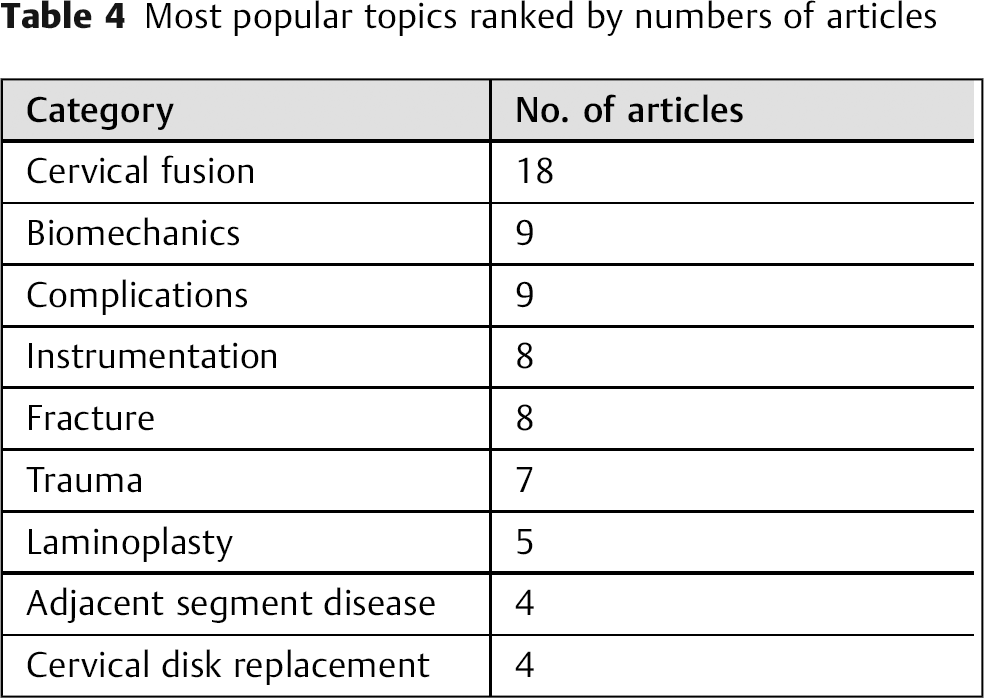
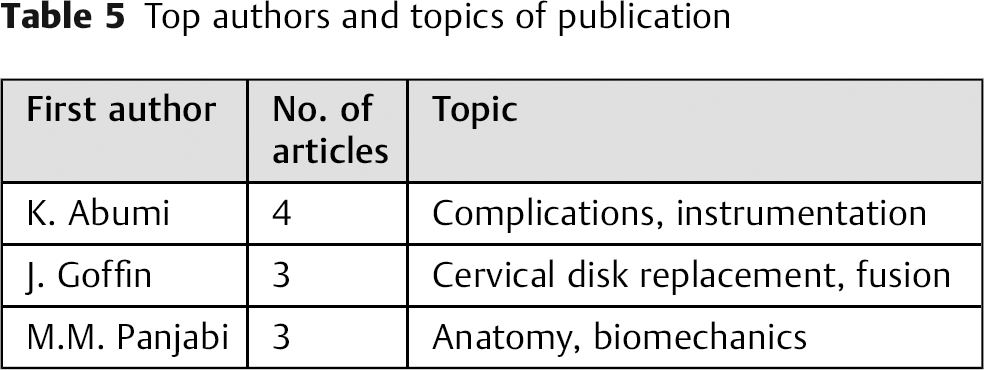
A total of 40,315 articles matched the search criteria. Of those, 409 were cited 100 times or more. The top 100 articles, their references, category, and corresponding number of citations are shown in Table 1. The top article was cited 826 times; the 100th article, 133 times; and the mean number of citations for the top 100 articles was 203.6. The oldest article was by Rogers, 12 published in 1957. The newest article was published in 2009 by Murrey et al. 13 Eighty-three percent of the top 100 cited articles were published after 1980, with the 1990s producing the largest number of highly cited articles (35%; Table 2). The top 100 articles were published in 18 journals, with the top three journals publishing 72% of the articles (Table 3). The top journal was Spine with 39 articles followed by the Journal of Bone and Joint Surgery American Volume with 20 articles and the Journal of Neurosurgery with 13 articles. The three most popular categories were cervical spinal fusion with 17 articles, surgical complications with 9 articles, and biomechanics of the cervical spine with 9 articles (Table 4). Eighty-six first authors contributed to the top 100 articles. Only three authors were credited with three or more publications and only one author, Abumi, had four publications in the top 100 (Table 5). The top articles originated from nine different countries, with the United States (65%) being the most prolific (Table 6). There were 61 institutions responsible for the top-cited articles with Hokkaido University in Sapporo, Japan contributing the most articles with five publications in the top 100 (Table 7).
The top 100 articles in cervical spine surgery

Publication dates
Top journals of publication
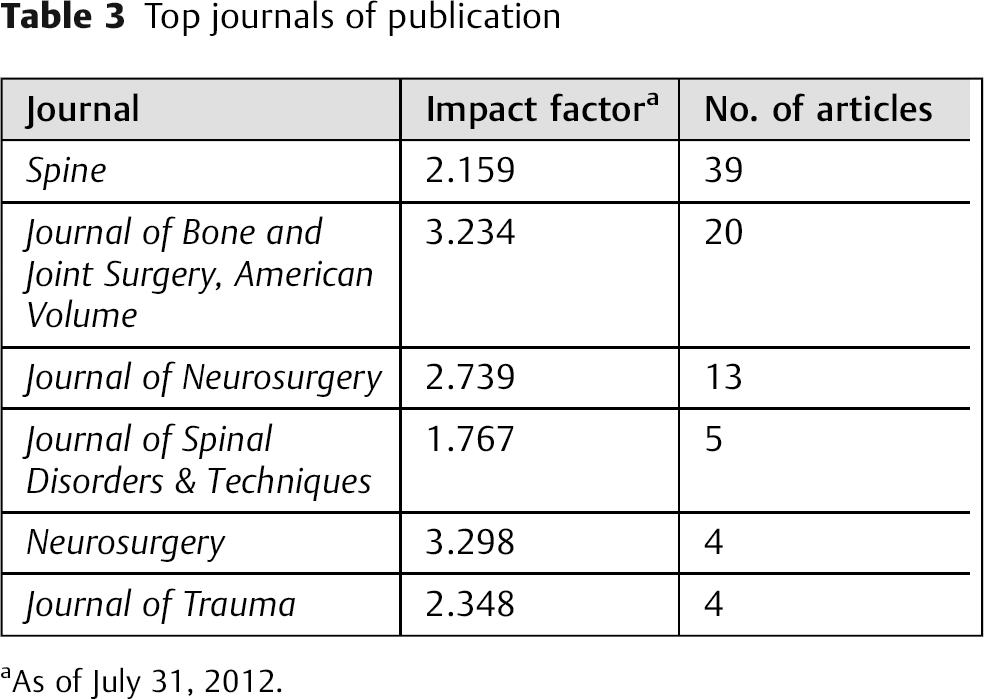
As of July 31, 2012.
Most popular topics ranked by numbers of articles
Top authors and topics of publication
Countries of origin
Top institutions of origin of articles
Discussion
This study identifies the authors and topics that made the greatest impact in the field of cervical spine surgery over the course of the last century and the beginning of this century. Through the identification of these classic works, we gain an insight into the history, development, and current trends in cervical spine surgery. The findings of this study identify the articles responsible for the most important developments in this field.
The most cited article in cervical spine surgery is the classic 1991 work by Vernon and Mior describing the Neck Disability Index (NDI), 14 a patient-reported outcome measure designed to evaluate neck-specific disability. The NDI is a modification of the Oswestry Low Back Pain Disability Index. It is a patient-completed, condition-specific functional status questionnaire with 10 items concerning pain and activities of daily living including personal care, reading, lifting, headache, concentration, sleeping, work status, driving, and recreation. 15 The NDI has been translated into over 22 languages and is reliable, valid, and responsive in many patient populations including patients with acute and chronic conditions, as well as those suffering from neck pain associated with musculoskeletal dysfunction, whiplash-associated disorders, and cervical radiculopathy. 16
The second most cited article was from 1958 by Smith and Robinson, 17 describing a surgical procedure for the removal of cervical intervertebral disks and for fusion of the cervical spine by the anterior approach. This article also outlined the indications for this procedure and reported the results from their first 14 patients. Smith and Robinson's procedure is known today as the anterior cervical diskectomy and fusion (ACDF), the current standard of care for patients with cervical spondylotic radiculopathy or myelopathy. Twenty-five of the top 100 articles described various aspects of the ACDF including indications, complications, technique, and outcomes.
The third most cited article was the 1999 work of Hilibrand et al, 18 describing the incidence, prevalence, and radiographic progression of symptomatic adjacent segment disease, defined as the development of new radiculopathy or myelopathy referable to a motion segment adjacent to the site of a previous anterior arthrodesis of the cervical spine. In their work, the authors opined that the risk of adjacent segment disease following cervical arthrodesis is related to the natural history of cervical spondylosis rather than to failure of the operative technique and that it is probably unaffected by the operative management. This topic has been controversial and of great debate with over 200 published articles in the literature and four articles in the top 100 list. 18 , 19 , 20 , 21
Cervical spinal fusion was the most popular topic in the top 100 articles with a total of 18 works dedicated to it. Of those, seven studies involved the atlantoaxial cervical spine and eleven studies involved the subaxial cervical spine. The most important subaxial cervical spine fusion study is the previously mentioned description of the ACDF by Smith and Robinson. Clinical results and long-term outcomes after the ACDF account for six of the top 100 cervical spine articles and outline the impact ACDF has had in cervical spine surgery. 22 , 23 , 24 , 25 , 26 , 27 Of the seven studies describing fusion of the atlantoaxial spine, the most impactful was the fourth most cited article in the top 100 by Harms and Melcher describing a novel technique of atlantoaxial stabilization using C1 lateral mass screws with C2 pedicle screws, 28 known today as the Goel or Harms technique. 29 , 30 The 26th most cited article, published in 1992, described the indications, techniques and results of posterior C1–C2 fusion in unstable odontoid fractures. 31 Coyne et al described the long-term results and efficacy of C1–C2 posterior cervical fusion. 32
The cervical spine is a complex three-dimensional structure with unique kinematic properties. The understanding of the normal biomechanical properties of the cervical spine is of utmost importance for evaluating clinical cases of cervical instability, which may require surgical intervention. The importance of this topic has made it the second most popular topic in the top 100 list. The 70th study on the list of top 100 was by Panjabi et al, 33 evaluating the mechanical properties of the human cervical spine in 16 human cadaveric specimens. This study revealed that the greatest degree of flexion occurred at C1–C2 (12.3 degrees), whereas the greatest degree of extension was observed at C0–C1 (20.2 degrees), and that with axial moment loading, rotation at C1–C2 was the largest (56.7 degrees). Four studies in the top 100 list examined the biomechanical stability of various anterior and posterior cervical spine fixation techniques. 34 , 35 , 36 , 37
The third most common topic published in the top 100 cervical spine articles was surgical complications. As in every surgical specialty, complications and their avoidance remain an important topic of discussion and research.
Modern advances in technology and surgical instrumentation have allowed for the introduction of novel surgical devices and techniques. A small number of these devices and techniques can have profound and sometimes long-lasting impact in their respective fields. Cervical laminoplasty, a motion-sparing posterior cervical technique for the treatment of myelopathy, was developed in 1977 and first described by Hirabayashi et al. 38 This unique technique has given the spine surgeon an alternative to the posterior arthrodesis procedure, a topic with five articles in the top 100 list. In hopes to eliminate the incidence of adjacent-level disease following anterior cervical arthrodesis, in 2007, the first cervical artificial disk device was approved for use by the United States Food and Drug Administration (FDA). Although it is too early to conclude on the long-term impact of this technology in cervical spine surgery, it has been the topic of intense research as evidenced by the presence of five articles in the top 100 list. 38 , 39 , 40 , 41 , 42
The oldest article, by Rogers, 12 was published in 1957 and described the management of acute fractures and dislocations of the cervical spine. The most recent article, published in 2009, was by Murrey et al, 13 and it described the results of the prospective, randomized, controlled, multicenter, FDA investigational device exemption study of the ProDisc-C (DePuy Synthes, Raynham, Massachusetts, United States) total disk replacement versus ACDF for the treatment of one-level symptomatic cervical disk disease. The 100th article on the list is by Hukuda et al, 43 comparing the results of anterior and posterior procedures for the treatment of cervical spondylotic myelopathy.
Of the top-cited articles, 17 were published before 1980. Previous articles have suggested that the older an article is, the more likely it is that it would be cited. However, this idea may not be completely true as one of the more important problems of this type of analysis is the phenomenon of “obliteration by incorporation.” This phenomenon describes the process whereby data from truly classic articles becomes cited less frequently as it is absorbed into the body of current knowledge. Some of the truly classic articles can sometimes be found referenced in top-cited articles.
In this study, the journal Spine produced the largest number of articles in the top 100 list. It must be noted that when evaluating contributions by various journals, those journals with bimonthly publications and those that have been in circulation for the longest time have more chance of being cited by other authors. Another limitation to this study is the inability to assess the true lead author of each article. For this reason, the first author was assumed to be the primary contributor to the work, and so the first author was used to create the ranking of authors according to the number of publications. A final limitation to this study is the problem of incomplete citing, which is described as the erroneous manner in which some citations are made in an effort to convince or persuade the readership of that particular journal, instead of giving credit to those who most significantly influenced the work.
Conclusion
To our knowledge, this study is the first to identify the top 100 classic articles in cervical spine surgery. This study gives a unique insight into the development and trends of this challenging subspecialty within spine surgery in the 20th and early 21st centuries. This work identifies those individuals who have made the greatest contributions to the ever-growing body of knowledge that guides everyday clinical decision making in the field of cervical spine surgery. Furthermore, the classic articles identified in this study are the ones that have had the most impact, and as such, will be the most remembered.
Disclosures
Branko Skovrlj, none
Jeremy Steinberger, none
Javier Z. Guzman, none
Samuel C. Overley, none
Sheeraz A. Qureshi, Consultancy: Medtronic, Orthofix, Stryker, Zimmer; Grant: CSRS; Royalties: Zimmer
John M. Caridi, Personal fees: Stryker, Zimmer
Samuel K. Cho, Grant: OREF; Consultancy: Stryker