






Abstract
The study is aimed to ascertain whether the Helicobacter pylori (Hp) infection is responsible for the vulnerability to oxidative stress observed in migraineurs. Hp sero-logical positivity was assessed by ELISA evaluation of specific IgA and IgG antibodies in 30 subjects (11 males and 19 females) suffering from migraine without aura during the headache-free period. The Hp infection was detected in 16.7% of migraineurs. Plasma accumulation of peroxidative substances (TBA-RS), an index of systemic oxidative status, was increased in migraineurs without Hp infection with respect to controls (P< 0.001), while no significant differences of TBA-RS were found in migraineurs with or without Hp infection. Unmodified values of plasma nitrite/nitrate concentrations, expression of systemic nitric oxide (NO), were obtained in migraineurs in comparison to controls indicating that Hp infection does not modify the plasma oxidative status and the systemic NO bioavailability of migraineurs. In conclusion, our results do not support any specific correlation between Hp infection and migraine.
Introduction
Helicobacter pylori (Hp), a Gram-negative spiral and microaerophil bacterium that lives in the deep mucous layer of the gastric epithelium and exhibits a complex system of enzymes, is involved in colonization, host epithelium damage, and provision of essential substances (1, 2).
Approximately half of the world population is infected by Hp; socioeconomic factors determine the acquisition of the infection; the Hp prevalence in asymptomatic patients appears to be age-related (3, 4). The Hp chronic infection represents a main aetiological factor of gastritis with a possible key role in the development of peptic ulcer and gastric cancer (4, 5). Moreover, an increased risk of extradigestive vascular disorders associated with Hp infection has been described; this relationship, which may be causal, is due to the release of substances with vasoactive and proinflammatory activity (6–10).
More recently, it has been suggested a pathogenic role of the Hp chronic infection in migraine, based on a relationship between the host immune response against the bacterium and the chronic release of vasoactive substances (11). During the infection, the bacterium releases in the infected tissue toxins and hydrolytic enzymes promoting the peculiar cascade of events associated to the host immune response (12, 13), inducing alterations of vascular permeability as a result of released vasoactive substances (3); superoxide radicals and nitric oxide (NO) are also produced (14–16). As a consequence, lipids, proteins, and other cellular components undergo oxidative modifications. The resulting oxidative damage may be assessed as an accumulation of lipid peroxidation by-products in the blood (17).
Therefore, the prolonged oxidative injury caused by the persistent infection and the release of vasoactive substances, might be involved in regional cerebral blood flow changes during migraine.
In this study we attempted to assess whether the Hp chronic infection may enhance the release and the production of oxygen free radicals and NO, causing the increased vulnerability to oxidative stress of migraine sufferers (18–21). For this purpose, we evaluated in migraine sufferers, with and without Hp infection, plasma amount of stable metabolites of NO and lipid peroxidation by-products as markers of oxidative stress.
Methods
Thirty subjects suffering from migraine without aura were examined during the headache-free period. Migraine without aura was diagnosed according to the Headache Classification Committee criteria of the International Headache Society (IHS) (22). No subject was affected by cardiovascular disease or gastric-related symptoms such as pyrosis, dyspepsia, and epigastric pain. Thirty subjects without migraine and without Hp infection were selected as controls. Migraineurs and controls did not take any medication, including specific antibiotic treatment that might influence plasma lipid peroxidation by-products or plasma nitric oxide metabolism, in the month preceding recruitment. Besides, all participants were carefully instructed to avoid any nitrite/nitrate enriched diet for at least 4 days before assessment (23). The purpose of the study was explained to all the participants, who gave informed written consent.
The Hp infection was diagnosed by means of specific serological determinations of the IgA and IgG anti-Hp antibody titre (ELISA) (24). Blood samples, obtained through venipuncture, anticoagulated with sodium-citrate 3.8%, were centrifuged at 1000× g for 15 min to obtain plasma samples, used for the evaluation of plasma lipid peroxidation and nitric oxide metabolites.
Plasma lipid peroxidation
Lipid peroxidation was measured in the plasma using the thiobarbituric acid assay which detects thiobarbituric acid reactive substances (TBA-RS) generated by peroxidative process, including lipid peroxides and malondialdehyde. Plasma samples were treated with an excess of ethanolic butylated hydroxytoluene (BHT) in order to stabilize lipid peroxidation by-products (25). Determination of TBA-RS was carried out fluorimetrically (excitation wavelength 510 nm, emission wavelength 553 nm); the evaluation was made using a standard curve obtained by a stock solution of 10 m
Plasma nitric oxide stable metabolites
Determination of plasma levels of nitrite and nitrate provides a useful method to quantify systemic nitric oxide (NO) amount. Plasma samples were ultrafiltered (Ultrafree MC microcentrifuge device, Millipore Corp., Bedford, MA) at 14 000 rpm for 15 min, to remove substances larger than 10 kD. Nitrate was reduced to nitrite by the action of nitrate reductase from Aspergillus niger (26). Nitrite, the stable end-product, was measured by a sensitive fluorimetric assay based on the reaction of nitrite with 2,3-diaminonaphthalene to form the fluorescent product 1-(H)-naphthotriazole (27). Intensity of the fluorescent signal of the sample was measured (excitation wavelength 375 nm, emission wavelength 415 nm) and compared with known concentrations of sodium nitrite.
Statistical analysis
Data are given as means±SD of TBA-RS and NO stable metabolites. Student's unpaired t-test was used to determine the statistical significance of differences. Statistical significance was accepted if P< 0.05.
We compared TBA-RS and NO stable metabolites in migraineurs without Hp infection and controls, and in migraineurs with and without Hp infection.
Results
The 30 migraineurs, 11 males and 19 females (mean age 38.9 ± 12.3 years) were sex and age-matched with 30 healthy subjects (mean age 39.7 ± 12.8 years). No difference in frequency, intensity, and duration of the migraine attack was evident in migraineurs. A previous Hp infection was found only in 5 migraineurs (16.7%) and in none of the control subjects.
As shown in Fig. 1, the group of migraineurs without Hp infection was characterized by an increase (P < 0.01) of the plasma oxidative by-products (58.9 ± 18.5 pmoles/ml) when compared with controls (23.7 ± 15.0 pmoles/ml).
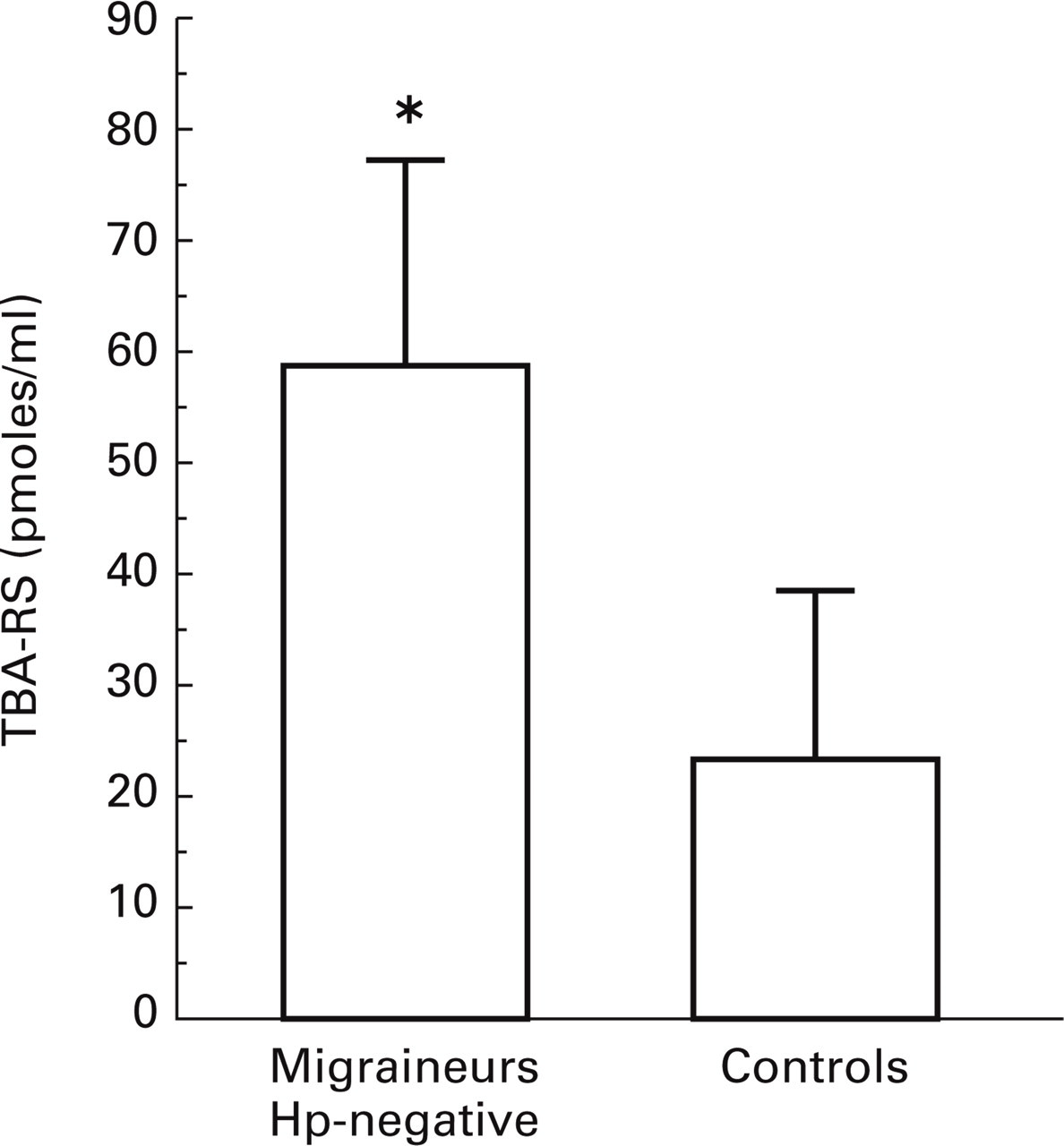
Mean values±SD of thiobarbituric acid reactive substances (TBA-RS) (pmoles/ml) as an index of oxidative stress in migraineurs without Hp infection and in controls (∗P< 0.001 vs. control values).
No relevant differences on TBA-RS levels were observed between migraineurs with (n=5) or without (n=25) Hp infection (63.2 ± 18.0 vs. 58.9 ± 18.5 pmoles/ml) as indicated in Fig. 2.

Mean values±SD of thiobarbituric acid reactive substances (TBA-RS) (pmoles/ml) as an index of oxidative stress in migraineurs with or without Hp infection (P=not significant).
No significant differences in plasma nitrite and nitrate concentrations, as index of plasma NO availability, were found between migraineurs without Hp infection and controls (26.0 ± 6.6 vs. 26.1 ± 6.9 µ
Discussion
According to the IHS criteria, several extracranial infections might induce headache associated to noncephalic infections (22). The association is generally related to the inflammation of blood vessels induced by the release of vasoactive substances during the infection and to stimulation of the meningeal and vascular pain receptors. The process may account for changes in regional and total cerebral blood flow during the migraine attack (11).
Our results do not support a causative involvement of Hp infection in the development of an oxidative status in migraineurs. During the headache-free period an increase of plasma TBA-RS was observed in migraineurs with respect to controls, suggesting that the oxidative status was unrelated to the vascular phenomena strictly bound to the attack.
No differences were observed in TBA-RS amount in migraineurs with or without the infection. As a consequence, the absence of an additional increase of plasma TBA-RS in migraineurs serologically positive to Hp suggests that localized gastric release of Hp-related oxidative by-products may be inadequate to produce systemic effects. Therefore, no evident link seems to associate the oxidative status in migraineurs with the Hp infection.
Moreover, plasma levels of NO stable metabolites were unmodified in migraineurs with respect to controls. It is widely accepted that NO plays a pivotal role in the initiation and maintenance of the migraine attack (28). Our results do not confirm any active role of NO during the headache-free period. The absence of any further increase of NO levels in seropositive migraineurs, suggests that its cytotoxic and cytostatic effects are confined to the infected tissue.
In conclusion, in the absence of any specific link between Hp infection and migraine, the association, when present, must be considered as merely casual.