





Abstract
The visual illusion of a typical corona phenomenon was represented as a visual migraine aura symptom in six of 562 Migraine Art pictures, whereas another five pictures illustrated atypical variants of the said illusion. The extra edges of the corona phenomenon are commonly seen around the perceptual images of objects, but in atypical cases they can similarly surround illusory images and both elementary and complex hallucinatory images. The corona phenomenon is strongly associated with visual loss and the presence of elementary geometric hallucinations.
Introduction
Klee & Willanger (1) introduced the term corona phenomenon for the visual illusion of an extra edge around an object. This illusion was also described by other authors who likened it to a halo, border or shiny ring, closely following the contours or surrounding either horizontal or vertical aspects of an object. Heron et al. (2), who observed the illusion of an extra edge surrounding objects after prolonged sensory deprivation, suggested that it may be related to disturbances of visual contrast perception, but the pathomechanisms of this illusion are yet to be elucidated. In this study, the assessment of paintings and drawings produced by migraine sufferers as entries to the four national Migraine Art competitions (3, 4) provides the material for a study of the phenomenological characteristics of typical and atypical variants of the corona phenomenon occurring as visual aura symptom.
Methods
The Migraine Art collection consists of 562 pictures drawn or painted by, mostly, amateur artists who suffer from migraine. With ages ranging between 8 and 73, they were asked to ‘paint a migraine’, highlighting the pain, visual disturbances and the social effect that migraine had upon their lives.
Pictorial representations of the corona phenomenon were studied with respect to their relationship with visual field defects and visual hallucinations. Visual field defects were assessed with respect to uni- or bilaterality, form and extent. Visual hallucinations were scored according to the form dimensions described for the analysis of drug-induced visual imagery (5). These include the categories random, line, curve, web, lattice, tunnel, spiral, kaleidoscope and complex hallucinations.
All 562 Migraine Art pictures were examined by both authors. Six pictures (1.1%) were identified as illustrating the typical characteristics of the corona phenomenon, whereas atypical variants of the said phenomenon were encountered in another five pictures (0.9%). These 11 pieces of Migraine Art were produced by 10 artists, one of them having submitted two pictures to successive Migraine Art competitions. Of the 10 artists, eight were female and two male, and all were over 16 years of age. Attempts were made to contact them by letter asking them to describe the migraine experiences represented in their picture, submitted to the Migraine Art competition some 10–17 years before. In all three patients who could be traced, a diagnosis of migraine with aura could be made on the basis of their responses to a questionnaire (6) assessing the diagnostic criteria of the International Headache Society (IHS) for migraine (7).
Results
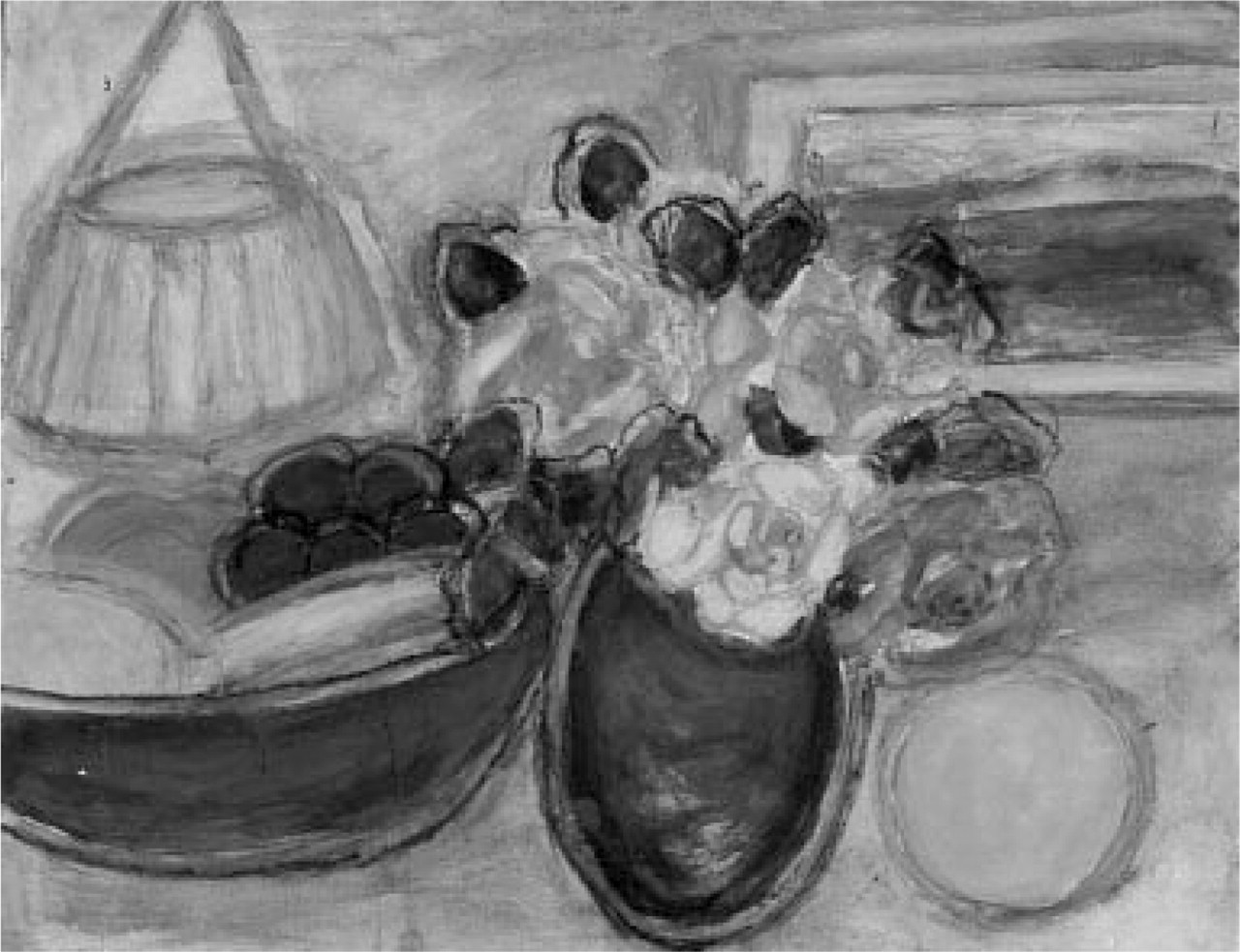
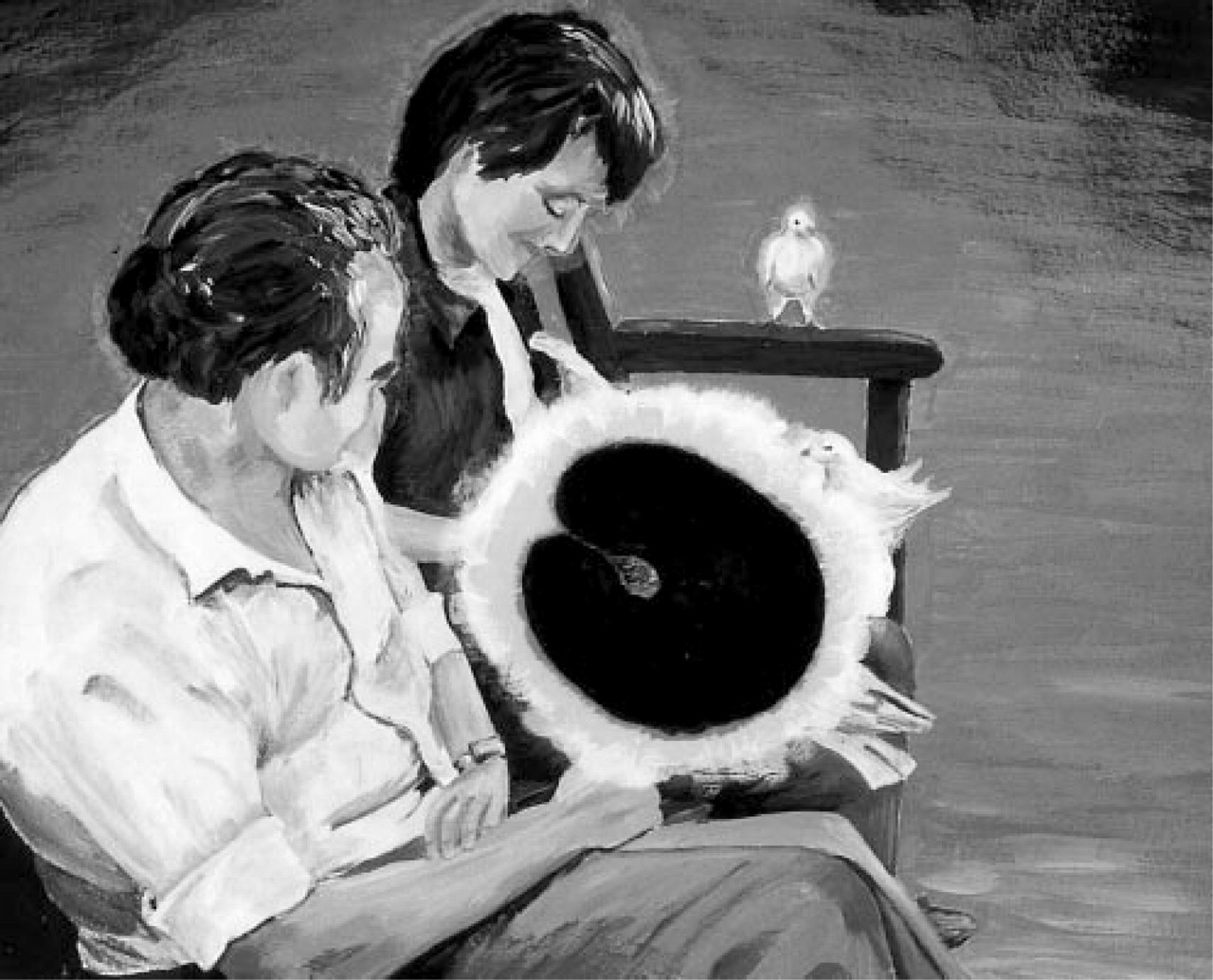
The Migraine Art collection includes six paintings illustrating the characteristics of a typical corona phenomenon, viz. an extra edge around an object. Figure 1 depicts the corona phenomenon during a sequence of three stages, the first characterized by blurred vision as if the eye were looking through a stream of tap-water, the second by a corona surrounding a tree, and the third by the pain depicted by the three mallets beating upon the migraine sufferer's forehead. Figure 2 depicts a still-life in which all the objects are bordered by a similarly tinged corona. Figure 3 shows a corona surrounding part of the contours of a man, woman, and a dove, together with a similar extra edge around a central positive scotoma. The artist writes (authors' comments in square brackets):

Blurred vision (I), corona phenomenon (II) and pain (III).
Corona phenomenon.
Central positive scotoma and corona phenomenon.
‘This migraine, typically, started with disturbed vision – a bright ‘sparkling’ which developed into a glowing dark mass [i.e. a positive scotoma], nearly always palette shaped, like the retained image one gets after staring at a bright light. This always blots out whatever one focuses on. The dark shape still had remnants of the sparkle around it and a similar sparkling ‘halo’ was also seen on things near to the centre of focus. As the dark shape fades it leaves the area focused on not there [i.e. a negative scotoma]. Unless you have experienced this it is difficult to appreciate how one can have an empty area of focus. This all gives plenty time to take medication as the headache starts with the return of normal vision about a half to one hour after the begin of the visual attack.’
The corona depicted in Fig. 4, in close proximity to a number of positive scotomas, follows parts of the contours of a vase containing three tulips. In Fig. 5, the artist experiences a right-sided hemianopia together with the illusion of a complete corona around three birds feeding on a table and a partial corona around three birds in flight. The teacher portrayed in Fig. 6 experiences ‘scintillating, seething blobs of colour’ in her entire visual field together with the illusion that ‘the blue exercise book is rimmed with luminous orange and a fringe of paler light’. Additionally, the artist has depicted her aphasic difficulties whereby she was ‘speaking complete rubbish’ and her abnormal bodily sensations of macrosomatognosia involving both upper extremities (8).

Positive scotomas and corona phenomenon.

Visual hallucinations in hemianopic visual field and corona phenomenon.

Migraine attack with corona phenomenon.
Summarizing the characteristics of the typical corona phenomenon, the corona can appear with a single or two extra contours, surrounding parts or the complete contours of an object, in black, white or in colour. There is no consistent relationship between the colour of the corona and that of the object it surrounds. In four of the six pictures, the said phenomenon is allied with an incomplete loss of vision distributed over the total visual field (Fig. 1), positive scotomas (Figs 3 and 4) or complete hemianopia (Fig. 5), respectively. In four of the six pictures, the said phenomenon is associated with visual hallucinations involving the form dimensions (5) random (four pictures) and curve (one picture). Two artists who had responded to the follow-up enquiry stated that they had experienced the typical corona phenomenon repeatedly, with a duration of a few minutes (range 5–10 min), and always followed by an attack of migraine headache.
A further five Migraine Art pictures represent atypical variants of a corona phenomenon. Figure 7 shows a female artist's view of a man in a stylized landscape. All parts of the male body, which are seen in the artist's left half-field of vision, are surrounded by either a single extra contour (inner side of leg) or multiple waves and zigzags (lateral aspect of body). The features of corona phenomenon and Gowers' (9) pericentral spectrum are combined in this record of the artist's visual aura. In another picture, by the same artist, the autoscopic image of the sufferer's own body is surrounded by a similar atypical corona (see 10, Fig. 2). Two pictures show multiple concentric halos surrounding the mirror images of the migraine sufferers' heads, together with the visual illusions of mosaic vision (see 11, p. 105) and facial metamorphopsia (not illustrated), respectively. In another picture, the polyopic images of the shape of a workman are surrounded by multiple coloured extra contours (see 12, Fig. 3). Consideration of such atypical variants demonstrates that corona-like extra contours cannot only be seen around perceived images, but can occur similarly around illusory images and around both elementary hallucinatory images (i.e. positive scotomas) and complex hallucinatory images (i.e. autoscopic images).
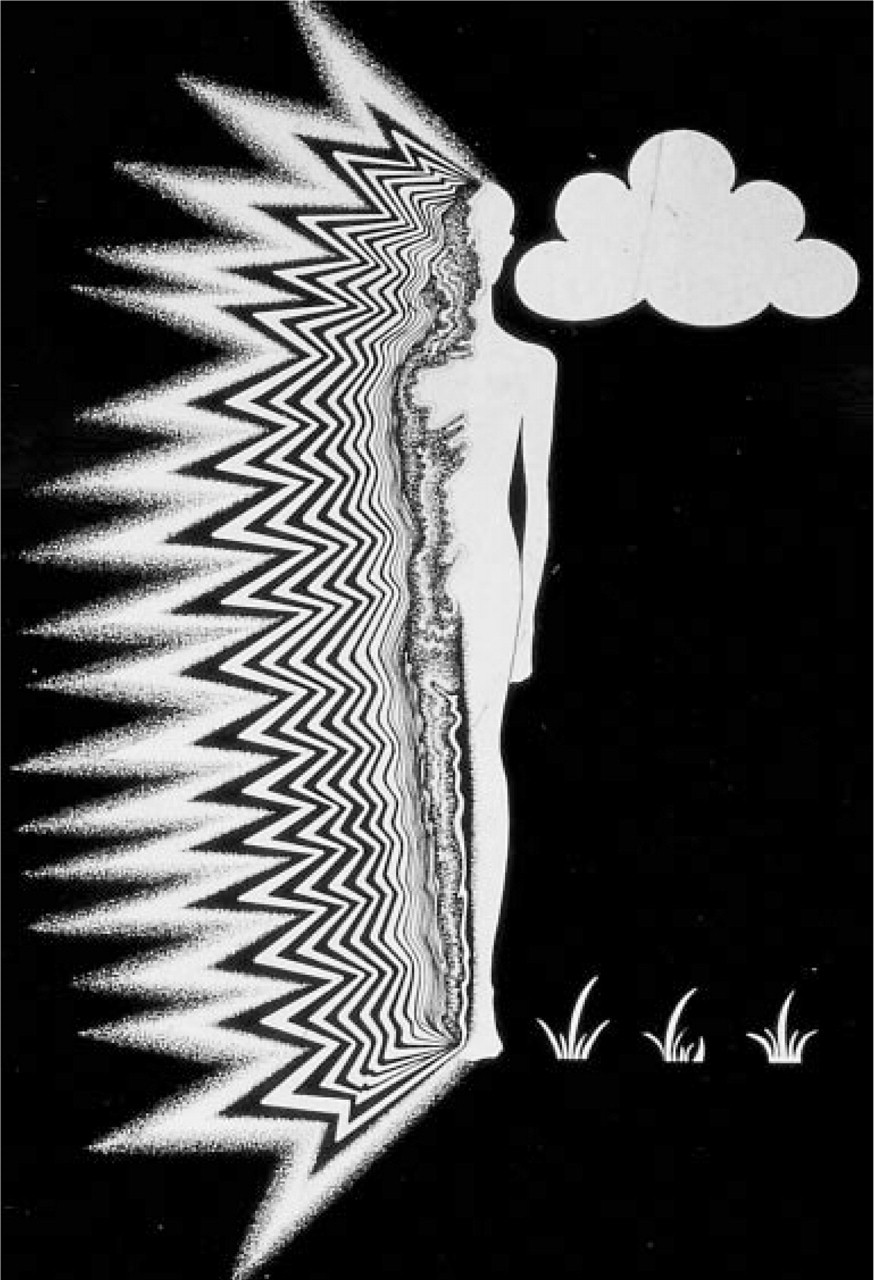
Atypical corona phenomenon.
Discussion
The first report of a typical corona phenomenon as a migraine aura symptom was that of Ruete (13) who recorded that objects seen in the area of a zigzagged scotoma were seen ‘as if surrounded by a halo’ (p. 71). Similarly, Gowers (14) described a migraine patient who saw objects surrounded by an iridescent fringe during his attacks, which prompted Möbius (15) to recommend an examination for glaucoma in which a similar fringe, in spectral colours, is seen around objects. However, Speed (16) also observed ‘halo vision’ as a migrainous aura symptom with glaucoma being excluded. Greenacre (17) described a ‘halo of the vision’ appearing as ‘a white or red shining light displaced to the head, as the figure of the Madonna’ (p. 187), which she considered to be a visual phenomenon which ‘may have some relation to the scintillating scotoma and headache of migraine’ (p. 193). The visual symptoms experienced by a 37-year-old female suffering from migraine with aura also included seeing halos around objects (18). It was not until Klee's study (19), which recorded the illusion in 8 out of 50 hospitalized patients, that the corona phenomenon was recognized as a common aura symptom of migraine. Queiroz et al. (20) found corona phenomena in 2 of 100 adult migraine sufferers with visual auras.
A main concern of the present descriptive phenomenological study of the corona phenomenon is its retrospective nature. Only three of 10 participants in the national Migraine Art competitions were available to provide descriptions of the symptoms depicted in their works and complete a questionnaire based on the IHS operational diagnostic criteria of migraine (7). In the three cases the questionnaire confirmed the artists' migraine, although it must be borne in mind that a questionnaire is not a satisfactory tool in diagnosing headache disorders (6). Despite these possible pitfalls, it emerges as a clear result of the study that the present series of six Migraine Art pictures confirms the previously reported descriptions of the typical corona phenomenon in migraine. Moreover, the analysis of these pictures clearly documents that the said visual illusion is strongly associated with visual loss and with elementary visual hallucinations of varying form dimensions, which has also been emphasized as a characteristic of other types of visual illusions (21).
An atypical variant of the said illusion was reported by Wilson (22) who recorded a combination of a corona phenomenon with teleopsia and micropsia in one of his patients. This lady observed that objects
‘suddenly appear to be surrounded by a series of clear concentric rings, inside which is a black ring; all the rings eventually become black, and seem to be rolling round and round. Whenever these rings appear, external objects seem to recede at once to a great distance, and to become very small. This state may last as long as half an hour, or even longer; as a rule, however, this stage of the attack is not so prolonged. As the rings and the micropsia begin to disappear, the left side of the face becomes quite numb, and this is followed by numbness of the left arm, hand, and fingers. Finally comes what the patient calls ‘a most terrific headache’ mainly frontal and temporal, as a rule more marked on the left side than on the right, together with a feeling of nausea. The headache lasts for about two hours, and when the attack is over she is weak and prostrate.' (p. 417)
Similarly, combinations of the corona phenomenon with other visual illusions, as well as other atypical variants which have not been described previously, are depicted in five Migraine Art pictures, giving testimony of the range of phenomenal variations which appears to be larger than has previously been assumed.
There is a remarkable similarity between the visual illusion of a corona around a human body and the supposedly paranormal phenomenon of ‘aura vision’, which has been described, in the theosophical, psychic research and parapsychological literature, as a vaporous light or emanation surrounding a person's head, shoulders, hands, or body, assumed to represent that person's spirituality, visible only to sensitive people, i.e. clairvoyantes (23). In this context, it may also be noted that both Ruete (13) and Greenacre (17) explicitly likened the said visual illusion to the religious vision of a saint's or the Madonna's halo. The similarity is even more striking if one also considers the atypical variants of the corona phenomenon such as illustrated in Fig. 7. It is suggested that aura vision may represent, at least in some cases, a visual aura symptom of migraine. This receives further support from an analysis of the pictorial representations of aura vision in the theosophical literature. Theosophists have published numerous illustrations with auras characterized by various forms and colours. They maintained that such auras were indicative of different emotional states, e.g. love and fear, as illustrated in the pictures reproduced in Leadbeater's book entitled ‘Man visible and man invisible’ (24). It does not escape notice that the zigzags featured in many of these pictures, which superimpose the image of the human body in the theosophist's aura vision, are identical with the form dimension of the visual hallucination most commonly encountered in migraine, viz. the zigzags of fortification spectra. Together with some phenomena of so-called paranormal hallucinations (25, 26) and out-of-body experiences (10), aura vision can be considered as another form of purely subjective experience where the migraine aura may serve, in Mercier's (27) words, as
‘a possible explanation, according to the known laws of physical nature, of those occurrences which seemed to us occult, mysterious, and inexplicable.’ (p. 257)
Footnotes
Acknowledgements
This research was supported by a grant from the START programme of the Medical Faculty of the University of Technology Aachen. Figures 1–7 are reproduced by permission of the Migraine Action Association and Boehringer Ingelheim UK Limited.