




Abstract
Maintenance of uninterrupted cerebral circulation is critical for neural homeostasis. The level of circulating CD34-positive (CD34+) cells has been suggested as an index of cerebrovascular health, although its relationship with cognitive function has not yet been defined. In a group of individuals with cognitive impairment, the level of circulating CD34+ cells was quantified and correlated with clinical diagnoses. Compared with normal subjects, a significant decrease in circulating CD34+ cells was observed in patients with vascular-type cognitive impairment, although no significant change was observed in patients with Alzheimer's-type cognitive impairment who had no evidence of cerebral ischemia. The level of cognitive impairment was inversely correlated with numbers of circulating CD34+ cells in patients with vascular-type cognitive impairment, but not Alzheimer's type. We propose that the level of circulating CD34+ cells provides a marker of vascular risk associated with cognitive impairment, and that differences in the pathobiology of Alzheimer's- and vascular-type cognitive impairment may be mirrored in levels of circulating CD34+ cells in these patient populations.
Introduction
Maintaining integrity of the cerebral circulation has a critical role in neural homeostasis. Although analysis of risk factors for cerebrovascular disease has certainly provided insights into mechanisms of vascular disease, it is still difficult to predict accurately the contribution of vascular dysfunction in the long-term outcome of acute vascular insufficiency or in chronic neurodegenerative disorders. For example, in Alzheimer's disease (Casserly and Topol, 2004; Vagnucci and Li, 2003), assessment of a possible vascular component in the pathogenesis of neuronal degeneration is often ambiguous during a patient's lifetime.
Repair of the cerebral microcirculation has traditionally been assigned to ongoing replacement of damaged cerebral endothelium from outgrowth of preexisting vasculature. However, recent studies have identified circulating bone marrow-derived immature cells, including CD34-positive (CD34+) cells, as contributors in maintenance of the vasculature; they have the potential to serve as a pool of endothelial progenitor cells (Asahara et al, 1997) and as a source of growth/angiogenesis factors (Majka et al, 2001). In a previous study, we have shown that circulating CD34+ cells provide an index of cerebrovascular function (Taguchi et al, 2004a). We have also found that in a model of experimental cerebral ischemia, intravenous administration of CD34+ cells improved neurologic function, at least in part, by restoring cerebral microcirculation in the ischemic area (Taguchi et al, 2004b).
These results lead us to propose that circulating immature vascular progenitor cells contribute to neural homeostasis, at least in part, through their role in maintaining cerebral microvascular function. Using a recently developed method that allows precise measurement of the CD34+ cell population in peripheral blood (Kikuchi-Taura et al, 2006), we have evaluated the level of circulating CD34+ cells in patients with impaired neurologic function of diverse etiologies. Our goal has been to determine if there is relationship between levels of CD34+ cells, impaired neural function, and vascular integrity.
Materials and methods
This study was approved by Institutional Review Boards of the respective institutions (National Cardiovascular Center, Hyogo College of Medicine, Hoshigaoka Koseinenkin Hospital, and Osaka Minami National Medical Center). All subjects provided informed consent. Individuals with Mini Mental State Examination Score (MMSE) < 24 and Clinical Dementia Rating (CDR) ≥0.5 were enrolled in this study and defined as having impaired cognitive function. In the view of history, evaluation of symptoms, and results of brain imaging studies (magnetic resonance imaging and single photon-computed tomography), patients with cognitive impairment were divided into two groups by neurologists blinded to the experimental protocol: vascular-type cognitive impairment or Alzheimer's-type cognitive impairment, according to the criteria of Diagnostic and Statistical Manual of Mental Disorders (4th ed, DSM-4) (American Psychiatric Association, 1994). To exclude the contribution of vascular element in patients with Alzheimer's-type cognitive impairment, patients' coexistent Alzheimer's-type cognitive impairment and cerebral infarction, observed by magnetic resonance imaging, were excluded from this study. In addition, patients with cognitive impairment diagnosed as neither of the Alzheimer's type nor vascular type were excluded. A total of 95 individuals, including 32 age-matched control subjects with no history of vascular disease, no neuronal deficiency, and no cognitive impairment, were enrolled. In addition, individuals excluded from the study included: premenopausal women, patients who experienced a vascular event within 30 days of measurements, history of cerebral hemorrhage, and evidence of infection or malignant disease. Using a modification of the International Society of Hematotherapy and Graft Engineering (ISHAGE) Guidelines (Sutherland et al, 1996), the number of circulating CD34+ cells was quantified as described (Kikuchi-Taura et al, 2006). In brief, blood samples were incubated with phycoerythrin-labeled anti-CD34 antibody, fluorescein isothiocyanate-labeled anti-CD45 antibody, 7-aminoacti-nomycin-D, and internal control (all of these reagents are from the Stem-Kit, Beckman Coulter, Marseille, France). 7-Aminoactinomycin-
Results
Baseline characteristics of the groups are shown in Table 1. In univariate analysis of control subjects, each cerebrovascular risk factor and other treatment showed no significant difference with the number of circulating CD34+ cells (data not shown).
Baseline characteristics
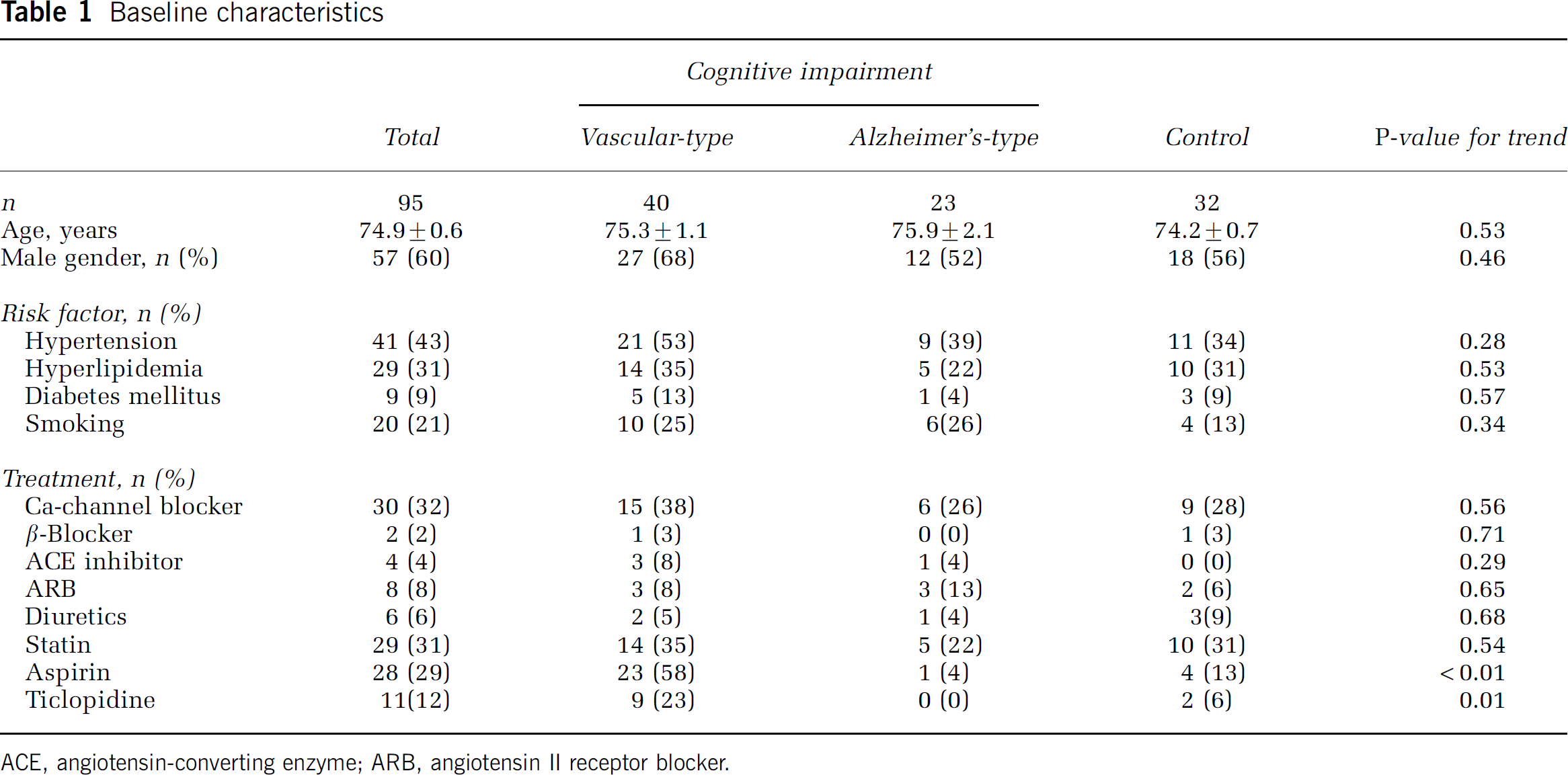
ACE, angiotensin-converting enzyme; ARB, angiotensin II receptor blocker.
To investigate a possible relationship between circulating CD34+ cells and cognition, the level of circulating CD34+ cells was compared among these groups. Representative fluorescence-activated cell sorting images are shown in Figure 1A (vascular-type) and 1B (Alzheimer's-type). Analysis of variance revealed a significant decrease of CD34+ cells in patients with vascular-type cognitive impairment compared with Alzheimer's-type cognitive impairment (P < 0.001) and normal subjects (P < 0.001, Figure 1C).
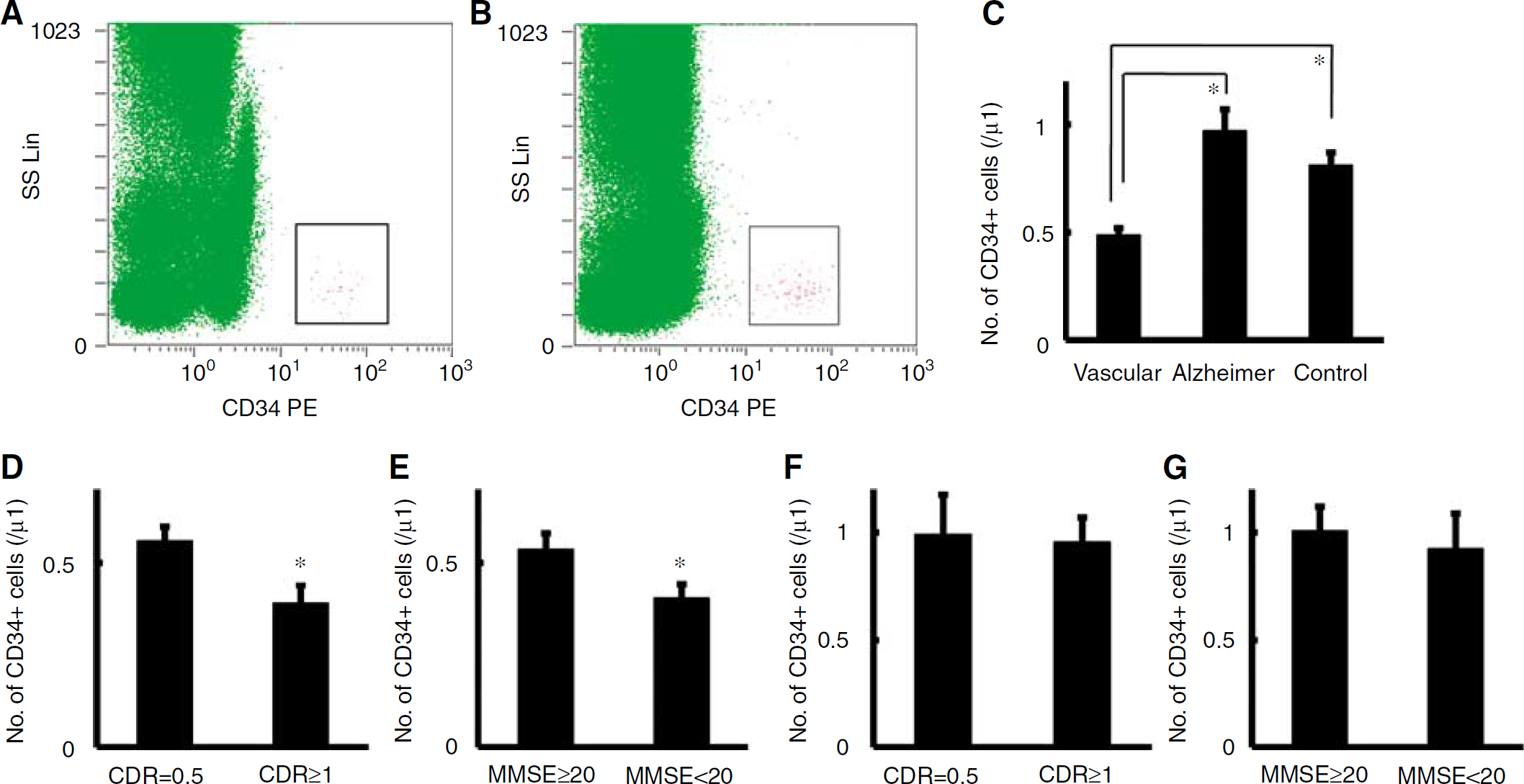
Levels of circulating CD34+ cells and cognitive impairment. (
To investigate further a possible association of circulating CD34+ cells with cognitive impairment, patients with vascular-type impaired cognition were divided into two groups according to their CDR (mild: CDR = 0.5, n = 22, mean age =75.2±1.6 years; moderate-severe: CDR≥1, n = 18, mean age =75.3±1.5 years) or MMSE (mild: MMSE ≥ 20, n = 25, mean age = 74.2 ±1.4 years; moderate-severe: MMSE < 20, n = 15, mean age = 77.1±1.5 years). The results showed a significant decrease in the level of circulating CD34+ cells in moderate-severe group, based on stratification by either CDR (Figure 1D, P = 0.01) or MMSE (Figure 1E, P = 0.03) in patients with vascular-type cognitive impairment. Similar analysis was applied to patients with Alzheimer's-type impaired cognition. They were divided into two groups according to CDR (mild: n = 8, mean age = 73.0±4.7 years; moderate-severe: n = 15, mean age = 77.5±1.9 years) or MMSE (mild: n = 12, mean age = 74.1±3.0 years; moderate-severe: n = 11, mean age = 77.8± 2.9 years). However, in contrast to patients with vascular-type impaired cognition, there was no significant difference observed in patients with Alzheimer's-type cognitive impaired, based on CDR (Figure 1F, P = 0.86) or MMSE (Figure 1G, P = 0.60).
Discussion
Our results are consistent with a contribution of circulating CD34+ cells in support of cognitive function, presumably through their positive homeostatic influence on the cerebral circulation in settings of ischemic stress. Further, these observations suggest a basic difference between the pathobiology of dementia in Alzheimer's disease (without associated cerebral ischemia) and declining cognitive function in patients with ischemic cerebrovascular disorders.
Late onset, sporadic Alzheimer's disease is a heterogeneous disorder (Casserly and Topol, 2004) and the contribution of a vascular factor is still controversial. In contrast to vascular-type cognitive impairment, no significant change (at most, a mild increase) in the level of circulating CD34+ cells was observed in patients with Alzheimer's-type cognitive impairment who had no cerebral ischemia. Consistent with a CD34+ cell-independent mechanism of cognitive decline in Alzheimer's-type impaired cognition, there was no correlation between circulating CD34+ cells and the level of CDR or MMSE. These results suggest that the level of CD34+ cells in the peripheral circulation might provide a useful means of separating dementia with a vascular etiology from dementia associated with nonvascular causes. This is not inconsistent with a previous report indicating decreased levels of CD34+ cells in patients with early Alzheimer's disease that did not exclude patients with coexisting cerebral ischemia (Maler et al, 2006). Our findings could have implications for treatment, especially as more modalities become available for patients with declining cognitive function.
The level of circulating endothelial progenitor cells, identified based on positivity for CD34 and kinase insert domain receptor (CD34+/KDR+ cells), has been correlated with cardiovascular risk factors (Vasa et al, 2001) and cardiovascular outcomes (Schmidt-Lucke et al, 2005; Werner et al, 2005). However, large variations in the levels of CD34+/ KDR+ cells in the latter reports (by ~ 100-fold between reports; Fadini et al, 2006; Werner et al, 2005) indicate the need to standardize this measurement. In contrast, in our study, although there was no strong correlation between levels of CD34+ cells and established cardiovascular risk factors and other treatments, probably because of the heterogeneity of our control subjects, the results indicate a close relationship between the overall CD34+ pool and the cognitive impairment with cerebral ischemia. Previous reports have indicated a positive correlation between mobilization of CD34+ cells and improved functional outcome in stroke patients (Dunac et al, 2007). Accelerated functional recovery after experimental stroke, because of administration of CD34+ cells (Shyu et al, 2006; Taguchi et al, 2004b), suggests the possible contribution of CD34+ cells in maintenance of brain function during cerebral circulation. Our method for quantification of CD34+ cells is simple, reproducible (Kikuchi-Taura et al, 2006), and suitable for screening a broad group of patients at risk for cerebrovascular disorders.
In conclusion, our results indicate that the level of circulating CD34+ cells provides a marker of vascular risk associated with cognitive impairment. Furthermore, differences in the pathobiology of Alzheimer's- and vascular-type cognitive impairment may be mirrored in levels of circulating CD34+ cells in these patient populations.
Footnotes
Acknowledgements
We thank Y Kasahara, K Obata, and Y Okinaka for technical assistance.
Conflict of interest
The authors state no conflict of interest.