





Background
[11C]-5-Hydroxy-L-tryptophan, [11C]-HTP, is apart from the radiolabel identical to the endogenous compound that will undergo both conversion to serotonin by the enzyme aromatic L-amino acid decarboxylase (AADC) and further catabolism by monoamine oxidase to hydroxyindole acetic acid (5-HIAA). It was suggested that the rate constant of tracer trapping reflects the conversion rate constant from 5-HTP to serotonin by AADC, independent of tracer transport1. Rhesus monkey PET studies were performed to further examine [11C]-HTP as a PET tracer for serotonin synthesis. The effect of irreversible transfer in the reference region was also addressed.
Methods
Cerebral [11C]-HTP kinetics was investigated after inhibition of monoamine oxidase A with clorgyline (2 mg/kg), or with one of the AADC inhibitors carbidopa (5 mg/kg, not entering the brain) and NSD1015 (10 mg/kg). A reference tissue model with irreversible transfer both in the target (k3) and in the reference region (l3) was used to fit data. The macro-parameter Ki = k2k3/(k2+k3) represents an index for the transfer rate (min−1) of 5-HTP to serotonin2. k2 is the rate constant for transport out of the target region. l3 was obtained from experiments where blood samples were taken (7 of 17 controls, 1 of 2–4 treatment scans), using the corresponding model with a plasma input function to fit the reference region (cerebellum) time-activity data.
Results
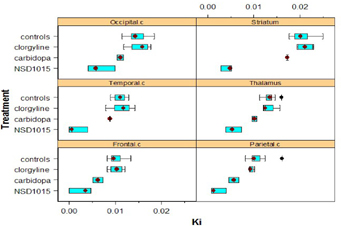
The mean l3 in control monkeys was 0. 0182 min−1 (± 0.0055). Binding was altered after treatment and l3 in each group (clorgyline 0.0161 min−1, carbidopa 0.0133 min−1, NSD1015 0.0076 min−1) was used when fitting the reference tissue model to the data. In the figure 1, box plots of regional Ki values are presented. Pretreatment with clorgyline did not change Ki, which suggested that although 5-HIAA was formed, the majority of radiolabelled compounds were trapped in the tissue. After pretreatment with carbidopa a slight decrease in Ki was seen. Carbidopa inhibits peripheral metabolism of 5-HTP and cause more tracer to reach the brain, but this increase does not change Ki appreciably as AADC operates far from saturation. Both peripheral and central blockade of AADC with NSD1015 resulted in a decrease in Ki, as expected, as the decarboxylation process in the brain was blocked.
Conclusion
The results illustrate that the applied model for [11C]-HTP with irreversible transfer in the reference region provides an index for the transfer rate, Ki, which gives good discrimination between regions. Treatment effects in these small monkey groups could be considered as support for the suggested process being studied with this tracer.