Introduction
The aim of this study is to develop noise reduction capability for Logan plot using a clustering approach. Logan plot is widely used algorithm because of its portability and model independent property. However, a distribution volume (DV) tends to be underestimated with existence of noise in a tissue time activity curve (tTAC). This is sometimes serious in case of voxel-by-voxel Logan plot to form images of receptor- radioligand kinetics.
Method
First, voxel-based tTACs are clustered based on radioligand kinetics. The ratio of a tTAC and tTAC multiplied by time is related to k2 (Y Kimura, NeuroImage 9:554), and the clustering is performed based on the ratio. Then, gathered tTACs are averaged in a cluster to improve their noise statistics. Logan plot is applied to the averaged tTACs.
Results and Comment
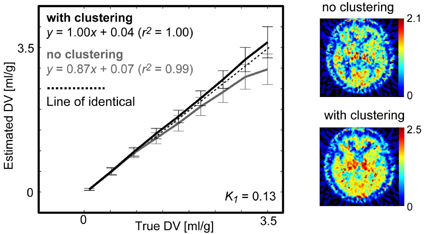
We applied the proposed method to simulation data and clinical image of 11C-PK11195. The simulation result is shown in Fig-1A where the true DV and the estimates are plotted on x- and y-axis. The gray solid line derived from Logan plot without clustering shows around 15% underestimation, meanwhile the clustering approach can compensate the noise in tTAC (the black solid line). Fig-1B demonstrates parametric images of DV with/without clustering. The contrast around the thalamus is improved. We conclude that the clustering approach is useful for voxel-based Logan plot.