Objectives
[18F]FCWAY is used in human subjects as a radioligand for PET imaging of brain 5-HT1A receptors, but suffers from significant defluorination and troublesome skull uptake of radioactivity. Our aim was to inhibit defluorination of [18F]FCWAY in a rat model.
Methods
Defluorination was examined by means of radio-TLC in i) phosphate buffer (0.1M; pH 7.4), ii) rat whole blood and iii) rat liver microsomes with and without NADPH. Inhibitors of cytochrome P450 2E1 enzymes (cimetidine, diclofenac and miconazole) were tested for their ability to inhibit defluorination in rat liver microsomes. The effects of miconazole dose on skull radioactivity uptake and spillover, metabolism of radioligand, brain radioactivity uptake and image contrast after i.v. [18F]FCWAY administration to rat were studied with PET.
Results
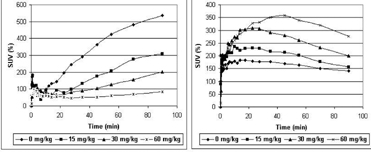
Defluorination of [18F]FCWAY occurred in rat liver microsomes only in the presence of NADPH, and not in phosphate buffer or rat whole blood. Defluorination of [18F]FCWAY in rat liver microsomes alone or in the presence of cimetidine, diclofenac, or miconazole, each for 30 min, was 13, 13, 5 and 2% respectively. After pretreatment of rats with 0, 15, 30 or 60 mg/kg miconazole nitrate, PET indicated that the skull uptake of radioactivity at 90 min after i.v. [18F]FCWAY administration was 540, 300, 180 and 82% SUV, while brain radioactivity was 137, 75, 68 and 89% SUV, respectively. The respective ex vivo measures of brain radioactivity were 41, 47, 52 and 74% SUV. Peak radioactivity in temporal cortex in vivo was 221, 236, 277 and 358% SUV, and at 35 min temporal cortex to cerebellum radioactivity ratios were 4, 6, 7 and 14, respectively. The biological half-life of radioligand was 11.2 and 19.5 min after pretreatment of rats with 0 and 30 mg/kg miconazole nitrate, respectively.
Conclusion
Miconazole effectively suppresses defluorination of [18F]FCWAY in rat in vivo, possibly by competitive inhibition of cytochrome P450 enzymes. This reduces the impact of the partial volume effect. Miconazole also reduces radioligand metabolism, thereby increasing plasma radioligand level and brain uptake of radioactivity. Consequently, overall PET image contrast is improved (See Figure 1).