





Introduction
Fully automated segmentation of PET images is very challenging due to the limited spatial resolution and signal to noise ratio in the PET images. It also does not easily accommodate optimization of parameters to extract out particular features or structures of interest to the physician in a given patient. In this study, we propose an interactive fuzzy thresholding method which can be used to interactively control the automatic segmentation results of dynamic PET images. Our approach permits the physician to weight the relative importance of the threshold while exploring the segmentation result.
Methods
The dynamic images are automatically segmented into similar temporal kinetic features based on iterative fuzzy-c-means cluster analysis (FCM) into predefined number of clusters 1 . In this approach, a fuzzy logic algorithm assigns probabilistic membership function (weighting) to every pixel representing the likelihood that the pixel is a member of a particular cluster. Upon convergence of cluster analysis, pixels are assigned to a cluster for which it has the highest membership. The proposed fuzzy thresholding works by controlling the fuzzy membership threshold of a selected cluster. By lowering the threshold, additional pixels with weaker membership can be assigned to a cluster. On the other hand, by increasing the threshold, fewer pixels of only the highest membership are likely to be clustered. We demonstrate the effectiveness of our method based on dynamic [18F]2-fluoro-deoxy-glucose (FDG) PET clinical human brain images.
Results
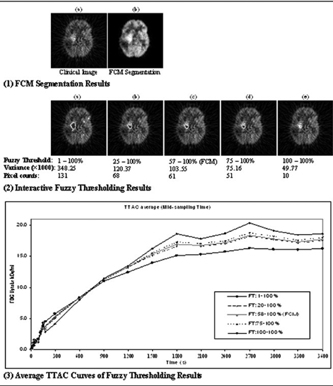
The first row of the figure 1 shows a single slice from the last temporal frame of a patient study with a cerebral tumor and the corresponding FCM automatic segmentation result which partitioned the image into clusters with similar temporal features. In the second row, the interactive fuzzy threshold results for the cluster representing tumor uptake are presented, where (c) is the result from the automatic FCM. Note that by adjusting the fuzzy threshold from (c), only the pixels with similar temporal features are affected, rather than all pixels with similar intensity value as in intensity-based thresholding. Accordingly, variance and pixel counts are lowered when the threshold is increased, where lower variance indicates better similarity among the pixels in the cluster. The average TTAC curves plotted in the third row shows that the results of fuzzy threshold maintains consistency and only adjusts pixels that are similar in temporal behavior.
Conclusion
The proposed fuzzy thresholding could be useful for physicians to interactively correct the automatic segmentation results, and therefore, potentially ease the performance requirements of automatic segmentation methods.