




Rationale
Several PET studies performed in the early phase of Parkinson's disease show an enhanced availability of striatal D2/3 receptors compared to a control population. In rodent striatum increases of D2/3 receptors density follows 6-OH lesions. This finding suggests an up-regulation of D2/3 receptors secondary to the progressive degeneration of dopamine afferent fibers. The aphakia mouse harbors a mutation on the Pitx3 gene which, similarly to Parkinson's, causes degeneration of dopamine cells that innervates the dorsal striatum. However, unlike Parkinson's disease, dopamine deficits are already present in the neonatal life. We used the aphakia mouse to test the hypothesis that the up-regulation of D2/3 receptors occurs independently of the age at which the dopaminergic deficit takes place.
Methods
Baseline [11C]raclopride PET scans were performed in three male aphakia (N=3, 23±2 g) and two C57 control mice (N=2, 38±2 g) using a CTI Concorde Microsystems microPET R4 scanner. PET data were obtained in animals anesthetized with isofluorane 2% administered by a nose cone. Each subject had a sixty-minute dynamic acquisition, which started concomitantly with bolus administration of [11C]raclopride (14–31 MBq) radioligand in the tail vein. Subsequently, data were reconstructed using Fourier rebinning followed by 2D filtered back projection, and time activity curves were obtained using regions of interest in both striatum (target region) and cerebellum (reference region). The output measure, distribution volume ratio (DVR), was calculated by the Logan reference tissue graphical method for irreversible ligands.
Results
Preliminary analysis shows DVR of 1.89±0.2 for aphakia and 2.20±0.09 for C57 controls. Results are summarized in Figure 1.
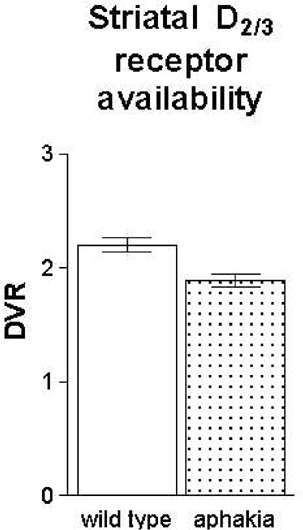
[11C]raclopride DVRs obtained from aphakia (N=3) and control mice (N=2).
Conclusion
These preliminary results support the use of microPET to evaluate the impact of genetically induced changes of dopamine neurotransmission in D2/3 receptor availability.
Footnotes
Acknowledgements
This work was founded by the Canadian Institute of Health Research (CIHR).