





Introduction
We have validated in monkeys a method for quantitative determination of regional rates of cerebral protein synthesis (rCPS) with L-[1-11C]leucine and PET 1 . The method uses a kinetic modeling approach to estimate λ, the fraction of the precursor pool for protein synthesis derived from arterial plasma 2 . The present study was undertaken to examine the feasibility of performing voxel-wise kinetic modeling analyses and to compare results with region of interest (ROI) analyses.
Methods
Anesthetized monkeys were dynamically scanned for 60 min following injection of L-[1-11C]leucine. A total of 9 studies were performed. ROIs were placed on MR images and transferred to co-registered PET images to construct tissue time activity curves. For ROI-based analyses, kinetic model rate constants and λ were estimated for whole brain and several gray and white matter regions. rCPS was computed as rCPS=[(K1k4)/(k2+k3+k4)](Cp/λ) where Cp is the arterial plasma leucine concentration. K1-k4 are rate constants for transport of leucine from plasma to brain, from brain to plasma, for catabolism of leucine, and for incorporation of leucine into protein, respectively. For voxel-based analyses, rate constants, λ, and rCPS were estimated for each voxel and averaged. Because estimates of k2+k3 and k4 in kinetically heterogeneous tissues are expected to decline with time 3 , estimations were performed for both analysis methods over 0–30 and 0–60 min intervals.
Results
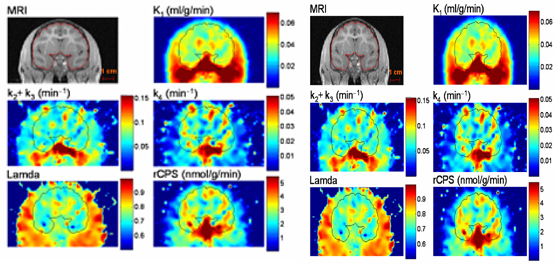
In whole brain 98.5% of voxels yielded valid parameters over 0–60 min (Fig 1). Regionally K1, k2+k3, and k4 were 12–15%, 22–36%, and 30–40% lower, respectively, estimated using voxel-based compared to ROI-based methods. rCPS and λ estimates were in closer agreement: rCPS was 1–9% lower and λ l–5% higher when computed by voxel-based methods. Rate constant estimates decreased with increasing fitting interval, but declines were sharper with voxel-based analyses. λ and rCPS were more stable with increasing fitting interval: λ decreased 0–7% with voxel-based and increased 0–2% with ROI-based analyses; rCPS varied ±11% with voxel-based and 0–13% with ROI-based analyses.
Conclusions
Decreases in rate constant estimates with increasing fitting interval are consistent with tissue heterogeneity, even in voxel-based analyses. Lower estimates of individual rate constants with voxel-based analyses are consistent with negative biases observed at high noise levels in simulation studies 2 . Voxel-based analyses, therefore, do not avoid the problem of tissue heterogeneity and may yield negatively biased rate constants. λ and rCPS were robustly estimated by both methods.