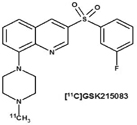
The 5-hydroxytryptamine-6 (5-HT6) receptor is one of 14 distinct mammalian 5-HT (serotonin) receptors expressed in the central nervous system through which 5-HT is involved in regulating a number of diverse biological processes 1 . Binding studies with [125I]SB258585, have localised 5-HT6 receptors almost exclusively in the CNS 2 . In these reports, SB258585 showed a high level of binding in rat, and pig striatal tissues and low in the cerebellum. In man SB258585 binding pattern is similar to rat and pig, being strongest in caudate, putamen, moderates in cerebral cortex and low in the cerebellum 3 . Despite its good in vitro profile, the development of SB285585 as an in vivo imaging tool was hampered due to its poor brain penetration properties and to date no successful 5-HT6 ligand has been reported for use in PET. We present here the radiolabelling and preclinical evaluation of [11C]GSK215083 a novel tool to probe the 5-HT6 receptors in vivo. [11C]GSK215083,[11C-N-methyl]3-[(3-fluorophenyl)sulfonyl]-8-(4-methyl-1-piperazi nyl) quinoline, was prepared by N-methylation of the corresponding desmethyl precursor with [11C]MeOTf in methanol:acetonitrile in presence of 2,2,6,6-tetramethylpiperidine, followed by HPLC purification. In a pilot study [11C]GSK215083 was evaluated in anesthetized Yorlshire pigs (40 kg). [11C]GSK215083 readily enters the brain reaching peak regional tissue concentrations at approximately 20 min post injection followed by a slow washout from brain regions known to be rich in 5-HT6 receptors with highest uptake and retention observed in striatum. The observed rank order of regional brain concentrations was striatum>cortical regions>cerebellum, consistent with reported 5-HT6 receptor densities and localisation determined by tissue section autoradiograpgy in animals and man. Upon injection of [11C]GSK215083, striatum to cerebellum and cortex to cerebellum ratios of 2 to1 and 1.5 to 1, respectively were reached at 60 min post injection. Co-administration of [11C]GSK215083 with escalating dose of authentic GSK215083 (0.005, 0.05 and 0.5 mg/kg) have located a saturable and dose dependent signal in the striatum and cortical regions. Treatment of pigs with the 5-HT6 binding drug, clozapine (6.25 mg/kg), significantly reduced the specific binding in striatum as compared to cerebellum. No significant effect on [11C]GSK215083 signal in striatum was observed following treatment with ketanserine (0.3 mg/kg), a selective 5-HT2a receptor antagonist, in contrast the same treatment reduced >90% specific binding in frontal cortex. Radio-HPLC analysis revealed that [11C]GSK215083 is rapidly metabolised in arterial plasma, representing approximately 60% of the total radioactivity 30 min post injection. [11C]GSK215083 shows properties suitable for studies probing 5HT6 receptor in man with PET (See Figure 1).