





Ischemic preconditioning (IPC) is a phenomenon by which a tissue suffering a sublethal ischemic episode develops tolerance against a subsequent ischemic event. A number of signaling pathways have been demonstrated in ischemic preconditiong, including protein kinase C epsilon (ePKC), Erk 1/2 and NFkB. In contrast, PKC delta (dPKC) promotes apoptosis after cerebral ischemia. The goal of the present study was to develop a lentiviral-based model to study selective activation of either dPKC or ePKC under conditions similar to IPC or ischemia.
Methods
To study how ePKC promotes ischemic tolerance and how dPKC promotes cell death, we have developed a lentivirus-based model. Rat dPKC and ePKC cDNA was cloned in frame with EGFP in a three plasmid lentiviral system developed by Naldini (Science, 272:263, 1996). PC-12 cells and hippocampal neurons were superfused with viral solution (MOI ∼100). Slices were injected with 10.000 transducing units of lentivirus using a picospritzer (General Valve). One week later fluorescence was determined by using a two-photon laser scanning microscope (Olympus BX51WI) analyzed with LaserSharp2000 (BioRad).
Results
We report here that we were able to express rat dPKC and ePKC tagged with EGFP in rat cultured hippocampal neurons and organotypic hippocampal slices using a lentiviral vector. Significant fluorescence can be observed in infected neurons. Significant translocation of dPKC and ePKC was achieved with the general PKC activator phorbol myristate acetate (PMA) in PC-12 cells. 1 μM PMA induced translocation of dPKC to the plasma membrane within 10–30 minutes, but not of ePKC even after 24 h (Figure 1A). At low PMA concentrations (100 nM) ePKC translocates to the membrane after 24 h. We detected both the native and the fusion isozymes by Western blot on protein extracted from cultured hippocampal neurons (Figure 1B).
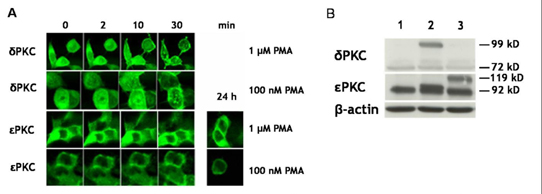
Characterization of lentiviral system to study PKC activation in hippocampal neurons. A Translocation of PKC isozymes in PC-12 cells in response to 1 μM and 100 nM PMA. B Immunodetection of fusion PKC constructs in cultured hippocampal neurons expressing EGFP (1), δPKC.EGFP (2) and ɛPKC.EGFP (3). The higher band corresponds to the fusion protien, the lower band to the endogenous PKC isozyme.
Conclusions
These findings suggest a difference in substrate affinities between both PKC isozymes and may explain why one translocates after IPC (ePKC) and the other after ischemia (dPKC).
Footnotes
Acknowledgements
Grant support: Supported by PHS grants NS34773, NS045676 and NS05820.