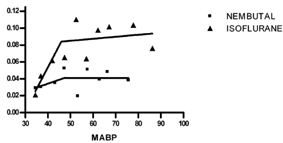
The introduction of transgenic mice models in neuroscience is associated with the need for miniaturisation of measuring systems such as multi-wavelength near infrared spectroscopy (NIRS). Our NIRS-system, developed at the University College London, can be used for the assessment of oxyhemoglobin ([Hb]), deoxyhemoglobin ([HbO2]), and oxidised cytochrome oxidase (CuA) in the brain in toto and has already been validated for rats 1 and mice 2 . We examined the possibilities of this technique in mice, the main research animal in transgenic models. Indocyanine green (ICG) is a tracer to measure blood flow index (BFI), an indication for cerebral blood flow2, 3. In a first study we determined the optimal ICG dose providing a sufficiently large signal in the brain of mice and estimate the effect of the tracer injection upon the other NIRS variables. We subsequently injected 0.5, 1, 2.5, 5 and 10 μl ICG in mice (n = 12) through the external jugular vein. Due to significant changes in optical path length after large ICG boli, back-calculation of NIRS variables was incorrect. It is therefore not possible to simultaneously measure CBF and [Hb], [HbO2] and CuA. The disturbance caused by ICG rose with larger ICG bolus, demonstrating the need to minimise bolus volume. On the contrary, while investigating variability by dividing BFI by the injection volume, we found that small injection volumes result in a large variability, indicating the need to increase the injected bolus. Therefore, at present the optimal bolus to measure CBF in mice is 2.5 μl ICG. Further attempts to increase reproducibility of the 1 μl bolus injection is under development. In a second study we compare the cerebral autoregulation curves (BFI vs mean arterial blood pressure (MABP)) in mice anesthetised with Isoflurane (n = 9) and Nembutal (n = 4). The cerebral autoregulation curve, for which MABP was lowered in steps of approximately 10 mmHg by blood withdrawal, was estimated by calculating the mean BFI per MABP and fitting a ‘two lines with a breakpoint’ model (fig 1). Isoflurane anesthetised mice had an increased CBF when compared to Nembutal mice. This is in accordance with the findings of Hendrich and collegues 4 who found, using MRI, that cerebral blood flow values are lower during anesthesia with pentobarbital as compared to Isoflurane. In conclusion, we find the optimal ICG bolus to measure cerebral blood flow in mice to be 2.5 μl and demonstrate that near infrared spectroscopy can be used to investigate cerebral autoregulation in mice.