





Introduction
Intraluminal filaments are widely used to produce focal ischemia in rodents1, 2. These result in significant CBF deficits outside the middle cerebral artery (MCA) territory 3 , and in rats can lead to confounding hyperthermia during occlusion. The presented studies optimized the design and use of an occluding filament to permit selective and reversible MCA occlusions in rats, avoiding these complications.
Methods
Silicone cylinders (diameter 0. 30 mm, length 0.7–0.8 mm) were molded onto 6–0 suture. These were introduced into the cerebral vasculature of adult male Wistar rats (250–300 g, n=107) under halothane anesthesia, using established surgical procedures1, 2. The final procedure included prior heparinization of the device as well as subcutaneous dosing of the animal (100 IU/kg). All rats were fitted with telemetry probes (Mini Mitter Co., Sun River, OR, USA). Infarct volumes were assessed at 3 days by triphenyltetrazolium chloride staining.
Results
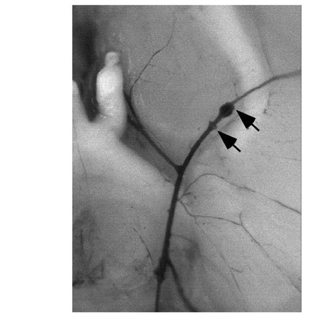
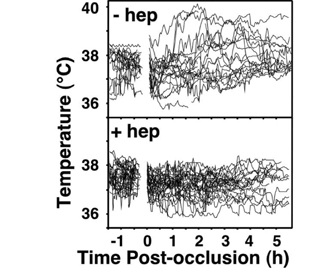
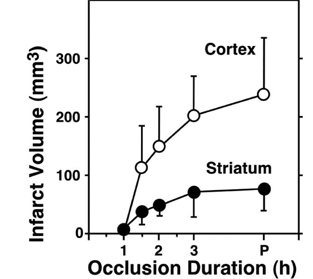
Optimized filaments entered the MCA in 85% of animals (Fig. 1), with failures attributable to anatomical variation at its origin. Heparin prevented spontaneous hyperthermia that otherwise occurred in 30% of animals (Fig. 2). Infarct volume at 3 days increased with occlusion duration and reached a maximum after 3 h (Fig. 3), with a distribution restricted to the MCA territory.
Conclusions
Selective filament occlusion of the MCA is feasible in rats. The device is simply made and required surgery uses standard approaches. Heparin prevents incidental hypothalamic ischemia and hyperthermia secondary to clot formation along the suture. Failures can be excluded by postmortem inspection of the vascular anatomy. Such anatomical considerations must be addressed in extending the approach to other rat strains. With adjustment in scale the device should also be applicable to mice.
Footnotes
Acknowledgements
Supported by USPHS grant NS42267.