





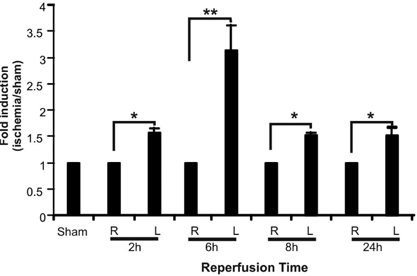
After cerebral ischemia, neurons must integrate a multitude of both inhibitory and stimulatory molecular cues, generated as a result of cortical damage, into a functional response. More often than not the response is one of growth cone collapse, axonal retraction and cell death. The mechanisms through which a repelled axon may transduce a death signal to the soma and through which the soma may signal axonal retraction/collapse remain largely unknown, however the neuropilin family of receptors for the repellant semaphorins has been implicated in such responses. Our previous studies have shown that the nuclear transcription factor E2F1 pathway plays an important role in modulating neuronal death in response to a wide range of insults such as glutamate toxicity and cerebral ischemia. Using a high density DNA microarray, we identified that the expression of an axonal guidance molecule, neuropilin-1, is regulated by the transcription factor E2F1. Bioinformatics analysis allowed the identification of a putative E2F1 binding site in the promoter region of neuropilin-1. Subsequent electrophoretic mobility gel shift analysis provided evidence to demonstrate that E2F1 protein is indeed physically capable of binding with specificity to the NRP-1 promoter sequence. Moreover, such binding by E2F1 to the promoter sequence increased in mouse brains subjected to focal cerebral ischemia (Fig 1). The increased occupation of E2F1 at the neuropilin-1 promoter sequence correlated with the temporal induction profile of the mRNA level of neuropilin-1, suggesting that E2F1 transcriptionally up-regulated neuropilin-1 during neuronal death following cerebral ischemia. Taken together, these findings support a model in that nuclear death factors contribute to processes which determine the fate of the damaged distal axons by increasing the amounts of receptors expression to axonal repellent guidance cues that may ultimately lead to cell death and failure to regenerate. Blocking this detrimental signal transduction pathway may have potential therapeutic values.
Footnotes
Acknowledgements
Supported by the Heart and Stroke Foundation of Canada grant-in-aid (NA5393) to STH. MS is supported by a Graduate Student's Scholarship from the Heart and Stroke Foundation of Ontario.