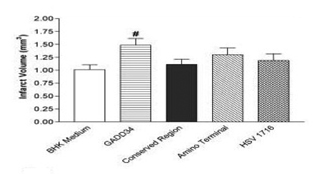
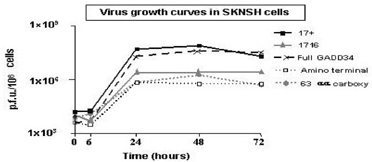
Growth arrest and DNA damage 34 (GADD34) is one of a family of proteins induced by endoplasmic reticulum stress, cell cycle arrest and DNA damage. GADD34 facilitates recovery of inhibited protein synthesis through the unfolded protein response (UPR). Protein synthesis inhibition is a critical event and a serious consequence of brain ischaemia. Originally, protein synthesis inhibition was thought to be protective, limiting the toxicity of misfolded proteins. However in the long-term it becomes maladaptive and detrimental to cell survival. We recently reported that GADD34 is upregulated in the peri-infarct zone following focal ischaemia in rodent and human brain. The aim of this investigation was to assess if overexpression of GADD34 (or its fragments) influenced ischaemic damage. The complete GADD34 gene (or amino or conserved carboxy terminal fragments) was cloned into a shuttle vector (RL1iresGFP) and recombinant HSV produced that expresses the novel gene in place of the gene coding ICP34.5. Novel GADD34 expression was confirmed by Western blot. The recombinant viruses were injected stereotaxically (10 to the 6 p.f.u) into the mouse striatum (n=8 per group). Control groups received medium or control ICP34.5 null mutant virus (1716). Twenty-four hours later, ischaemia was induced by a stereotaxic injection of the vasoconstrictor peptide, endothelin 1 (400 pmol) at the same site. Mice were then killed by perfusion fixation 72 hours later. Ischaemic damage was assessed in histologically stained sections. Administration of full length GADD34 virus resulted in significantly increased infarct volume compared to control (from 1±0.1 to 1.5±0.1 mm3) (p<0.05, ANOVA, unpaired Student's t-test) (Fig 1). The other constructs did not influence infarct volume significantly. HSV immunohistochemistry confirmed virus distribution. GADD34 shares sequence homology with the HSV protein ICP34.5, a specific determinant of virulence. Growth curves in SKNSH human neuroblastoma cells confirmed that the full length GADD34 gene compensated for lack of ICP34.5 and restored virulence (Fig 2). Protein synthesis profiles show that GADD34 precludes protein synthesis shutdown in specific cell types in vitro. These results indicate that GADD34 can modulate cellular protein synthesis. Infarct volume was significantly greater in the presence of virus expressing the full length GADD34 gene. Other methods of GADD34 delivery are currently under investigation as the protein is developed further as a therapeutic target.