





Introduction
It is suggested that endothelial nitric oxide synthase (eNOS) is closely related to cerebral autoregulation because cerebral autoregulation is impaired in eNOS knockout mice 1 . Ii is also suggested that eNOS may protect brain tissue during cerebral ischemia. The purpose of this study is to investigate the cerebral blood flow and the kinetics of cerebral production of NO during cerebral ischemia and reperfusion and the activity of nNOS in mice deficient in eNOS.
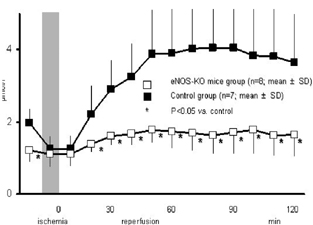
The level of the NO3−
Methods
Male eNOS knockout mice [n=8] and control mice (C57BL/6 mice [n=7]) were aneshetized by halothane. NO production was continuously monitored by in vivo microdialysis. Microdialysis probes were inserted into the left striatum and perfused with Ringer's solution at a constant rate 2 μl/min. Laser Doppler probes were also inserted into the right striatum. Fractions were collected every 10 minutes. Forebrain cerebral ishemia was produced by occlusion of both common carotid arteries for 10 minutes. Levels of nitric oxide metabolites, nitrite (NO2-) and nitrate (NO3-), in the dialysate were determined using the Griess reaction. Brain sections were immunostained with an anti-nNOS antibody. To determine the fractional area density of nNOS-immunoreactive pixels to total pixels of the whole field, the captured images were analyzed. Mann-Whitney U test was used for group comparisons.
Results
Blood Pressure: eNOS knockout group (85. 0 ± 18.4 mmHg) showed significantly higher blood pressure than that of the control group (68.6 ± 10.9), before ischemia, and 10, 60, 80 minutes after the start of reperfusion. Cerebral Blood Flow (CBF): No significant differences were obtained between the two groups. Nitric oxide metabolites
NO2-: There were no significant differences between the two groups. NO3-: eNOS knockout group (1.20. ± 0.33 μmol/L) showed significantly lower than that of control group (1.97 ± 0.49) before ischemia, and 20∼120 minutes after the start of reperfusion. (Fig.1) total NO (NO2-+ NO3-): eNOS knockout group (3.04 ± 0.37. μmol/L) showed significantly lower than that of the control group (4.35 ± 1.01 μmol/L) at 10 minutes before ischemia, and 30∼120 minutes after the start of reperfusion. nNOS activity: There were no significant differences in the percentage of nNOS-immunoreactive pixels to whole area between eNOS knockout group (0.57 ± 0.61%). and the control group (0.60 ± 0.68%).
Conclusion
The above data suggested that high blood pressure in the eNOS knockout mice may be due to lack of NO production by eNOS, and that NO production in striatum during ischemia and reperfusion is closely related to both activity of nNOS and eNOS.