





Introduction
Apoptosis signal-regulating kinase 1 (ASK1), a member of the mitogen-activated protein kinase (MAPK) kinase kinase family, activates the MAPK kinase (MKK) 4/7-c-Jun N-terminal kinase (JNK) and MKK3/6-p38 MAPK pathways. ASK1 is strongly activated in response to diverse stress and apoptotic stimuli. However, whether ASK1 is activated after transient focal cerebral ischemia and leads to JNK or p38 MAPK activation remains to be fully understood. We examined the activation of the MAPK cascade, including ASK1, after transient middle cerebral artery occlusion (MCAO) in rats.
Methods
Adult male Sprague-Dawley rats (body weight 250–280 g) were used. Under anesthesia with 1.5% isoflurane, the left MCA was occluded by insertion of a 3–0 nylon suture. After 90 min of MCAO, blood flow was restored by withdrawal of the nylon suture. For Western blotting studies, the entire MCA territory on the ischemic side was quickly removed 1, 3, 7, and 24 h after reperfusion (n=4 at each time point, including a sham-operated group). We performed Western blotting analysis for phospho-ASK1, phospho-MKK4, phospho-JNK, phospho-MKK3/6, and phospho-p38 MAPK.
Results
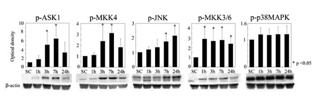
Expression of phopho-ASK1 increased at 3 h, reached a peak at 7 h, and kept increasing to 24 h after transient MCAO. Expression of phospho-MKK4 increased 3, 7, and 24 h after transient MCAO. The maximal increase in phospho-MKK4 expression was observed 7 h after transient MCAO. phospho-JNK expression initially increased at 3–7 h and reached a peak 24 h after transient MCAO. The increase in phospho-ASK1 expression was accompanied by the increase in phospho-MKK4 expression, followed by the increase in phospho-JNK expression. In contrast, phospho-MKK3/6 expression increased significantly 1 h after transient MCAO, before expression of phospho-ASK1 increased, and kept increasing to 24 h after transient MCAO. phospho-p38 MAPK expression slightly increased from 1 h to 24 h, but not significantly. The temporal pattern of phosho-ASK1 expression was different compared with phospho-MKK3/6 or phospho-p38 MAPK.
Conclusions
Our results demonstrate that brain damage after transient brain ischemia triggers activation of the MAPK cascade, including early expression and phosphorylation of ASK1, and suggest that ASK1 might play a pivotal role in activation of the MKK4-JNK pathway, which is involved in neuronal apoptosis after transient focal cerebral ischemia, as previously reported (Okuno et al., 2004). (See Figure 1)
Footnotes
Acknowledgements
Grant support: NIH grants P50NS14543, RO1 NS25372, RO1 NS36147, and RO1 NS38653, and the AHA Bugher Foundation.