





Introduction
Nitric oxide (NO) plays an important role in the pathogenesis of neuronal injury during cerebral ischemia. Edaravone has scavenging effect toward free radicals such as hydroxyl radicals and inhibiting action to lipid peroxidation, but its direct action for NO production is not clarified. We investigated the effects of edaravone on NO production and on nNOS activity during cerebral ischemia and reperfusion.
Methods
Twenty three C57BL/6 mice were used in the study. Edaravone (3 mg/kg) was intravenously infused just before each brain ischemia in 9 mice (edaravone group), and the drug was not administered in the remaining 14 mice (control group). The animals were anesthetized with 2% halothane and maintained with 0.5–1% halothane. NO production was continuously monitored by in vivo microdialysis. A microdialysis probe was inserted into the left striatum and perfused with Ringer's solution at a constant rate of 2 μl/min. After 2 hours equilibrium period, fractions were collected every 10 minutes. A laser Doppler probe was placed on the right skull surface. Global ischemia was produced by clipping both common carotid arteries using Zen clips for 10 minutes. The levels of nitrite (NO2-) and nitrate (NO3-) in the dialysate samples were measured by the Griess reaction. After euthanasia, the brains were immunostained with an anti-nNOS antibody. To determine the fractional area density of nNOS-immunoreactive pixels to total pixels in the whole field, the captured images were analyzed with image analysis software. Mann-Whitney's U test was used for the roup comparisons.
Results
1. Blood Pressure: No significant difference was observed between edaravone group and control group.
2. Cerebral Blood Flow (CBF): CBF decreased to 3.7±0.7(mean±SE)% in edaravone group and 4.4±0.7 in control group during ischemia. After reperfusion, CBF transiently returned to baseline values and then gradually decreased significantly in both group. There was no significant difference between the two groups.
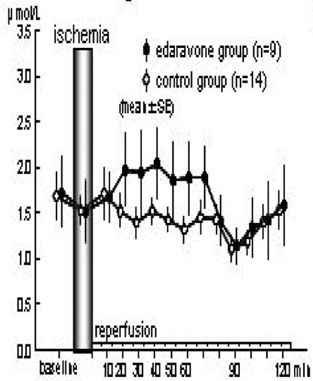
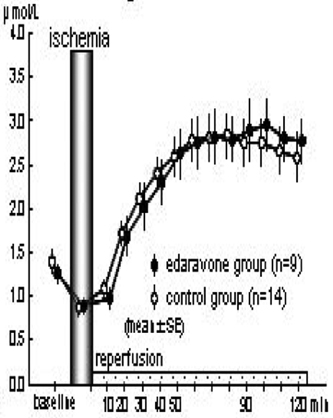
3. NO Metabolites (Fig1, Fig2): In edaravone group, the level of NO2- increased significantly at 20 minutes (2.0±0.4 μmol/L) and 40 minutes (2.0±0.4) (p<0.05) after reperfusion compared with baseline value (1.7±0.4), but no significant differences were obtained in comparison to control groups. NO3- levels in edaravone group decreased significantly during ischemia (0.9±0.1) (p<0.005) and then increased significantly at from 20 (1.7±0.2) (p<0.05) to 120 minutes (2.8±0.2) (p<0.001) after reperfusion in comparison to baseline value (1.3±0.2). But no significant differences were observed between the two groups.
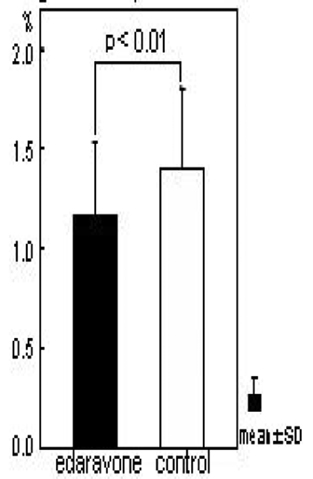
4. nNOS-positive area (Fig3): nNOS-positive area in edaravone group (1.17±0.05%) was significantly lower than that of control (1.40±0.07) (p<0.01).
Conclusion
The above data indicate that edaravone does not affect the whole NO production but inhibits nNOS activity. It has been reported that nNOS might exacerbate acute ischemic injury. These data suggest the possibility that edaravone exerts the brain protective effect not only through scavenging action toward free radicals but also through the influence on NO metabolism.