





Introduction
Non-parametric singular value decomposition deconvolution can produce a reliable estimate of mean transit time (MTT) from dynamic contrast imaging 1 but is sensitive to arterial delay and dispersion 2 . In this study, we use computer simulations to compare methods of estimating arterial delay and test the hypothesis that a better estimate of delay will improve the estimate of MTT.
Methods
Monte Carlo simulations were conducted using realistic models 3 of delayed and dispersed arterial input, recirculation, convolved tissue function and MR parameters at varying contrast to noise. Delay was estimated from 1) the time to peak of the deconvolved residue function, 2) a “curve shifting” method based on iterative convolution and deconvolution after gamma variate arterial curve fitting 4 , 3) the time at which the arterial and tissue curves reached 3% of maximum, 4) and the time point at which the unfit curves exceeded 2 standard deviations of baseline. The residue and curve shifting methods were studied using the simulated TR and after five point interpolation of the data (eg - using a TR of 1.5 or interpolated data of 0.3 sec). MTT was calculated by the non-parametric SVD method after adjustment of the tissue data for the estimated delay. Errors in estimated delay and MTT were analyzed using non-linear multiple regression analysis and by visual analysis of graphs.
Results
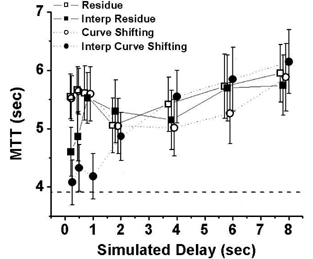
Estimates of delay based on curve shifting with interpolation consistently yielded the most accurate delay values, followed by the 3% method. Delay was severely overestimated from the residue function. Curve shifting underestimated delay with large arterial dispersions, but only if the delay exceeded 2 sec. MTT estimates at MTT of 4 sec with delays of less than 2 sec were significantly improved by the better estimates of delay from the interpolated curve shifting method (Figure 1). This method also improved MTT estimates at MTT of 10 or 16 sec, but only by about 0.5 sec. There was a consistent tendency for longer MTT to be underestimated with delays below 4 sec and overestimated above 4 sec.
Discussion
Under the most commonly encountered conditions, with MTT values below 10 sec and mild or moderate delay and dispersion, estimates of delay by curve shifting of interpolated data improve estimates of MTT obtained by SVD deconvolution. With larger MTT, delay and dispersion, this method still produces the best estimates of delay but the gain for calculation of MTT are modest.