





Introduction
AMPA receptor potentiators enhance AMPA receptor-mediated glutamatergic neurotransmission in the brain. The biarylpropylsulfonamides are a group of AMPA receptor potentiators with potential for treating a number of psychiatric (depression) and neurological (Alzheimer's and Parkinson's disease) disorders 1 . The aim of the current study was to examine the effects of two of these AMPA receptor potentiators, LY450108 and LY451395, on cerebral glucose utilisation in the rat using 14C-2-deoxglucose (14C-2-DG) autoradiography, to compare and contrast the specific anatomical sites of action of these compounds.
Methods
Male Sprague Dawley rats (417 g±4 g; n=35) received subcutaneous administration of LY450108 or LY451395 (0.15, 0.5 or 1.5 mg/kg) or vehicle (5% DMSO, 24% βCD) 15 minutes prior to intravenous administration of 50 μCi 14C-2-DG. Cerebral glucose utilisation was quantified in 40 anatomical brain regions using a computer-based densitometer.
Results
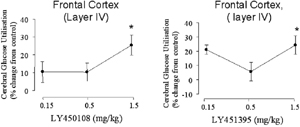
LY450108 produced modest, dose dependent increases in glucose utilisation, with statistically significant increases observed in 14 anatomical areas following administration of the top dose (1.5 mg/kg), notably the globus pallidus and substantia nigra. All doses of LY451395 also produced increases in glucose utilisation. Statistically significant increases were observed following administration of the high dose of LY451395 (1.5 mg/kg), which effected increases in 11 anatomical brain regions, such as the hippocampus and nucleus accumbens. Both compounds increased glucose utilisation in the frontal and parietal cortex and dorsal raphe nucleus (See Figure 1).
Conclusion
This study has revealed that both compounds have broadly similar effects on cerebral glucose utilisation, but with subtle differences. These data suggest that AMPA receptor potentiators enhance specific AMPA receptor-mediated processes in the cortex and limbic system.