





Introduction
Normal brain function is dependent on an adequate glucose supply that is maintained by a highly efficient homeostatic system keeping glucose levels within a well defined range. Acute hypoglycaemia in healthy subjects is associated with neuroendocrine and behavioural responses with distinct time-courses leading to awareness of the hypoglycaemic state. However, an important problem for sufferers of diabetes is ‘hypoglycaemia unawareness’ leading to potentially life threatening complications. Our aim was to investigate the regional brain responses to the onset and prolongation of acute hypoglycaemia in healthy volunteers using water positron emission tomography ([15O]-H2O PET), to determine the normal response prior to examining responses in diabetic subjects.
Methods
Seven healthy men underwent a hypoglycaemic insulin clamp to sustain a plasma glucose level of 2.6 mmol/l over a 60 minute period. Subjects were scanned four times - at euglycaemia 30 minutes prior to reaching hypoglycaemic target and then at 30 minute intervals.
Results
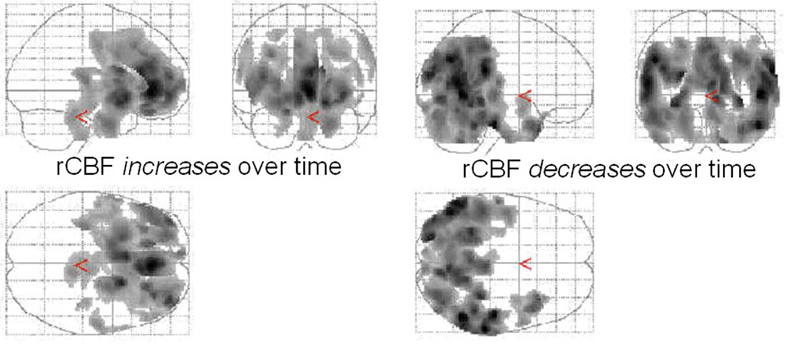
Adrenaline, noradrenaline, cortisol and growth hormone rose in all subjects with hypoglycaemia. Analysis of the PET data over time is shown in the figure 1, and revealed significant increases in regional cerebral blood flow (rCBF) (p<0.05) with hypoglycaemia in subgenual to rostral anterior cingulate, and contiguous regions spanning bilateral orbitomedial frontal cortices, amygdala and ventral striatum. Significant decreases in rCBF (p<0.05) over time were observed in retrosplenium, visual cortices, bilateral parietal and cerebellar vermis. Region of interest analysis revealed distinct time courses of responses, in particular early activation of orbitomedial frontal and amygdala, later engagement of anterior cingulate and disengagement of retrosplenium.
Discussion
This is the first study to examine the evolution of neuronal responses to hypoglycaemia over time. The networks of regions involved are also known to be involved in the human response to primary stressors, e.g. pain, hunger, air hunger. Decreases in rCBF in the retrosplenial, visual and cerebellar cortices are consistent with the memory, visual and coordination disturbances associated with prolonged hypoglycaemia in diabetics. Considering hypoglycaemia as a dynamic state has also allowed us to identify pathways from correlates of neuroendocrine release with rCBF involving sympathetic networks, interoception and reward pathways.