





Introduction
The NMDA antagonist ketamine hydrochloride induces a psychotic-like state in man thought to be analogous to the positive, negative and disorganisation symptoms of schizophrenia (Andreasen et al., 1995 Arch Gen Psychiatry, 52, 341–51; Krystal et al., 1994 Arch Gen Psychiatry, 51, 199–214). To date, little research has been conducted into the neuroanatomical targets of subanaesthetic ketamine in rats (Burdett et al., 1995 Magn Reson Imaging, 13, 549–53; Duncan et al., 1999 Brain Res, 843, 171–83; Duncan et al., 1998 Brain Res, 787, 181–90). In our initial studies we evaluated the effects of ketamine (2.5, 10, 25 and 50 mg/kg) on locomotor activity, measured by light beam interruptions, thus creating an appropriate pharmacodynamic input funtion for subsequent correlation with MRI (Roberts et al., in press). phMRI was then utilised to elucidate the spatial and temporal alterations in brain activity following an acute dose of ketamine (25 mg/kg s.c.) via localised changes in Blood Oxygen Level Dependent (BOLD) MR signal. Microdialysis experiments using a separate group of rats examined temporal changes in dopamine concentrations in the nucleus accumbens (NAcc) following the same dose of ketamine.
Results
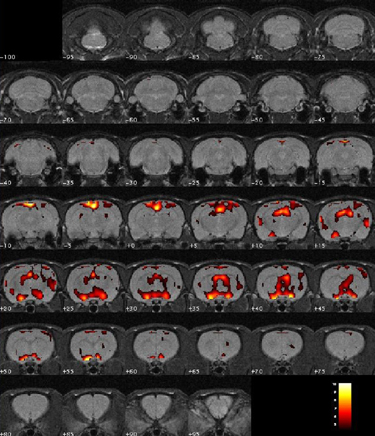
25 mg/kg ketamine produced a significant increase in locomotion and stereotypy in comparison to control animals. MRI analyses, revealed significant increases in BOLD signal following ketamine challenge, most notably in subcortical structures. Corresponding increases were seen in dopamine concentrations in the NAcc, an area known to be rich in dopaminergic fibres that are consistently activated by psychotomimetics (Kuczenski et al., 1991 JNeurosci, 11, 2703–12).
Conclusions
These results confirm previous observations that an acute dose of ketamine produces increases in locomotor behaviour and stereotypy in rats (Moghaddam et al., 1998 Science, 281, 1349–52) The behavioural effects of ketamine may be mediated by its actions in discrete brain regions including subcortical regions that were observed using fMRI. MRI technology appears sensitive to the neural effects of ketamine, with changes in BOLD contrast correlating to the pharmcodynamic and initial changes in the neurochemical profile of the drug In the future we plan to investigate the potential interaction of antipsychotics on the ketamine-induced effects. The current data suggest that MRI may form a powerful tool for future research into schizophrenia and development of new antipsychotic medications.
Footnotes
Acknowledgements
Funded by Eli Lilly and BBSRC studentship.