





Background and Purpose
Crossed cerebellar diaschisis (CCD) is well described in the subacute and chronic phase of stroke. However, there is few data about acute CCD and its serial changes after supratentorial reperfusion. Using positron emission tomography (PET) we (i) describe acute CCD in human MCA stroke; (ii) study time-dependent changes of CCD in relation to supratentorial reperfusion; (iii) describe its association to outcome parameters.
Methods
Nineteen patients (8 female; mean age 67 years) with acute middle cerebral artery stroke received intravenous thrombolysis within 3 hours of symptom onset. Serial PET with 15O-water was performed before thrombolysis, 3 hours, 24 hours and 14 days later. CCD was defined as an asymmetry index. For supratentorial regions, the hypoperfusion volume (defined by the volume of CBF <20 ml/100 g/min) and the hypoperfusion asymmetry (defined by an asymmetry index) were assessed. Infarct volume at day 14 and NIHSS score at 3 months were used as outcome parameters.
Results
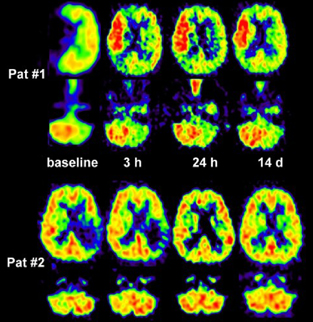
Supratentorial hypoperfusion volume decreased from 25 ccm (median) before thrombolysis to 1.0 (3 h), 0.2 (24 h) and 0.1 (14 days). Baseline CCD was 13.4% and decreased continuously to 10.4% (3 h), 9.9% (24 h) and 6.1% (14 days). The NIHSS-score decreased from 11 (baseline) to 4 pts after 3 month. Final infarct volume was 1.1 ccm. CCD was not significantly associated to the severity of supratentorial hypoperfusion at any time point. CCD was significantly correlated to the volume of supratentorial hypoperfusion within the first hours after stroke (Spearman's rho, r=0.65) but not later. Hypoperfusion volume was correlated to outcome parameters at the early stage only (r=0.68). At later time points this association was lost since reperfusion was seen despite large final infarcts and poor outcome. In contrast, CCD correlated significantly to outcome values at all four measurements (r>0.7). Patients with favourable outcome had lower CCD values and a marked decrease of CCD along the four measurements. Fig. 1 illustrates examples of successful reperfusion (Pat #2, no infarct) and non-nutritional reperfusion (Pat #1, 60 ccm infarct volume).
Conclusions
These first PET data of serial CCD changes after intravenous thrombolysis within a three hour time window suggest that (i) CCD occurs as early as 3 h after stroke and recovers over time; (ii) in the first hours after stroke, CCD is closely related to the volume of supratentorial hypoperfusion. At later time points, however, CCD is partly disconnected from supratentorial perfusion and better associated to outcome parameters than the volume of supratentorial hypoperfusion itself; (iii) CCD is not susceptible to non-nutritional reperfusion and can add valuable information in order to interprete supratentorial reperfusion patterns.