Introduction
Obsessive-compulsive disorder (OCD) is a disabling psychiatric disease, causing patients to repetitively perform actions or persevere thoughts whose futility is obvious to the patient, but refraining from these actions or thoughts instils overwhelming fear. In many cases, medication and behaviour therapy can ameliorate symptoms. In those who did not respond to conservative therapy, stereotactic implantation of electrodes into the right-sided nucleus accumbens and inhibitory deep brain stimulation (DBS) is a concept currently under evaluation at Cologne University's Department of Stereotactic Surgery. Advantages are a generally well-tolerated procedure and, in contrast to established lesional approaches, the ability to fully reverse it, should complications arise.
Methods
In one such patient, an electrode with 4 contact pads (Medtronic, Minneapolis, USA) was inserted into the shell region of the right sided nucleus accumbens using a Leibinger guidance system (Stryker Leibinger, Freiburg, D), the electrode was connected to a signal generator (Medtronic). Electrode trajectory was plotted into pre-surgical MR data using software developed at our lab. Before surgery, we obtained diffusion-weighted MR imaging on a 1.5 T Gyroscan Intera system (Philips, Best, NL) using an 8 element phase-array head coil in SENSE mode. 32 isotropic diffusion encoding directions were applied to minimize directional uncertainty while maintaining tolerable scan times. The FSL software library (FMRIB, Oxford, UK) was used for probabilistic fibre tracking. One week after surgery, 15OH2O-PET (4 rest vs. 4 stimulation, unipolar, 3 V, distal two electrodes) datasets were recorded on a Siemens/CTI ECAT HR scanner. As opposed to fMRI, this method is not hindered by the presence of the implants nor does it interfere with stimulation. Coregistration with anatomical MR and diffusion data was achieved using VINCI software. PET activation data was transformed to Z-scores using the AAT algorithm developed here.
Results
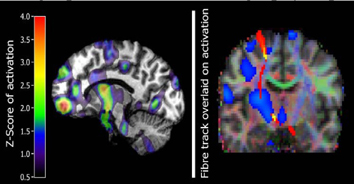
PET demonstrated significant stimulation-induced blood flow increase in right-sided pregenual, subgenual and orbitofrontal cortex as well as in striatal and frontolateral gray matter. Inhibition at the rostral edge of the electrode was detected, but Z-scores did not reach significance. Diffusion tractography depicted the anatomical pathways between disjoint cortical and subcortical stimulation foci, such as pallidal to frontolateral, pregenual to orbitofrontal, thus demonstrating the network responsible for remote effects of DBS.
Conclusion
For the first time, combined diffusion tractography and PET activation provide non-invasive in vivo insight into DBS's effects on cerebral activation along with its anatomical substrates. We demonstrated that DBS of the nucleus accumbens achieves increased activity in anterior cingulate and orbitofrontal cortex, areas that are part of the phylogenetically old limbic system and believed to play key roles in OCD symptom formation. Connectivity between deep brain and cortical activations was established using probabilistic tractography, proving that cortical activation is a remote effect of DBS (See Figure 1.).