Introduction
The discrepancy between the increases in cerebral blood flow (CBF) and cerebral metabolic rate of oxygen (CMRO2) during neural activation causes an increase in venous blood oxygenation and, therefore, a decrease in paramagnetic deoxyhemoglobin concentration in venous blood. This can be detected by functional magnetic resonance imaging (fMRI) as blood oxygenation level-dependent (BOLD) contrast. However, the relation between cerebral oxygen extraction fraction (OEF), that corresponds to the ratio of CMRO2 to CBF, and BOLD contrast during neural activation has not been shown directly in human subjects. In the present study, changes in the OEF and in the BOLD signal during neural activation were measured by both positron emission tomography (PET) and fMRI in the same human subjects.
Methods
C15O, 15O2, and H215O PET studies were performed in each of seven healthy men (20–22 years, right-handed) at rest (baseline) and during performance of a right hand motor task. The motor task consisted of a finger tapping activity in which each finger of the right hand was sequentially touched to the thumb. fMRI studies were then performed to measure the BOLD signal under the two conditions. Z-score maps of the motor task condition measurement minus the baseline measurement and the baseline measurement minus the motor task condition measurement were created from CBF images using SPM99. Regions of interest (ROIs) were defined on all CBF, cerebral blood volume (CBV), OEF, CMRO2, and BOLD images for the statistically significant areas on the Z-score maps.
Results
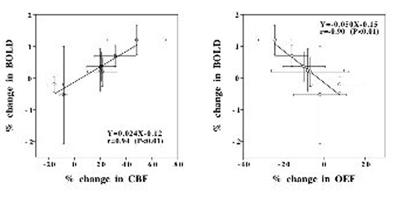
Significant relative hyperperfusion indicating neural activation during the motor task activity was observed in the left precentral gyrus, left superior frontal gyrus, right precentral gyrus, right cingulate gyrus, and right cerebellum. Significant relative hypoperfusion indicating neural deactivations during the motor task activity was observed in the left anterior part of cingulate gyrus and right occipital cuneus. A significant positive correlation was observed between changes in the CBF and the BOLD signal, and a significant negative correlation was observed between changes in the OEF and the BOLD signal for all ROIs.
Conclusions
This supports the assumption on which BOLD contrast studies are based, that the discrepancy between increases in CBF and CMRO2 during neural activation causes an increase in venous blood oxygenation (See Figure 1).