




Introduction
Ischemic preconditioning has been correlated with numerous biochemical changes, but the actual effector mechanisms by which neurons gain resistance to ischemia remain uncertain. Emerging evidence now suggests that caspase-3 activation can occur in processes other than apoptotic cell death (1). Consistently, we recently showed using an in vitro model of preconditioning that PARP-1 cleavage by caspase-3 was in part responsible for the acquisition of neuronal ischemic tolerance (2). Here, we explored the possibility that such a mechanism could occur in an in vivo model of ischemic preconditioning in gerbils.
Methods
Global ischemia was induced by a 8-min bilateral carotid artery occlusion. Ischemic preconditioning was performed by a 2-min artery occlusion 48 h prior to the global ischemic episode. Neuronal death was quantified in the hippocampal CA1 subfield by Haematoxylin / Eosin staining 7 days after the global ischemia. PARP-1 inhibition was performed by i.p. injection of 3-aminobenzamide (30 mg/kg). Expression of the PARP-1 89 kDa cleavage product and the cleaved caspase-3 17 kDa active fragment were assessed by immunocytochemistry using a confocal microscope 24 h and 48 h after ischemic preconditioning. Caspase-3 activity was measured using the fluorogenic peptide DEVD-AMC.
Results
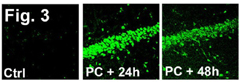
Ischemic preconditioning affords a robust protection of CA1 neurons against a subsequent severe ischemic challenge (Fig 1). Because of the importance of PARP-1 activation in ischemic neuronal death, we tested the effect of the PARP-1 inhibitor 3-AB against the lethal ischemic episode. Neuronal death after global ischemia was reduced by i.p. injection of 3-AB (Fig 1). Since PARP-1 can be irreversibly inactivated by caspase-3 cleavage, we examined whether this process occurs in preconditioned animals. Ischemic preconditioning caused a significant increase in caspase-3 activity (Fig 2) and in the cleaved caspase-3 active fragment (Fig 3). This mechanism was associated with a significant expression of the PARP-1 89 kDa fragment (Fig 4)



Conclusion
These findings suggest that caspase-3 inactivation of PARP-1 could be also an important effector mechanism in the acquisition of ischemic tolerance in vivo. The causative role for the observed PARP-1 cleavage in ischemic neuroprotection is currently being evaluated by blocking this cleavage with a caspase-3 inhibitor.