Objective
Following Controlled Cortical Impact Injury (CCI) a perifocal brain edema develops within the first 24 to 48 hours, which is restricted to the injured hemisphere and has mainly cytotoxic as well as some vasogenic edema components. Leukotrienes, which strongly augment vascular permeability and promote vasoconstriction, are generated following the posttraumatic arachidonic acid release and increase in CSF with a maximum in the first 6 h. We investigated in a controlled study following cortical contusion injury the effect of Boswellia carterii (BC), a known natural non-redox 5-lipoxygenase inhibitor, on the development of posttraumatic brain edema and on the post-traumatic cysteinyl-leukotrienes (LT) levels in CSF.
Methods
34 male Sprague Dawley rats were studied. Animals of Group I (n=17) received 400 mg/kg p.o. BC 1 h prior to controlled cortical impact injury. 6 of them received another dose 12 h later. Animals of Group II (N=17) received an equal amount of saline. 5 animals per group received a sham operation and served as baseline. 12 animals per treatment group received controlled cortical impact injury (2.5 mm, 4m/s, 5 mm Impactor). 6 animals each were sacrificed at 4 h and 24 h, respectively. Left hemispheric brain water content (%BW) and left hemispheric swelling (%HS) was assessed by wet-dry weight method. After purification of CSF, LTC4, LTD4 and LTE4 fractions were separated by HPLC and levels determined quantitatively (pg/100 μl) with tandem gas chromatography-mass spectrometry. Differences between groups were determined using Mann-Whitney test. A p value of <0.05 was required to reject the null hypothesis of equivalence.
Results
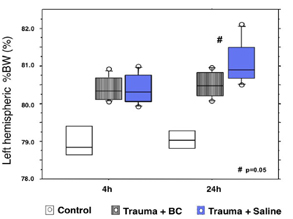
At 4 h brain water content (%BW) and hemispheric swelling (%HS) increased in both groups versus baseline significantly and to a comparable extent. At 24 h %BW and %HS of Group I did not progress any further and were significantly (p<0.05) below Group II, where both parameters further increase. LTC4 levels in CSF of Group I were significantly below Group II at 4 hours. At 24 h no difference could be detected. LTD4 and LTE4 levels did not differ at any time point.
Conclusions
These first data suggest, that BC can attenuate the posttraumatic pericontusional oedema formation. This effect is possibly mediated by the documented partial inhibition of the posttraumatic LTC4 production. To further investigate a possible therapeutic role of Boswellia carterii and its main effectors, boswellic acids, in traumatic brain injury, future studies need to confirm these preliminary results also in comparison to the effects of synthetic 5-LO inhibitors (See Figure 1).