





Introduction
SHRSP show an impaired ability to recover compared to their reference control strain, Wistar Kyoto (WKY), up to 28 days following middle cerebral artery occlusion (MCAO), even when MCAO is controlled to induce comparable ischaemic damage in the two strains (McGill et al, 2005). It is well documented that blood-brain barrier (BBB) breakdown and oedema occur in the acute phase after stroke, but this is thought to resolve within 2 weeks (Hatashita et al, 1990). Following MCAO and a recovery period of 28 days, swelling of the ipsilateral hemisphere is evident in SHRSP but not WKY. Since this indicates oedema and possibly BBB breakdown, this has been investigated further.
Methods
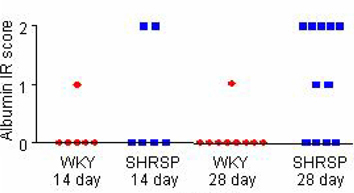
Fourteen and 28 days following MCAO rats were transcardially perfused with heparinised saline followed by paraformaldehyde and brains removed for tissue processing. Coronal sections (6 micrometres) at the level of the anterior commisure from SHRSP & WKY were stained with haematoxylin and eosin (H&E) for assessment of neuropathology. BBB integrity was analysed with albumin immunohistochemistry (polyclonal antibody, Abcam, 1:1000). Albumin immunoreactivity was scored as follows: 2=widespread dark staining, 1=focal lighter staining, 0=no staining. Scores were analysed using a Mann-Whitney test.
Results
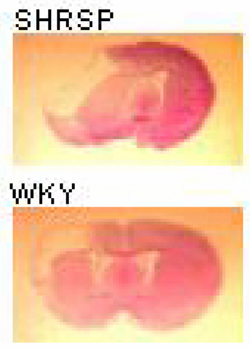
Obvious ipsilateral hemispheric swelling was evident in 6/11 SHRSP and 1/9 WKY (Figure 1). H&E stained sections revealed that the majority of SHRSP displayed protein exudate in the brain parenchyma, indicative of BBB breakdown. This was confirmed by evidence of widespread albumin extravasation in the majority of SHRSP at 28 days post MCAO (7/11) compared to just 1/9 WKY (p=0.03) at the same time point (Figure 2).
Conclusions
Ongoing or delayed BBB breakdown and oedema formation in SHRSP could be a contributory factor in impaired functional recovery after stroke.
Footnotes
Acknowledgements
JK McGill is supported by an MRC CASE award.