





Introduction
Vascular basement membrane (BM) stabilizes brain vessels and inhibits endothelial cell cycle. Cerebral ischemia causes BM breakdown with the loss of structural BM components including collagens and laminins and subsequent endothelial cell activation and proliferation 1 . However, the fate and role of BM proteoglycans and non-structural BM constituents, including SPARC (BM-40, osteonectin), in ischemic blood-brain barrier (BBB) pathophysiology remains unknown.
Methods
A transient 20 min forebrain ischemia followed by 24 h of reperfusion was induced in adult Sprague-Dawley rats by combined bilateral common carotid artery occlusion and hypotension (42–45 mmHg) 2 . In a separate group of animals, a mild (32oC) post-ischemic hypothermia was induced for 6 h. RNA from ∼300 brain vessels (20–100 m) extracted by laser-capture microdissection (LCM) microscopy as described 3 was used to determine the expression of BM constituents, laminin, proteoglycan agrin and SPARC mRNAs by quantitative PCR (Q-PCR). Protein expression was determined by immunohistochemistry in adjacent tissue sections. BBB permeability was assessed using 3H-sucrose as a tracer 2 .
Results
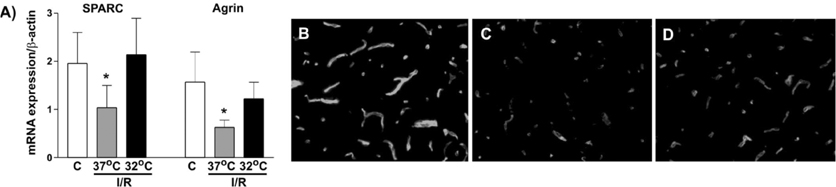
A transient global brain ischemia resulted in a significant (ANOVA, p<0.05; 6 animals/group) reduction in SPARC and agrin mRNAs in LCM-captured brain vessels 24 h after reperfusion (Figure 1A). A time-dependent loss of SPARC (not shown) and agrin (Fig 1B–C) from the BM during reperfusion was also observed by immunochemistry. A 6-h postischemic hypothermia reduced SPARC and agrin mRNA (Fig 1A) and protein loss (Fig 1D) from BM, and also reversed increased BBB transfer constants for 3H-sucrose seen at 24 h after reperfusion (basal – 1.75 ± 0.20; I/R- 13.88 ± 1.59; I/R-hypo - 4.84 ± 0.34 nl/g/s).
Conclusions
A transient post-ischemic hypothermia appears to stabilize brain vessels and reduce BBB leakage in part by preventing proteolytic degradation of regulatory BM constituents, SPARC and agrin.