





CBF as measured by laser-Doppler flowmetry (LDF) in rat brain has been demonstrated to contain spontaneous fractal fluctuation patterns during normotension1, 2. In this study we characterized to what extent during hypotension does perfusion autoregulate and fluctuations in local and global CBF maintained. Artificially ventilated rats (male, Sprague-Dawley, n=17) were anesthetized with urethane (1.3 g/kg). Dynamic changes in global and local CBF were measured by LDF probes of different sizes (Perimed and Oxford Optronix, respectively) placed superficially and in deeper cortical layers. The interoptode distances of the two probes were 1.0 and 0.2 mm, respectively. The local and global CBF were measured on opposite sides of the cortex. The local LDF signal was localized to layer 4 and the global LDF signal was comprised of superficial layers in a small region of that hemisphere. The hypotensive steps (of 80, 60, and 40 mmHg) were maintained by a computer-controlled negative lower body pressure method (figure 1) 3 . The duration of each hypotensive step was ∼10 minutes and after each step the pressure was let to rise back spontaneously. Spontaneous fluctuations were characterized by fractal analysis where the Hurst exponent (H) ranging from 0 to 1 corresponded to very rapidly changing hence noisy signal to a very slowly changing, smooth signal, respectively. The value of H=0.5 is a random pattern. The H values of the spontaneous fluctuations in local CBF were 0.30±0.04, 0.29±0.05 and 0.30±0.05 before each hypotensive step of 80, 60 and 40 mmHg. During hypotension these values (for local CBF) were significantly increased (p<0.05) in every step (H:0.32±0.06, 0.32±0.07 and 0.33±0.1) and the local CBF changed according to autoregulation (ΔCBF:93.9%, 90.3% and 72.4% of local CBF under normotension). On the contrary there were no significant differences in values of H for global CBF between the three hypotension levels. The values of H for global CBF did not show significant changes as pressure dropped from the spontaneous level (H:0.43±0.06, 0.39±0.08 and 0.40±0.08, respectively) to the levels of hypotension (H:0.44±0.06, 0.41±0.09, 0.42±0.14) and the global CBF changed only slightly according to autoregulation (ΔCBF: 99.1%, 98.8%, 79.3% of global CBF under normotension). Fractal analysis reveals that local LDF signal is sensitive to hypotension challenges probably because local CBF is controlled in the deep cortical layers with a unique mechanism that alters the pattern of local CBF fluctuations. In contrast this hypotension-induced change in the fractal pattern of the global LDF signal was not detected probably because the fluctuations in global CBF can be obscured by integration of layer-specific CBF signals. These results suggest different analytical treatments of local and global CBF data for quantitative neuroimaging methods like fMRI and PET.
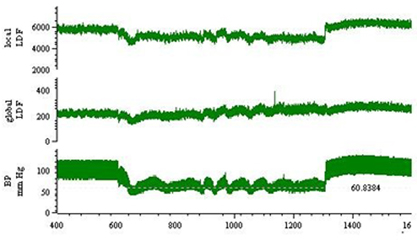
Computer-controlled hypotensive step (60 mmHg) with the lower body negative pressure method
Footnotes
Acknowledgements
Supported by NIH (DC-003710, MH-067528) and OTKA T34122.