Introduction
The mechanism of the blood flow increase by trigeminal activation is an important issue in terms of the pathophysiology of migraine and ‘vascular headache’. We have previously demonstrated that 5-HT1B/1D receptor agonist and CGRP receptor antagonist abolished the blood flow increase elicited by trigeminal activation1, 2 and that NK1 receptor antagonist and leukotriene receptor antagonist failed to attenuate this flow increase. Yet, the precise neurotransmitter-receptor mechanism of the trigeminal neurogenic vasodilatation is unclear. It has been proposed that nitric oxide (NO) may be the causative molecule of ‘vascular headache’. The purpose of this study is to investigate the role of NO in the trigeminal neurogenic vasodilatation utilizing selective nNO-synthase inhibitor.
Methods
Seven male Sprague-Dawley rats, weighing 350–400 gram, were anesthetized with - chloralose and urethane, and ventilated mechanically with room air. Parietal cortical blood flow (CoBF) on the right side was continuously monitored with the Laser-Doppler flow meter system. The nasociliary nerve (NCN) - a cerebrovascular branch of the trigeminal nerve in the rat - was carefully approached from the orbit in the right side. The post-ganglionic nerves from the pterygopalatine ganglion were gently eliminated from the ethmoidal foramen (EF). NCN was stimulated electrically near its entrance to EF through a bipolar platinum electrode with an electrical stimulator (5–25 μA, 0.5 ms duration, 10 Hz, 30 sec stimulation). CoBF were measured during and after electrical stimulation of NCN under intravenous injection of 1.0 ml saline followed by nNO-synthase inhibitor, NOS-547 (100 μg/kg in 1.0 ml saline). The flow data were analyzed by one-way ANOVA followed by Bonferronil Dunn adjustment for multiple comparisons and repeated measures ANOVA.
Results
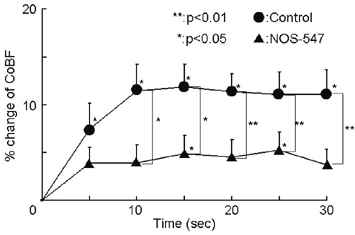
No significant change in physiological parameters was observed during and after electrical stimulation. CoBF was significantly increased upon electrical NCN stimulation at 20 sec, 25 sec, 30 sec from the initiation of stimulation by 11.3±1.9 %, 11.1±2.4 %, 11.1±2.5 %, respectively in control state. This increase was significantly suppressed after NOS-547 administration to 4.5±1.8 %, 5.3±1.9 %, 3.7±1.7 % at 20 sec, 25 sec, 30 sec, respectively. The amount of blood flow increase when NOS-547 was given was significantly less than the control data.
Conclusion
NO-synthase inhibitor attenuated the blood flow increase upon trigeminal nerve stimulation. NO is one of the most important neurotransmitter molecule in the trigeminal neurogenic vasodilatation (See Figure 1).