





Introduction
It is known that the local cerebral blood flow (LCBF) in rat somatosensory cortex demonstrates transient changes in response to peripheral stimulation. However, the mechanism responsible for the transient evoked LCBF has yet to be determined. As the change in LCBF is almost certainly coupled to neuronal activity, the correlation between evoked LCBF and field potential (FP) as a function of the characteristics of the stimulus is important to understanding this mechanism. In the present study, we examined the relationship between local cerebral blood flow (LCBF) and field potential (FP) evoked by hindpaw stimulation in rat somatosensory cortex while changing the stimulus current.
Methods
Twenty Sprague-Dawley rats were used in this study. The tail artery and femoral vein were cannulated for blood pressure monitoring, blood gas sampling and drug injection. Rats were anesthetized with a–chloralose during the experiments and were fixed in a stereotactic frame. The parietal bone was thinned to translucency with a drill and the thinned region covered an area of 3×3 mm2 over the left somatosensory cortex centred 2.5 mm caudal and 2.5 mm lateral to the bregma. The cortex was activated by electrical stimulation of the hind paw with 5 Hz pulses (0.1 ms width) applied at currents of 1.0, 1.5, 2.0 and 2.5 mA for 5 s. LCBF was measured using Laser-Doppler flowmetry and the FP was recorded by a tungsten microelectrode inserted into the cortex.
Results
The peak value of the LCBF and integrated evoked LCBF increases linearly with stimulus current. On the other hand, the gradient of the summed FP decreases at higher currents. Consequently, the relationship between integrated evoked LCBF and summed FP was nonlinear and a least-squares fit of a power-law to the data gave y = a x∧b, a = 1.05e-3, b = 2.25 (R = 0.962).
Discussion
There are two possible reasons for the nonlinear correlation between the integrated evoked LCBF and summed FP. One possibility is a mismatch in the size of the fields-of-view of the measurement probes. The second possibility is that the measure of neural activity, SFP, did not include the slower, low amplitude contributions to the FP by unmyelinated nerve fibers at higher currents. It isn't yet clear which of these possibilities is more likely (See Figure 1).
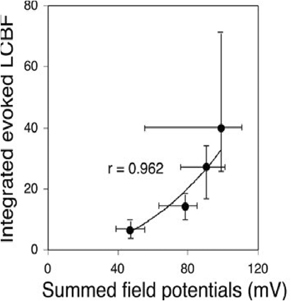
The relationship between the integrated evoked LCBF and summed field potentials.
Footnotes
Acknowledgements
Grant support: Science and Technological Research Fellowship of Japan Society for the Promotion of Science (JSPS) and National Institute of Health MH57180