





Introduction
Isovolemic hemodilution causes decreased blood viscosity and arterial oxygen content (CaO2). It is also known that isovolemic hemodilution increases the baseline local cerebral blood flow (LCBF) and this phenomenon has been interpreted as maintaining the baseline oxygen delivery. However, the changes in evoked local oxygen delivery with stimulation have not been reported during isovolemic hemodilution. The aim of the present study is to investigate this relationship.
Methods
Twenty Sprague-Dawley rats (12 for LCBF and 8 for field potential) were used in this study. The tail artery and femoral vein were cannulated for blood pressure monitoring, blood gas sampling and drug injection. Rats were anesthetized with a–chloralose during the experiments and were fixed in a stereotactic frame. The parietal bone was thinned to translucency over the left somatosensory cortex. The cortex was activated by electrical stimulation of the hind paw with 5 Hz pulses (0.1 ms width) applied at a current of 2.0 mA for 5 s. LCBF was measured using Laser-Doppler flowmetry. To confirm that the neurological activity was unchanged, the field potential was recorded with a tungsten microelectrode inserted into the cortex. Isovolemic hemodition was performed by drawing 9 ml of blood from the tail artery and infusing the same volume of hetastarch through the femoral vein. Blood pressure was kept constant by infusing methoxamine after isovolemic hemodilution.
Results
Hematocrit decreased from 37.2±3.1% to 20.3±2.0 % and CaO2 decreased from 17.5±1.4 ml/dl to 9.8±0.9 ml/dl after isovolemic hemodilution. The summed field potentials did not change after isovolemic hemodilution. Figure 1 shows the evoked LCBF before and after isovolemic hemodilution. Both curves were normalized by the baseline level before isovolemic hemodilution The local oxygen delivery was calculated as the product of the integrated evoked LCBF and CaO2. The local oxygen delivery after isovolemic hemodilution was a factor of 0.88 (0.69 – 1.12) (median (25–75%)) times that before isovolemic hemodilution despite an increase in integrated evoked LCBF by a factor of 1.48 (1.31 – 1.85). The change in evoked local oxygen delivery was not significant (p > 0.05).
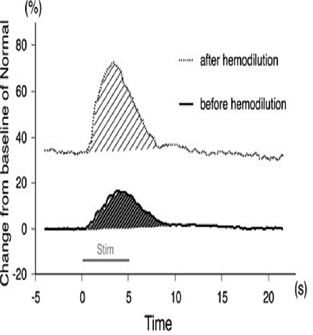
LCBF responses before and after isovolemic hemodilution. Both were normalized by the baseline LCBF before isovolemic hemodilution.
Discussion
This is the first report to investigate evoked oxygen delivery after isovolemic hemodilution. Despite a 50% increase in evoked LCBF, the evoked local oxygen delivery is kept constant. Thus, evoked LCBF maintains a constant local oxygen delivery even in the transient condition although its vascular mechanism is yet to be elucidated.
Footnotes
Acknowledgements
Grant support: Science and Technological Research Fellowship of Japan Society for the Promotion of Science (JSPS) and National Institute of Health MH57180