





Introduction
After ischemia the adult brain can regenerate and compensate for motor deficits by plastic change, including an initial recruitment of motor pathways in the intact hemisphere, and in patients with good recovery, return of activity to the ipsi-lesional side. Diffusion tensor axonal fiber tracking reveals the correlation between brain plasticity and recovery of motor function during rehabilitation. However, the reorganization of fiber tracks was not previously mapped in a longitudinal study of humans during recovery from stroke. We used diffusion tensor imaging (DTI) with 3D fiber tracking to test the relationship between density ratio (number of tracked fibres per unit volume) of the ipsi- and contral-lesional pyramidal tract fibres and motor function. We hypothesized that bilateral increase in fiber density underlies good recovery, whereas a persistent low ratio is associated with poor outcome.
Methods
Five right-handed patients with subcortical ischemic infarcts were tested with a battery of neurological motor scales acutely, and at one and three months post-stroke. Serial DTI was performed using a birdcage head-coil and double spin echo single shot EPI at 1.5 T, employing 17 isotropically-distributed directions, and a b-factor of 1000 s/mm2, with additional b-factor=0 s/mm2 images. Maximum gradient strength was 36 mT/m. 50 slices of 3.3 mm thickness were acquired, covering a 24 cm FOV in a 128×128 matrix. TR/TE =17000/84 ms. The sequence was repeated four times for a total 22 min acquisition time. The eigensystem was calculated from the diffusion tensor in each voxel using diagonalization. Fiber tracking was calculated with the FACT algorithm.
Results
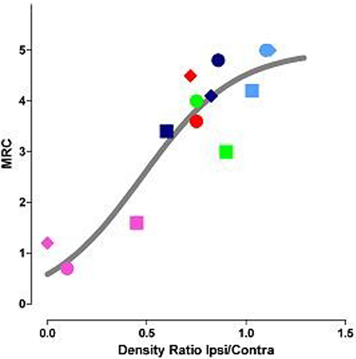
The figure 1 shows temporal evolution of the density ratio in relation to motor function (Medical Research Council=MRC), with squares representing acute studies. Overall, fiber density ratio in the ipsi-lesional pyramidal tract increased in the four patients with good outcome (MRC≥4). Transiently increased contral-lesional fiber density ratio approved to predict better outcome (not shown).
Discussion
The novel finding of fiber density related progression of outcome from ischemic stroke is based on preliminary data and more studies are needed to validate the method. The present results in a group of five stroke patients suggest that DTI fiber tracking detects changes in fiber density correlated with motor recovery within three months post-stroke. Bilateral increases in fiber density suggest plastic changes in both pyramidal tracts during recovery from hemiparesis.