




Purpose
To clarify the load of various subtypes of cerebrovascular disease on the functional ability of workers.
Materials and Methods
1. From the database of Japanese acute cerebrovascular disease, we studied modified Rankin Scale (mRS) at discharge of 1298 patients with atherothrombotic infarction, 1252 with lacunar infarction, and 1149 with cardiogenic embolism. These subjects were classified into age classes with range of 5 years.
2. We studied the patients with the first-ever ischemic stroke who were younger than 65 years when they admitted to Tokai University Hospital from April 2001 to March 2002. We evaluate mRS of these subjects at discharge, and their functional ability of working by the questionnaire. Functional disability ratio is expressed as the ratio of subjective disability to their ability before their onset of ischemic stroke.
3. Disease burden from cerebral infarction of various clinical categories with various age of onset was calculated as follows. disease burden = occurrence rate × functional disability ratio × expected workable years until 65.
Results and Discussion
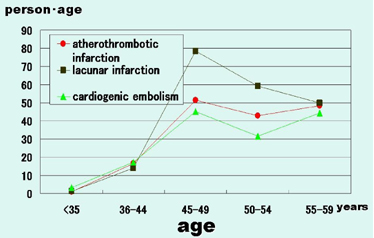
As shown in Figure 1, disease burden from lacunar infarction is the highest among the three clinical categories of cerebral infarction due to the highest incidence of occurrence rate among these categories under age of 65. Also as shown in Figure 1, disease burden is the highest on workers with age rank of 45–49, in all of clinical categories, because they have relatively long expected workable years until 65.
Conclusion
From the standpoint of disease burden on working, lacunar infarction in young subjects is most important and needs strengthened efforts of prevention.