





Introduction
Hyperglycemia adversely affects the outcome of stroke1, 2. A raise in plasma corticosteroids is thought to be involved in this effect after transient global ischemia 3 . Here we investigated the harmful effects of hyperglycemia after transient middle cerebral artery (MCA) occlusion in rats and whether these are dependent on plasma corticosteroids.
Methods
One-hour intraluminal MCA occlusion was induced in adult male Sprague-Dawley rats (n=159). Sham-operated and non-operated rats were used as controls (n=20). Acute hyperglycemia was induced by i.p. injection of dextrose (25%) 30 min prior to MCA occlusion. Corticosteroid synthesis was inhibited by injecting i.p.metyrapone (100 mg/Kg). Plasma corticosteroids were measured by radioimmunoassay. Neutropenia was induced with vinblastine (0.5 mg/Kg i.p.) 4 days prior to ischemia, and neutrophils in plasma were determined. The neurological function was assessed at 24 h, then rats were killed and infarct volume was measured. Neutrophil infiltration was evaluated with the mieloperoxidase assay (MPO), and matrix metaloproteinase-9 (MMP-9) content was determined by gel zymography. Measuring Evans blue extravasation at 48 h assessed blood-brain barrier leakage.
Results
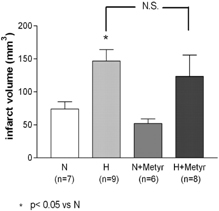
Hyperglycemia (H) significantly increased infarct volume (p<0. 01) (Fig. 1), it worsened the neurological score (p<0.001), and it enhanced the ischemia-induced rise in MPO (p<0.001) and MMP-9 (p<0.01) in tissue and the Evans blue extravasation (p<0.001), compared with normoglycemic (N) rats. Metyrapone maintained plasma corticosterone under the basal level. Infarct volume in hyperglycemic rats receiving metyrapone (H+Mety) was not significantly different from hyperglycemic rats not receiving the drug (H) (Fig. 1). Metyrapone did not prevent the increased MPO and MMP-9 in hyperglycemic rats compared to the normoglycemic groups. Vinblastine caused neutropenia in hyperglycemic rats and prevented the increase in MPO and MMP-9 in brain tissue after ischemia, but it did not reduce infarct volume at 24 h.
Conclusion
Hyperglycemia exacerbated the outcome of ischemia as infarct volume was larger and the neurological outcome was worst that in normoglycemic rats. Subsequently, neutrophil infiltration, MMP-9, and BBB leakage were higher. Inhibiting the synthesis of corticosteroids did not prevent the adverse effects of hyperglycemia. Also, neutrophils were not responsible for the worst outcome of ischemia in hyperglycemic rats. Hyperglycemia during transient focal cerebral ischemia has per se adverse effects that are not attributable to increased plasma corticosteroids or neutrophil infiltration.
Footnotes
Acknowledgements
Supported by the Comisión Interministerial de Ciencia y Tecnologia (CICYT SAF2002-01963)